
Nvidia Stock Is Closed 81% of the Week. Your Risk Isn't.

 Prefer us on Google
Nvidia stock closed at $225.30 on August 13, 2026 — about 4% below the record close of $235.47 set on May 14. The number most retail traders never look at is the other one: Nasdaq's regular session runs 9:30 a.m. to 4:00 p.m. ET, five days a week. That's 32.5 hours out of 168. For the remaining 135.5 hours — 81% of every week — Nvidia stock has a price but no market.
That gap normally doesn't matter. It matters enormously in the two weeks around August 26, 2026, when NVIDIA reports fiscal Q2 2027 results after the bell, and again on any weekend when an export-control headline or a hyperscaler capex leak lands on a Saturday. This piece is about what actually happens in those 135.5 hours, and what the crypto-side instruments tracking NVDA do and don't give you.
Where Nvidia stock stands going into the August 26 print
The setup is unusually asymmetric. Management guided Q2 revenue to $91 billion, ±2%, with gross margin around 75%. Sell-side consensus sits above that, in the $93–95 billion range — which means the company has to beat its own guide by roughly two to four billion dollars just to hit the number the market has already priced.
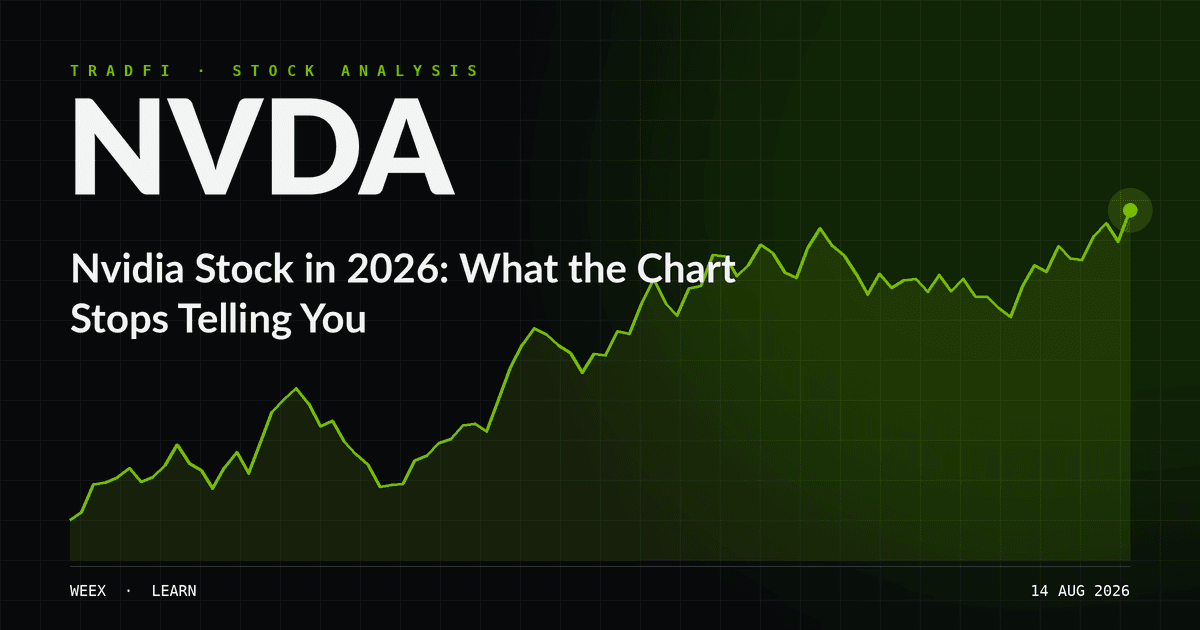
The Q1 FY2027 base makes the bar clearer: Data Center revenue was $75.2 billion, up 92% year over year and 21% sequentially, with hyperscale and AI cloud/enterprise demand now split roughly 50/50. That 50/50 split is the detail worth watching. A quarter where hyperscale carries the beat is a different quarter, strategically, than one where enterprise does — the second is stickier revenue and harder for a customer to insource.
| Nvidia stock snapshot | Value | As of |
|---|---|---|
| Cash close (NASDAQ: NVDA) | $225.30 | Aug 13, 2026 |
| Record close | $235.47 | May 14, 2026 |
| NVDA/USDT perpetual quote, WEEX | 224.77 | Aug 14, 2026 |
| Next earnings | Q2 FY2027, after close | Aug 26, 2026 |
| Company revenue guide | $91B ±2%, ~75% GM | Q2 FY2027 |
| Street revenue consensus | $93–95B | Aug 2026 |
| Consensus 12-mo target (61 analysts, S&P Global) | $302.83 avg; $180–$500 range | Aug 2026 |
Note the third row against the first. The perpetual was quoting about 0.2% below Thursday's cash close. Small, but it is the whole point: a derivative tracking NVDA is a separate market with its own supply and demand, and it will not sit exactly on the cash print.
The 135-hour problem: why Nvidia stock and its risk keep different hours
Earnings land after the close. Guidance revisions, GTC keynotes, chip-export rulings and supply-chain reports do not consult the NYSE calendar. If you hold Nvidia stock in a brokerage account, your only options between 4:00 p.m. Tuesday and 9:30 a.m. Wednesday are thin extended-hours books or nothing at all.
| Feature | Cash equity (NASDAQ) | USDT-margined NVDA perpetual |
|---|---|---|
| Tradable hours per week | 32.5 | 168 |
| Weekend access | No | Yes, thinner liquidity |
| Direction | Long, or borrow to short | Long or short natively |
| Settlement asset | USD, T+1 | USDT, instant |
| Account needed | Brokerage + bank | Existing crypto balance |
| You own | Actual shares, voting, dividends | A price-tracking contract |
Read the last row twice. This is the trade-off nobody selling 24/7 access puts in the headline: a perpetual gives you the hours and the ability to be short; it does not give you ownership. No shares, no votes, no dividend, no claim on the company. If your thesis is "hold NVIDIA for a decade," a perpetual is the wrong instrument and always was.
Tokenized NVDA versus NVDA perpetuals: two different products
These get conflated constantly. Tokenized stocks — the NVDAX-style products from issuers like Backed, distributed through Kraken, Bybit and, as of August 2026, Crypto.com — are collateralized 1:1 by real NVIDIA shares held with a regulated custodian. They are spot, long-only, and redeemable through the issuer for a fee. Their failure mode is depegging: when on-chain liquidity thins out, the token's price drifts from the underlying, and you eat the difference.
A perpetual future is not collateralized by anything. It tracks a price index and holds itself near that index through a funding rate paid between longs and shorts. Its failure modes are different and faster: funding cost when the book is one-sided, and liquidation when leverage meets a gap.
Neither is "safer" in the abstract. Tokenized stock carries issuer, custody and redemption risk. Perpetuals carry funding and liquidation risk. Choose based on which risk you can actually monitor.
How to trade Nvidia stock exposure with USDT on WEEX
The NVDA/USDT perpetual on WEEX settles in USDT and supports up to 100× leverage. The mechanics are deliberately unremarkable, which is the appeal — there's no separate TradFi account, no brokerage onboarding, no wire:
- Fund your existing WEEX spot or futures balance with USDT. That balance is the margin; USDT is the only accepted margin asset.
- Open Futures → TradFi and select NVDAUSDT.
- Size the position against the notional, not the margin. At 100×, a 1% move against you is a 100% loss of margin — and NVDA has moved more than 1% in a single after-hours print more times than it hasn't.
- Set the stop before you enter, not after. Weekend books are thinner; a stop placed Friday afternoon is doing real work Sunday night.
The broader TradFi suite — gold, silver, oil and index products alongside stocks — runs on the same USDT margin, with up to 400× on XAUT and XAG. WEEX also has a walkthrough of trading U.S. equities through TradFi if you want the full order-entry flow.
There's a Global market rewards event running on TradFi pairs with a $100,000 prize pool, open to users who haven't traded TradFi before. One detail in the terms is worth reading before you size around it: zero-fee TradFi volume does not count toward the event. If the reward is part of your reason for trading, check the fee schedule for which pairs actually accrue.
Is Nvidia stock a buy? What the $302 target does and doesn't tell you
Consensus across 61 analysts is a "Strong Buy" with an average 12-month target of $302.83 — roughly 34% above the August 13 close. That headline hides the real information: the range runs from $180 to $500. A 2.8x spread between the bear and bull case is not a forecast. It's an admission that the analyst community cannot agree on what AI capex looks like in 2028.
The more useful reading is that Nvidia stock is now a macro instrument, not a single-company story. It moves on hyperscaler capex guidance, on export policy, on power-grid buildout timelines — inputs that mostly get announced when the U.S. market is shut. That's why the hours question and the "is it a buy" question are the same question for anyone using leverage.
What traders usually get wrong here
Three failure patterns, in order of how much money they cost:
- Sizing off margin instead of notional. 100× on a $200 stock means a $2 move wipes the position. Earnings weeks routinely deliver $15 moves.
- Assuming the perpetual gaps in sync with the stock. It doesn't. It reprices continuously while the cash market is shut, so by Monday's open the derivative has already discovered a price the equity hasn't.
- Holding leverage through the print. After-hours NVDA moves have repeatedly overshot and then round-tripped inside 48 hours. Leverage doesn't survive the round trip even when the thesis does.
If you want the AI-capex thesis and nothing else, unleveraged spot or tokenized exposure expresses it without adding a liquidation to your risk. Leverage is for a view on timing, not a view on NVIDIA.
The short version
Nvidia stock is the most-watched equity in the world and it is untradable for 81% of every week. That mismatch is the actual opportunity in USDT-margined NVDA products — not the leverage number, which mostly functions as a way to lose the trade you were right about. Going into the August 26 print, the practical decision isn't bullish or bearish. It's whether you need access during the 135 hours when the exchange is closed, and whether you can size for it. If you do, WEEX TradFi gives you that access from a USDT balance you already have.
FAQ
1. Can I actually buy Nvidia stock with crypto?
Not directly on an exchange like WEEX. NVDA/USDT is a perpetual future that tracks the price; you don't receive shares. Tokenized stock products such as NVDAX are backed 1:1 by custodied shares, but they're issued by third parties and carry their own redemption and depeg risk.
2. Do I get dividends or voting rights from an NVDA perpetual?
No. A perpetual is a contract on price only. NVIDIA's dividend is negligible relative to price moves, but the ownership distinction matters for anyone holding a long-term position.
3. What happens to my NVDA position over the weekend?
It stays open and keeps repricing, since the perpetual trades 24/7. Liquidity is thinner while traditional markets are closed, so spreads widen and stops can fill worse than expected.
4. How much leverage is available on Nvidia stock pairs at WEEX?
Tokenized stock products support up to 100×. Gold products (XAUT, XAG) go to 400×; PAXG is capped at 100×. Available leverage is not a recommendation — most traders using 100× on an earnings week are sizing wrong.
5. When does NVIDIA report next?
Fiscal Q2 2027 results are scheduled for August 26, 2026, after the U.S. close. Company guidance was $91 billion ±2% in revenue at roughly 75% gross margin; the street is modelling $93–95 billion.
6. Do I need a separate account for TradFi trading?
No. TradFi pairs draw margin from your existing WEEX spot or futures USDT balance. Only USDT is accepted as margin.
Risk Warning
Trading Nvidia stock derivatives carries risks that differ from owning shares, and you can lose more than you expect — including your entire margin balance. Perpetual futures on equities involve leverage risk (at 100×, a 1% adverse move liquidates the position), funding-rate cost when positioning is one-sided, and gap risk around earnings and weekends when the underlying cash market is closed and liquidity on the derivative is thinner. NVDA/USDT does not confer share ownership, voting rights or dividends. Tokenized stock products carry separate issuer, custody, redemption and depeg risks, and are geo-restricted in several jurisdictions including the United States. Prices, contract parameters and event terms cited here are accurate as of August 14, 2026 and change without notice. Nothing here is investment advice; assess your own circumstances and never commit funds you cannot afford to lose entirely.
This content is provided for general informational purposes only and doesn't constitute financial, investment, legal, or tax advice. Any events, rewards, online promotions, or related information mentioned herein should not be considered a recommendation, solicitation, or invitation to purchase, sell, trade, or otherwise deal in any crypto assets. Crypto assets are highly volatile and may result in loss. The availability of WEEX services, products, and related events may vary by region. You are responsible for ensuring that your participation is in accordance with applicable local laws and regulations.
You may also like

NVIDIA (NVDA) Earnings Date: When Q2 FY2027 Reports and What to Watch

BitMEX Is Closing September 23, 2026: Timeline and How to Withdraw Before the Deadline

Micron Stock (MU): Price, Outlook and How to Buy

How to Log In to MetaMask: Unlock, Troubleshooting and Recovery (2026)

SanDisk Stock (SNDK): Price, Outlook and How to Buy

Bybit Japan Service Termination: The Complete Timeline and What Happens on July 22, 2026
Bitcoin Price Over 10 Years: Historical Recap and Long-Horizon Outlook
BitMart Is Closing: Shutdown Timeline and How to Withdraw Before August 26, 2026

SOXSB Explained: Why the 3x Chip Bear ETF Resets Without You

CLARITY Act: What Happens in the Senate's September Window

How to Call a Crypto Exchange API Without Getting Blocked
Crypto Exchange API: Permissions, Signing and Rate Limits

QQQB and the Fed: What the FOMC Minutes Mean for Nasdaq-100
How to Trade Unitree Stock When You Can't Buy 688836
ETH to USDT: What the Converter Rate Leaves Out
Your Crypto Exchange Is Shutting Down: How to Move Your Funds and Choose the Next Exchange
Meta Stock at $548: The Free Cash Flow Number Behind the Drop
MU Stock Is Down 24% While Micron's Profits Hit Records
Kioxia Stock Before the Oct 1 Split: The 24/7 Perp Problem
Recordati Stock (REC): The Respighi BidCo Tender Offer, the Timetable and What Happens If You Do Nothing
Eiffage Stock (FGR): The Two Engines, the Motorway Concession End Dates and the 26 August 2026 Half-Year Results
Deutz Stock (DEZ): The 24 August 2026 Extraordinary General Meeting, the FFG Share Issue and What the Resolution Says
Logista Stock (LOG): The August 2026 Interim Dividend, the Four Dates That Decide Who Is Paid and What the Company Is
Netflix Stock Is Down 38%: What the Tape Is Pricing
BlackBerry Stock Up 125%: Why BB and BBX Are Not the Same
Nasdaq Futures vs Stocks: NQ at 30,141 and 3 Ways to Trade
XST Coin Has $12,000 of Real Depth Behind a $31 Million Price
CRCL Stock in 2026: Why Rate Cuts Now Drive Circle's Price
Nebius Stock After a 34% Pop: What the Capex Math Says
Tencent Stock (0700): Where the Shares Actually Trade, and What Each Venue Owes You
NVIDIA (NVDA) Earnings Date: When Q2 FY2027 Reports and What to Watch
BitMEX Is Closing September 23, 2026: Timeline and How to Withdraw Before the Deadline
Micron Stock (MU): Price, Outlook and How to Buy
How to Log In to MetaMask: Unlock, Troubleshooting and Recovery (2026)
SanDisk Stock (SNDK): Price, Outlook and How to Buy
Bybit Japan Service Termination: The Complete Timeline and What Happens on July 22, 2026


