
SOXSB Explained: Why the 3x Chip Bear ETF Resets Without You

 Prefer us on Google


SOXSB is a tokenized version of the Direxion Daily Semiconductor Bear 3X Shares (SOXS), an ETF built to deliver -300% of the ICE Semiconductor Index's move for one trading day. The token trades around the clock on WEEX. The fund behind it does not. That mismatch is the single most important thing to understand before you touch SOXSB, and it is the part most coverage of semiconductor bear ETFs skips entirely.
The interest is easy to explain. Chip stocks ran hard into late June 2026, then broke sharply in July as traders started questioning whether AI capital expenditure could keep compounding, SK Hynix missed on earnings, Korean regulators tightened rules on leveraged ETFs, and Chinese domestic competition kept grinding at margins. When a crowded sector cracks, inverse products get attention. SOXS climbed roughly 13% over a 30-day window during that July drawdown.
But over the same quarter, SOXS was down about 61% — because the second-quarter rally it was positioned against was historic. Same instrument, same three months, two completely different stories depending on when you stepped in. That is not a bug in the product. That is the product working as designed.
What SOXSB actually is, and what it is not
SOXSB is a bStock: a tokenized certificate backed 1:1 by a share of SOXS held with a regulated custodian. On WEEX it trades as a BNB Chain token (contract 0xe28cd11c99af2df76bb8ada4cd0ef3904378280f) against USDT, in fractions, with no brokerage account and no US market hours.
What you are not getting is ETF shareholder status. You hold a claim on the wrapper, not a line in Direxion's register. Primary issuance and redemption run through a KYC-gated process for eligible non-US persons on a weekday schedule; secondary trading on the token is what runs 24/7. For a short-term trader that distinction rarely bites. For anyone holding through a corporate action or a stressed market, it is the whole question.
Worth knowing up front: SOXS tracks the ICE Semiconductor Index, not the more widely quoted PHLX Semiconductor Index (SOX). The two are close cousins with overlapping constituents, but if you are eyeballing a SOX chart to time a SOXSB entry, you are trading off the wrong benchmark.
Why SOXS keeps grinding lower — and keeps reverse splitting
Direxion announced a 1-for-10 reverse split of SOXS on 4 February 2026. That was not the first. Since the fund's 2010 launch there have been five split events — four reverse splits and one forward split in 2022.
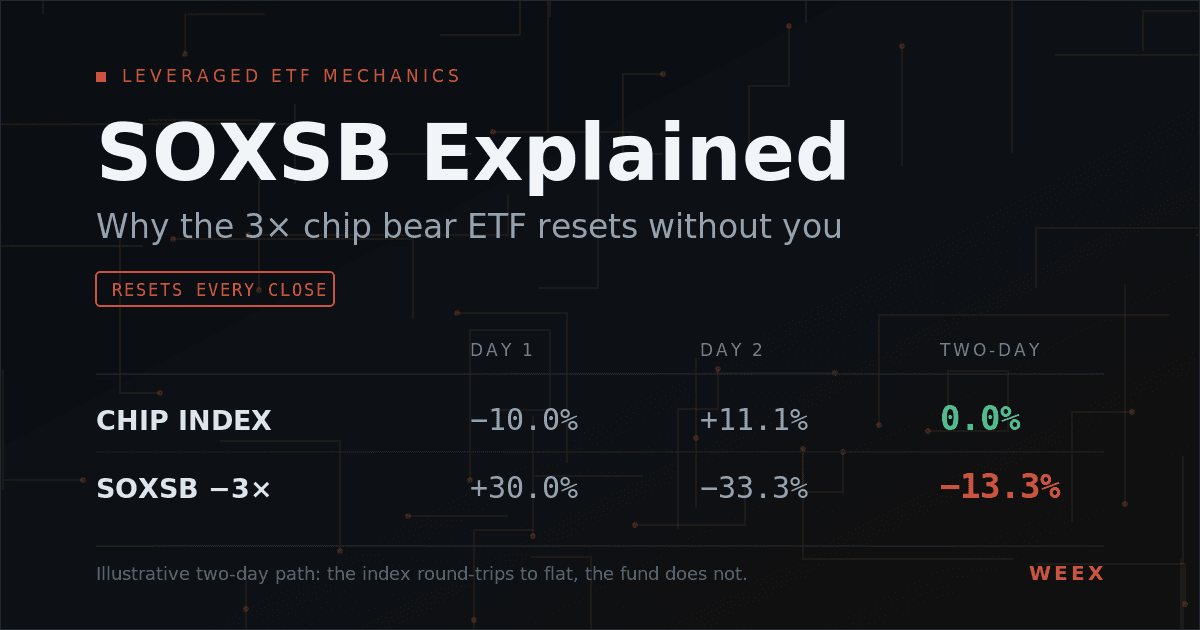
Reverse splits in leveraged ETFs are a symptom, not a strategy. The cause is volatility decay, sometimes called beta slippage. Because the -3x objective resets every single trading day, gains and losses compound off a fresh base each session, and choppy markets bleed the fund even when the index goes nowhere.
The arithmetic is worth doing once by hand. Say the index falls 5%, then rises 5%. The index ends at 0.95 × 1.05 = 0.9975 — down a quarter of a percent, so a bear position should be marginally green. A -3x fund does +15%, then -15%: 1.15 × 0.85 = 0.9775. Down 2.25%. The index was basically flat and the bear product still lost. Add an annual expense ratio near 1% on top, and the drift is structural.
The practical translation: SOXSB is a tool for expressing a view on the next few sessions. Held across a sideways month, it will usually cost you money even if your directional call was broadly right. Traders who lose money on inverse chip ETFs mostly do not lose on direction — they lose on duration.
The 24/7 problem: SOXSB trades when the reset doesn't
Here is the wrinkle nobody flags. The daily reset that defines SOXS happens once, at the close of a NYSE session. SOXSB quotes continuously — through the US overnight, through weekends, through American market holidays.
So on a Saturday afternoon there is a live SOXSB price with no underlying ETF NAV moving behind it. What you are trading in those hours is the market's guess about where SOXS opens next, expressed through whatever order flow happens to be in the book. Spreads widen. Depth thins. And any large semiconductor headline that lands on a Sunday — an export-control announcement, a guidance pre-release, a supply-chain report — gets repriced in a token market with a fraction of the liquidity the NYSE would bring to it on Monday.
As of 25 August 2026, SOXSB was quoting 48.15 on WEEX. SOXS closed at 47.03 on the NYSE on 24 August, against a prior close of 46.25. The gap between those two numbers is not automatically a premium or a mispricing — it can simply be the token pricing forward from the last US session. But it illustrates the point: the token and the fund are never quite reading from the same clock, and the further you get from a US close, the looser the coupling.
If you carry SOXSB into a weekend, you are holding two exposures at once: a leveraged bet on chip stocks, and a bet on the token market's ability to price it accurately while its reference market is shut.
-- Price
The order book tells you who is actually here
This is the part that changes the trade. As of 25 August 2026, WEEX shows SOXSB with a market cap of roughly $1.005 million across a circulating supply of about 20,796 tokens. Its bull-side twin, SOXLB, carries a market cap near $11.29 million on roughly 100,349 tokens.
The bull token is about eleven times the size of the bear token.
That ratio is a sentiment reading and a liquidity warning in the same number. Positioning in tokenized semiconductor exposure is still overwhelmingly long, which tells you something about how much of the July correction the market treated as a dip rather than a turn. It also tells you the exit door on SOXSB is narrow. A seven-figure float is thin enough that a moderately sized market order can walk the book, and thin books do not get thicker during the exact panics you bought the instrument for.
The operational consequence: size SOXSB positions against the visible depth, not against your conviction, and use limit orders. On an instrument this small, slippage can quietly eat more of the trade than the daily decay does.
Where semiconductors actually stand in August 2026
The sector's medium-term picture is still constructive — the June 2026 advance was not a fluke, and AI infrastructure demand is real spending, not narrative. What changed in July is the market's willingness to pay any multiple for it.
That leaves chips in an uncomfortable middle: strong fundamentals, stretched valuations, and a shareholder base that has already learned it can be shaken out. Sectors in that state tend to produce violent two-way sessions rather than clean trends. Which is precisely the regime that punishes leveraged ETFs in both directions.
The better reading is that SOXSB is worth watching as a hedge or a short-horizon tactical position around a specific catalyst — an earnings print, a policy headline, a Fed meeting that moves long-duration growth stocks — rather than as a way to bet that the AI trade is over. If the AI capex thesis genuinely breaks, that will play out over quarters, and a daily-reset -3x product is close to the worst available vehicle for a quarters-long view.
How to trade SOXSB on WEEX without getting caught by the reset
Buying the token is straightforward: fund a WEEX account with USDT and trade the SOXSB/USDT spot pair. The discipline around it matters more than the mechanics.
Define the horizon before you enter. If your plan does not have an exit inside a few sessions, SOXSB is probably the wrong wrapper for the idea. Set the stop when you open the position, not after it moves against you — this is what a proper risk-management framework is for, and leveraged inverse products punish improvisation faster than most assets. Check depth before sizing, given the float discussed above. And treat weekend holds as a deliberate decision with its own risk budget, not as a default.
One more habit worth building: reconcile the SOXSB price against SOXS's last NYSE close before you trade. If they have diverged unusually far and there is no obvious news explaining it, that is a reason to wait rather than a free edge. Tokenized wrappers can drift, and the wider structural questions around tokenized equity products — issuer risk, redemption terms, what the holder actually owns — apply to SOXSB exactly as they apply to every other tokenized stock.
The bottom line on SOXSB
SOXSB gives round-the-clock access to a -3x semiconductor bear position that used to require a US brokerage account, which is a genuine expansion of who can express that view. It also inherits every structural cost of the fund underneath it — daily reset decay, repeated reverse splits, an expense ratio near 1% — and adds two of its own: a thin order book, and long stretches of trading hours when the reference market is closed.
None of that makes SOXSB unusable. It makes it a short-horizon instrument that rewards traders who respect the clock and punishes those who forget it exists. If you want a view on semiconductors that survives a sideways month, this is not the product. If you want a defined-risk, few-session hedge against a crowded chip trade, SOXSB on WEEX is a reasonable tool — as long as you size it for the liquidity that is actually there.
FAQ
1. What is SOXSB?
SOXSB is a bStocks tokenized certificate backed 1:1 by a share of the Direxion Daily Semiconductor Bear 3X Shares ETF (SOXS), which seeks -300% of the ICE Semiconductor Index's daily performance. It trades as a BNB Chain token against USDT on WEEX.
2. Is SOXSB the same as owning SOXS?
No. You hold a claim on a tokenized wrapper rather than an ETF share, so you do not get ETF shareholder status. Price exposure tracks SOXS, but redemption is KYC-gated and runs on a weekday schedule, while secondary token trading is continuous.
3. Why does SOXS keep doing reverse splits?
Because volatility decay erodes the share price over time. The -3x objective resets daily, so choppy markets compound losses even when the index is flat. Direxion announced a 1-for-10 reverse split on 4 February 2026 — the fourth reverse split since the fund's 2010 launch.
4. Can I hold SOXSB long term?
It is not designed for that. A daily-reset leveraged product's multi-month return can diverge sharply from -3x the index's multi-month return, and the drift is usually negative. Traders typically use it over days, not quarters.
5. What happens if I hold SOXSB over a weekend?
You keep a live token position while the NYSE is closed and no ETF reset is occurring. Spreads generally widen and depth thins, so weekend news about semiconductors gets priced into a much smaller book than a Monday session would provide.
6. How liquid is SOXSB on WEEX?
Thin relative to its bull-side counterpart. As of 25 August 2026, SOXSB showed a market cap near $1.005 million versus roughly $11.29 million for SOXLB — about eleven to one. Use limit orders and size against visible depth.
7. Does SOXSB track the SOX index?
Not exactly. SOXS is benchmarked to the ICE Semiconductor Index, not the PHLX Semiconductor Index (SOX). The two overlap heavily but are not identical, so timing entries off a SOX chart introduces basis you may not have accounted for.
8. When does using SOXSB make sense?
Most often as a short-horizon hedge against an existing long position in chip stocks, or as a tactical trade around a dated catalyst such as an earnings release or a policy announcement — with a predefined exit.
Risk Warning
Crypto assets are volatile and may result in partial or total loss of capital. SOXSB carries risks beyond ordinary crypto volatility. Its underlying ETF resets its -3x exposure daily, so returns over any period longer than one session can differ substantially from -3x the index move, and volatility decay makes sustained losses likely in sideways markets even when your directional view is correct. The tokenized wrapper adds issuer and custody risk, smart-contract risk on BNB Chain, and redemption terms that are KYC-gated and time-restricted rather than continuous. Liquidity is limited — a market cap near $1 million as of 25 August 2026 means slippage risk on larger orders and potentially wide spreads during stress. Because SOXSB trades while US equity markets are closed, holders are exposed to overnight and weekend gap risk with no underlying reset to reference. Regulatory treatment of tokenized securities continues to evolve and may affect availability or redemption. Do not allocate capital you cannot afford to lose, and treat leveraged inverse products as short-term instruments requiring active management.
This content is provided for general informational purposes only and doesn't constitute financial, investment, legal, or tax advice. Any events, rewards, online promotions, or related information mentioned herein should not be considered a recommendation, solicitation, or invitation to purchase, sell, trade, or otherwise deal in any crypto assets. Crypto assets are highly volatile and may result in loss. The availability of WEEX services, products, and related events may vary by region. You are responsible for ensuring that your participation is in accordance with applicable local laws and regulations.
You may also like
NVIDIA (NVDA) Earnings Date: When Q2 FY2027 Reports and What to Watch
Who Gets the Next HUMA Tokens? Investors, Team Allocations and the PayFi Unlock Risk
Choosing a Crypto Exchange in Pakistan Before the Sept 5 Deadline
How to Buy Crypto in Pakistan With PKR After the Bank Rule Change
Pakistan Crypto Exchange Comparison: Which Platform Works Best for PKR Traders in 2026

Crypto P2P Trading in Pakistan: Which Exchange Has the Best PKR Marketplace in 2026

CLARITY Act: What Happens in the Senate's September Window
XST Coin Rebounds From Its Post Peak Low: What the Recovery to a $45M Market Cap Actually Signals
ETH to USDT: What the Converter Rate Leaves Out
Telegram Airdrop Calendar: Hamster Daily Cards, Notcoin and New Mini-App Tokens
Broadcom (AVGO) Earnings Date: September 2, 2026 (Confirmed) — Japan Time and What to Watch
The XSolut (XST) Contract Address: How to Identify the Real XST Token on Solana 2026

Master Account vs Sub-Account: What the Difference Means for Crypto Broker Partners

Is OPAI.PVT OpenAI's Real Stock Symbol? What Investors Need to Know Before the IPO 2026
Your Crypto Exchange Is Shutting Down: How to Move Your Funds and Choose the Next Exchange
Meta Stock at $548: The Free Cash Flow Number Behind the Drop
Buy Crypto With JazzCash and Easypaisa, Now Live on WEEX
Tencent Stock (0700): Where the Shares Actually Trade, and What Each Venue Owes You



NVIDIA (NVDA) Earnings Date: When Q2 FY2027 Reports and What to Watch
Who Gets the Next HUMA Tokens? Investors, Team Allocations and the PayFi Unlock Risk
Choosing a Crypto Exchange in Pakistan Before the Sept 5 Deadline
How to Buy Crypto in Pakistan With PKR After the Bank Rule Change
Pakistan Crypto Exchange Comparison: Which Platform Works Best for PKR Traders in 2026
Crypto P2P Trading in Pakistan: Which Exchange Has the Best PKR Marketplace in 2026
Contents
Popular coins
Latest articles