
How to Trade Unitree Stock When You Can't Buy 688836

 Prefer us on Google

Unitree Robotics opened at RMB 1,100 on the Shanghai STAR Market on August 19, 2026 — 629% above its RMB 150.80 IPO price — then closed at RMB 845, up 460%, at a market value of roughly $50 billion (Reuters, Aug 19, 2026). It is the first pure-play humanoid robot maker listed on a mainland Chinese exchange, and for most of the people who read that headline, the practical follow-up question is not "what does Unitree build?" It is: can I trade this, and where?
The honest answer is that the share itself, ticker 688836, is out of reach for almost every reader outside mainland China. What is reachable is a derivative — and the derivative has been mispricing this company badly enough that understanding the gap matters more than the entry button.
Why you can't buy Unitree stock (688836) directly
688836 is a STAR Market listing. STAR shares only enter Northbound Stock Connect once they qualify as SSE 180/380 constituents or have an A+H structure, and even then the channel is open to institutional professional investors — a category that excludes individuals regardless of account size. Schwab, Robinhood, Interactive Brokers retail tiers: none of them route to the STAR Market.
That leaves a short list of routes, and they are not equivalent:
| Route | Instrument | Who can access it | Tracks the 688836 price? |
|---|---|---|---|
| Mainland A-share | 688836 on the STAR Market | Mainland residents and QFII-designated institutions | Yes — it is the price |
| Index ETFs | KOID (Nasdaq), KSTR (NYSE Arca) | Any retail brokerage | Only fractionally, via weighting |
| Stock perpetual futures | UNITREE-USDT, UNITREE-USDC | Crypto exchange accounts, region-restricted | Loosely — see the basis section |
| Pre-IPO secondary desks | Private share platforms | Accredited investors only | No — stale private marks |
The ETF route is the one most English-language guides land on. It is also the weakest expression of the view: a humanoid-robotics index fund gives you a few percent of Unitree wrapped in twenty other names. If the reason you are reading this is the 629% print specifically, an ETF is not the trade.
What Unitree's 629% debut actually priced in
The numbers are worth having in one place, because the gap between them is the story.
| Metric | Value | As of |
|---|---|---|
| Ticker / venue | 688836, Shanghai STAR Market | Aug 19, 2026 |
| IPO price | RMB 150.80 (~$9B valuation) | Aug 6, 2026 pricing |
| Opening print | RMB 1,100 (+629%) | Aug 19, 2026 open |
| Closing price | RMB 845 (+460%) | Aug 19, 2026 close |
| Market cap at open / close | ~$66B / ~$50B | Aug 19, 2026 |
| Capital raised | RMB 6.1B (~$905M), 40.45M shares, 10% of enlarged capital | Aug 2026 |
| Retail allocation odds | 0.018% win rate, ~9.78M valid applications | Aug 2026 |
Sources: Caixin Global, Bloomberg, Reuters, CoinDesk (all Aug 18–19, 2026).
A 0.018% allocation rate is the number to sit with. Even inside China, essentially nobody got shares at RMB 150.80. The 629% open is what happens when a fixed-price IPO meets 9.78 million subscription accounts and a float of 10%. It is a scarcity print, not a valuation print — which is why the stock gave back a fifth of it before the first session closed.
Where Unitree stock trades outside Shanghai
Crypto venues got there first. Perpetual futures on Unitree existed before the listing: MEXC launched UNITREEUSDT on July 31, 2026 at up to 10× leverage, tracking an implied pre-IPO valuation, and a synthetic UNITREE market built by xyz.trade on Hyperliquid was trading around $92–$94 in the week before the debut (CoinDesk, Aug 19, 2026). These are cash-settled contracts on a share price. They convey no equity, no shareholder rights, no dividend.
Post-listing, the contract is still the accessible instrument. As of August 20, 2026, the UNITREE-USDT perpetual on WEEX was quoted at 106.20, with the contract page advertising leverage of up to 20× — higher than the 10× cap on the Hyperliquid contract. WEEX has been listing this category steadily since January 2026, when it added ORCL and PLTR stock perpetuals; Unitree sits in the same USDT-margined product line.
-- Price
How to trade Unitree stock on WEEX: steps and costs
The mechanics are short. The judgment calls inside them are not.
- Fund a futures account in USDT. These are USDT-margined contracts, so your collateral is a stablecoin, not fiat and not shares.
- Open UNITREE-USDT and read the contract detail panel before anything else: leverage tiers, funding interval, and mark-price source. The mark price is what liquidates you, not the last traded price.
- Set leverage deliberately low. The available 20× is a ceiling, not a suggestion. On a name that moved 629% and then gave back 20% inside one session, 20× is a coin flip with a fee attached.
- Check the funding rate before you size. On the Hyperliquid Unitree contract immediately after the listing, funding ran around −0.13%, meaning shorts were paying longs (CoinDesk, Aug 19, 2026). Negative funding is a carry tailwind for longs and a bleed for shorts — and it flips.
- Set a stop before you enter. Post-IPO robotics names gap. Thin perp order books gap harder.
- Confirm your fee tier on the WEEX fee schedule. Maker/taker cost compounds fast at high turnover, which is exactly how people trade a debut week.
Regional availability differs — stock perpetuals are not offered everywhere, and what your account actually shows overrides any guide, including this one.
Why the Unitree perp price won't match the Shanghai close
This is the part most coverage skips, and it is the part that costs money.
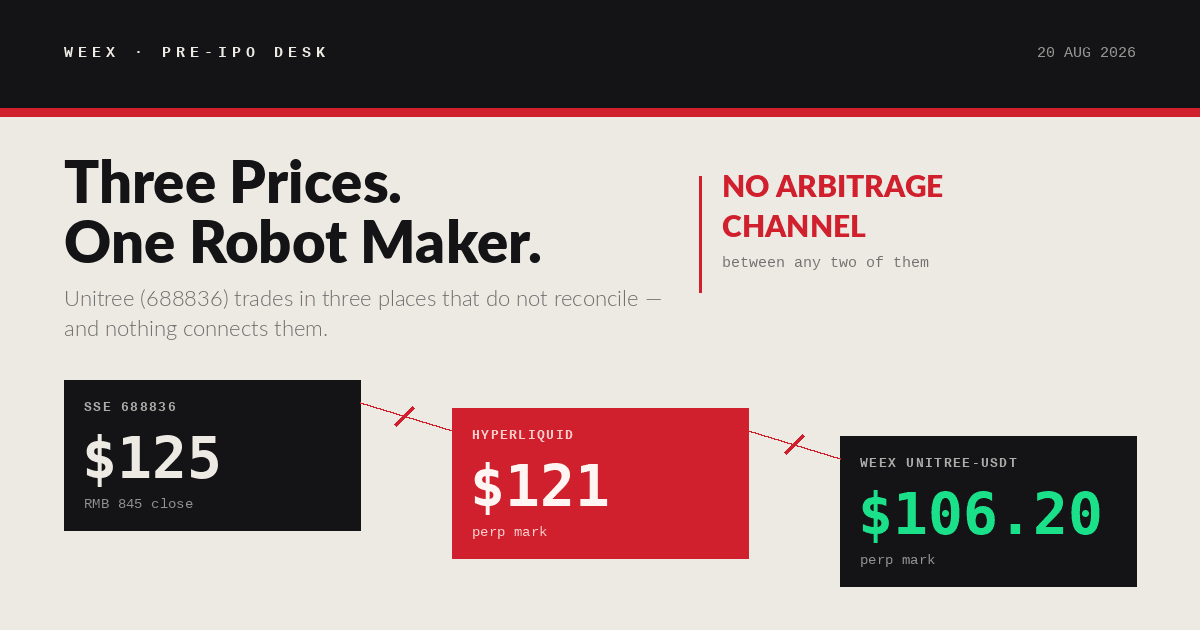
At the RMB 845 close, Unitree was worth roughly $125 a share at the exchange rate implied by CoinDesk's $66 billion valuation of the 1,100 yuan open. On Hyperliquid, UNITREE-USDC traded around $121 on Wednesday morning after briefly printing above $140. On WEEX, the USDT contract was at 106.20 on August 20.
Three different numbers for the same company on the same day.
There is no arbitrage channel to close that gap. You cannot borrow a STAR-listed share, you cannot deliver into these contracts, and capital controls sit between the two markets. The basis is therefore free to persist and to move on its own supply and demand — perp flow, funding, and liquidations — rather than on anything Unitree does. If your thesis is "the A-share will keep running," a perpetual is a correlated proxy for that thesis, not a clean expression of it.
The other structural problem is depth. Open interest on the Unitree contract was about $29 million after the listing, against roughly $216 million on SpaceX's pre-IPO contract before its June 2026 debut (CoinDesk). A pool that small, with 10–20× leverage available, is a liquidation cascade looking for a reason.
What the pre-IPO perp got wrong, and what that costs you
Crypto traders had this name pegged at about $38 billion before Shanghai opened — more than four times what Unitree's own bankers priced it at. They were still 75% too low.
| SpaceX (June 2026) | Unitree (Aug 2026) | |
|---|---|---|
| Pre-listing perp implied price | ~$170/share | ~$92–94/share (~$38B) |
| Actual first-day range | Above $176, closed $161 | Opened ~$163-equivalent (RMB 1,100), closed ~$125 (RMB 845) |
| Verdict | Near-exact | Directionally right, magnitude badly wrong |
| Pre-listing open interest | ~$216M | ~$29M |
Source: CoinDesk, Jun 10 and Aug 19, 2026.
The pattern is not subtle: the deep contract priced its IPO almost perfectly, the thin one did not. That is a usable rule for the next pre-IPO perp you see — treat implied valuations from a $29 million book as an opinion poll, not a price.
What experienced traders watch here: the funding rate, not the chart. When a debut name's funding goes deeply negative, the crowd is short and paying to stay short, which is the setup for a squeeze that has nothing to do with robot shipments. When it flips positive and stays there, longs are paying rent on a position while the underlying sits closed for the Shanghai session.
The practical read on trading Unitree stock
Unitree is a real business — over 5,500 humanoid units shipped in 2025, first globally, and 5,900 in H1 2026 — but at RMB 845 the market is paying for a decade of execution up front, and the perpetual you can actually access is a leveraged bet on a price you cannot arbitrage. Knowing how to trade Unitree stock through a perpetual is the easy part; the discipline is in sizing for a contract whose price, funding, and liquidity are set by a market roughly one-seventieth the size of the underlying's market cap.
If you want the exposure, the UNITREE-USDT contract is where it lives. Start with leverage you would be comfortable holding through a limit-down session in Shanghai, because that session will come and the perp will keep trading through it.
FAQ
1. Can foreign investors buy Unitree stock (688836) directly?
No. STAR Market shares reach Northbound Stock Connect only after meeting index or A+H criteria, and even then trading is restricted to institutional professional investors. No mainstream Western retail broker offers access.
2. What is Unitree's stock price now?
Unitree closed at RMB 845 on August 19, 2026, its first session, up 460% from the RMB 150.80 IPO price. The A-share price moves only during Shanghai hours; perpetual contracts on the name trade 24/7 and can print materially different levels.
3. Is the UNITREE perpetual the same as owning Unitree shares?
No. It is a cash-settled derivative on the share price. It carries no equity, no voting rights, and no dividend, and its price can diverge from the Shanghai print because there is no arbitrage channel between the two markets.
4. What leverage is available on Unitree stock futures?
As of August 20, 2026 the WEEX UNITREE-USDT contract page advertises up to 20×; the Hyperliquid contract caps at 10×. Available leverage is a ceiling, and thin order books make high leverage disproportionately dangerous on this name.
5. Why did crypto traders underprice the Unitree IPO?
Thin participation. The pre-listing contract carried roughly $29 million in open interest versus about $216 million on SpaceX's, whose implied price landed almost exactly on the first-day range. Small books produce noisy estimates.
6. Do Unitree perpetuals trade when the Shanghai market is closed?
Yes — 24/7, including weekends. That is an advantage for reacting to news and a hazard for holding through gaps, because the reference market is shut for most of the perp's trading hours.
Risk Warning
Unitree stock perpetual futures are high-risk leveraged derivatives and may result in partial or total loss of your capital. Specific risks on this contract are elevated: open interest of roughly $29 million makes the book thin enough that modest orders can move price and trigger liquidation cascades; leverage of up to 20× means a single-digit adverse move can close your position; funding payments accrue continuously and can invert without warning; and the contract's price can diverge persistently from 688836's Shanghai quote because no arbitrage channel exists between the two markets. Corporate actions and A-share trading halts may cause sharp moves or early settlement. Stock perpetuals are not available in all jurisdictions. Nothing here is investment advice — assess your own risk tolerance and never commit capital you cannot afford to lose.
This content is provided for general informational purposes only and doesn't constitute financial, investment, legal, or tax advice. Any events, rewards, online promotions, or related information mentioned herein should not be considered a recommendation, solicitation, or invitation to purchase, sell, trade, or otherwise deal in any crypto assets. Crypto assets are highly volatile and may result in loss. The availability of WEEX services, products, and related events may vary by region. You are responsible for ensuring that your participation is in accordance with applicable local laws and regulations.
You may also like
XPL/USDT After the August 25 Unlock: Will Ecosystem Incentives Create Demand or Selling Pressure?

Bitcoin at $75,000: Anatomy of a $3 Billion Short Squeeze

What Is ANSEM (The Black Bull)? The Pump Story, the 60 Percent Wallet and the Risks

What Is Based (BASED)? The Hyperliquid Super App Token Explained
Why Did SIREN Crash? The Whale Dump Explained, and What SIREN Is
Why POPCAT Crashes? A Complete Explanation
Memecoin Season 2025 is Coming?
What is niggaliquid (NL) Coin: A Comprehensive Guide to the Solana Meme Token
NVIDIA (NVDA) Earnings Date: When Q2 FY2027 Reports and What to Watch
BitMEX Is Closing September 23, 2026: Timeline and How to Withdraw Before the Deadline

Micron Stock (MU): Price, Outlook and How to Buy
How to Log In to MetaMask: Unlock, Troubleshooting and Recovery (2026)
SanDisk Stock (SNDK): Price, Outlook and How to Buy
Bybit Japan Service Termination: The Complete Timeline and What Happens on July 22, 2026
Bitcoin Price Over 10 Years: Historical Recap and Long-Horizon Outlook
BitMart Is Closing: Shutdown Timeline and How to Withdraw Before August 26, 2026
SOXSB Explained: Why the 3x Chip Bear ETF Resets Without You

CLARITY Act: What Happens in the Senate's September Window

How to Call a Crypto Exchange API Without Getting Blocked
Crypto Exchange API: Permissions, Signing and Rate Limits

QQQB and the Fed: What the FOMC Minutes Mean for Nasdaq-100
ETH to USDT: What the Converter Rate Leaves Out
Your Crypto Exchange Is Shutting Down: How to Move Your Funds and Choose the Next Exchange
Meta Stock at $548: The Free Cash Flow Number Behind the Drop
MU Stock Is Down 24% While Micron's Profits Hit Records
Kioxia Stock Before the Oct 1 Split: The 24/7 Perp Problem
Recordati Stock (REC): The Respighi BidCo Tender Offer, the Timetable and What Happens If You Do Nothing
Eiffage Stock (FGR): The Two Engines, the Motorway Concession End Dates and the 26 August 2026 Half-Year Results
Deutz Stock (DEZ): The 24 August 2026 Extraordinary General Meeting, the FFG Share Issue and What the Resolution Says
Logista Stock (LOG): The August 2026 Interim Dividend, the Four Dates That Decide Who Is Paid and What the Company Is
XPL/USDT After the August 25 Unlock: Will Ecosystem Incentives Create Demand or Selling Pressure?
Bitcoin at $75,000: Anatomy of a $3 Billion Short Squeeze
What Is ANSEM (The Black Bull)? The Pump Story, the 60 Percent Wallet and the Risks
What Is Based (BASED)? The Hyperliquid Super App Token Explained
Why Did SIREN Crash? The Whale Dump Explained, and What SIREN Is
Why POPCAT Crashes? A Complete Explanation


