
CLARITY Act: What Happens in the Senate's September Window

 Prefer us on Google


The CLARITY Act is not law, and the window in which it could become law is now measured in working days rather than months. President Donald Trump spent Wednesday, August 19, in the White House Roosevelt Room flanked by the CEOs of Coinbase, Gemini, Ripple and Chainlink Labs, telling Congress to "take the next step" and pass what he called "a fair version" of the Digital Asset Market Clarity Act. Twenty-four hours later, bitcoin was up 8% and through $75,000.
The gap between those two facts is the thing worth understanding. Presidential enthusiasm does not produce 60 Senate votes, and the bill that would reshape how US regulators treat digital assets is stuck on a clause that has nothing to do with digital assets.
Did the CLARITY Act pass? Where the bill stands now
No. As of August 21, 2026, the CLARITY Act has passed the House but not the Senate, and it is not law. The House cleared H.R. 3633 on July 17, 2025 by 294–134. The Senate Banking Committee advanced its own version on May 14, 2026 by 15–9. Before the Senate broke for summer recess on August 8, Majority Leader John Thune filed cloture on the motion to proceed — a procedural step that keeps the bill alive on the docket without testing whether it can actually pass.
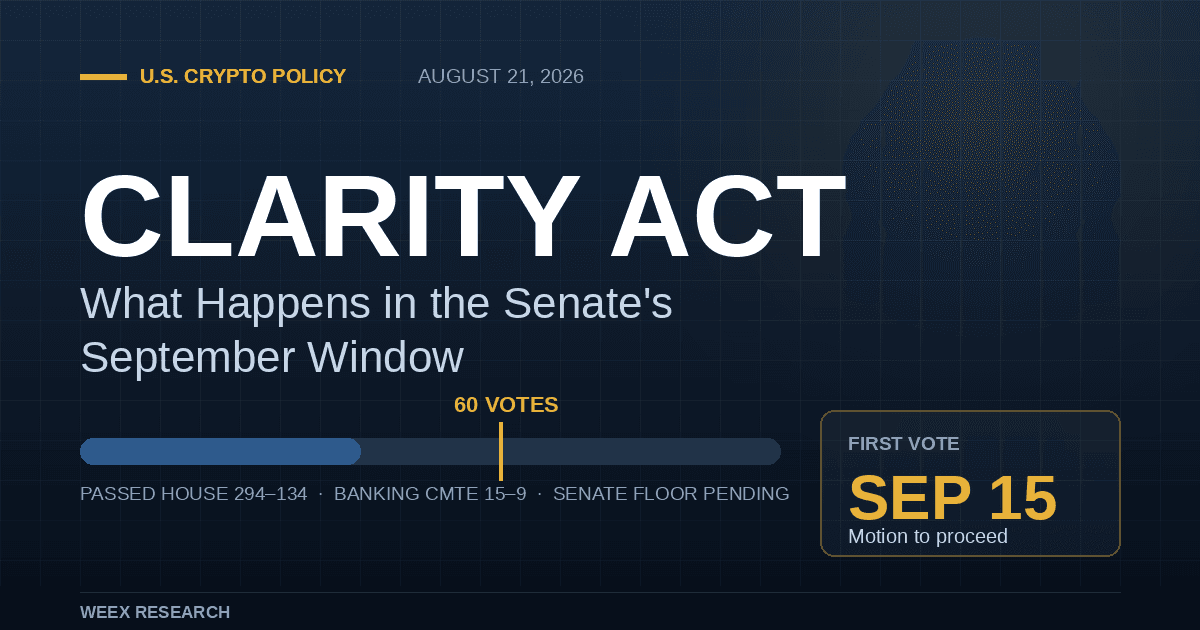
The Senate reconvenes September 14. The first real vote is expected the following day.
Date | Step | Result |
|---|---|---|
Jul 17, 2025 | House vote on H.R. 3633 | Passed 294–134 |
May 14, 2026 | Senate Banking Committee | Advanced 15–9 |
Aug 3, 2026 | Thune commits to a floor vote | Promise, not a schedule |
Aug 8, 2026 | Cloture filed on motion to proceed | Bill stays on docket |
Aug 19, 2026 | Trump White House crypto event | Public pressure, no new votes |
Sep 15, 2026 | Expected first procedural vote | Needs 60 |
The distinction that matters: a motion to proceed is a vote about whether to debate the bill, not about the bill. Clearing it would be the furthest the industry's central legislative effort has ever travelled. Failing it would end the CLARITY Act until after the November midterms.
What the CLARITY Act actually changes: SEC vs CFTC
Today a US exchange listing a token has to guess whether the SEC will later call it a security. That guess is the entire compliance problem. The CLARITY Act replaces the guess with a statutory sorting rule.
| Today | Under the CLARITY Act |
|---|---|---|
Who decides if a token is a security | SEC, retroactively, via enforcement | Statutory test based on decentralization |
Spot trading of large-cap tokens | Ambiguous | CFTC oversees "digital commodities" |
Token fundraising | Registration or an awkward exemption | Purpose-built SEC exemption |
Exchanges, brokers, dealers | State money-transmitter patchwork | Federal registration regime |
Tokens still tied to a founding team | Unresolved | "Ancillary asset" with tailored disclosure |
The Senate draft's most consequential addition is that last row. An ancillary asset is a network token whose value still depends on the entrepreneurial efforts of an originator. It gets SEC disclosure obligations now and a path out of securities treatment once the founding team's efforts stop being the primary source of value. That is the mechanism the industry has wanted for eight years, and it is why Coinbase CEO Brian Armstrong described the bill on August 19 as making the current administration's progress "durable into the future."
That word — durable — is doing the real work. Rules written by agencies can be unwritten by the next agency head. A statute cannot.
The September window and the 60-vote math
The bill needs 60 votes. Republicans do not have 60 seats. That arithmetic means the CLARITY Act passes only with Democratic support, and the sticking point is an ethics provision.
Senators Thom Tillis and Ruben Gallego sent the White House a revised ethics proposal in late July aimed at barring senior government officials — the president included — from profiting off the crypto industry. Tillis told reporters on August 5 that the White House had begun engaging with it. As of the CFTC's August 20 advisory committee meeting, no agreement had been announced. Illicit-finance provisions and agriculture-committee issues are also unresolved.
There are roughly 14 Senate working days across September and October, and government funding will compete for floor time. The honest read is that the CLARITY Act's fate depends less on crypto policy than on whether one ethics clause about the president can be drafted in a way both parties will sign.
-- Price
What happens to crypto if the CLARITY Act fails
Less than the headlines imply, and that is genuinely new information as of this week.
On August 20, CFTC Chairman Mike Selig told the inaugural meeting of his agency's Innovation Advisory Committee that he has already directed staff to prepare a fallback. "If Clarity continues to stall," Selig said, "the CFTC will utilize its existing authorities to begin establishing a regime for crypto asset markets." The plan is a new registration category for crypto trading venues modelled on the CFTC's existing designated contract markets.
The SEC has already moved on its own. On August 18 it proposed Regulation Crypto Assets, its first major crypto rulemaking, creating registration exemptions for token fundraising and a route for an asset to shed securities classification once a project meets defined managerial commitments. The Treasury proposed its GENIUS Act stablecoin approach on August 17.
So the realistic outcomes are not "clarity" versus "chaos."
Scenario | Probability signal | What it means for markets |
|---|---|---|
Senate passes in September | Armstrong publicly optimistic; ethics clause still open | Statutory permanence; listing risk drops structurally |
Vote fails or is not held | Only 14 working days; recess before midterms | CFTC and SEC rulemaking proceeds anyway, slower and reversible |
Passes after the midterms | Depends on which chamber flips | Same substance, one to two years later |
The market read: agency rulemaking delivers perhaps 70% of the practical benefit and none of the permanence. A trader positioned for a binary September outcome is probably mispricing it.
How traders are positioning around the CLARITY Act vote
Bitcoin's 8% day on August 20 is being widely attributed to Trump's remarks, and the sequencing does not support that cleanly. The move began when the US Treasury said it would at least double long-dated bond buybacks to $4 billion, pulling the 30-year yield back from 5.337% — its highest since 2007. That bid cleared bitcoin's six-week ceiling and triggered $3 billion in short liquidations. Trump's comments landed hours later, into a market that had already made most of its move, and gave it a second leg.
Regulatory headlines are a legitimate catalyst. They are rarely the whole catalyst. Anyone sizing a position off the September vote should check what the live BTC price has already absorbed before assuming the news is unpriced — on August 21, bitcoin was trading around $75,280 with a market cap of $1.51 trillion and 24-hour volume of $60.28 billion, well above its 50-day EMA of $64,534.
Two practical notes. First, a failed cloture vote on September 15 is a headline risk that resolves in minutes, which is exactly the kind of event that punishes leverage rather than direction. Traders who want exposure to the outcome without gap risk generally take it in the BTC/USDT spot market rather than in perpetuals. Second, the CLARITY Act matters most for tokens with unresolved securities questions — mid-cap alts with identifiable founding teams — not for bitcoin, which no serious regulator has called a security in years. If you are trading the CLARITY Act through BTC, you are trading sentiment, not classification.
For readers thinking past the September vote, WEEX's longer-dated BTC forecasts put 2027 near $82,996 and 2030 near $96,078 — model outputs, not promises, and a useful reminder that legislative catalysts fade faster than supply schedules.
What to watch next
The CLARITY Act is one procedural vote away from either the most significant US crypto statute ever written or a nine-month delay. September 15 is the date. The ethics clause is the obstacle. The CFTC's fallback regime is the reason failure would not be catastrophic.
Track it with position sizing that survives being wrong on the headline. You can follow BTC pricing and open a spot or futures position on WEEX in a few minutes — but the trade worth making here is patience, not leverage.
FAQ
1. Has the CLARITY Act passed?
No. It passed the House on July 17, 2025 and cleared the Senate Banking Committee on May 14, 2026, but has not passed the full Senate. As of August 21, 2026 it is not law.
2. When is the Senate vote on the CLARITY Act?
The Senate reconvenes September 14, 2026, with a first procedural vote expected September 15. That vote is on the motion to proceed and requires 60 votes.
3. What is an "ancillary asset" under the CLARITY Act?
A network token whose value still depends on the entrepreneurial or managerial efforts of its originator. It receives tailored SEC disclosure requirements and can exit securities treatment once those efforts are no longer the primary source of value.
4. What happens to crypto if the CLARITY Act fails?
The CFTC has said it will build a crypto market regime under existing authorities, and the SEC already proposed Regulation Crypto Assets on August 18, 2026. Regulation proceeds either way — it just remains reversible by future agency leadership.
5. Does the CLARITY Act affect bitcoin's classification?
Not meaningfully. Bitcoin has been treated as a commodity by US regulators for years. The bill matters far more for mid-cap tokens with identifiable development teams and unresolved securities status.
6. Why is an ethics clause holding up a crypto bill?
Democratic negotiators want provisions barring senior officials, including the president, from profiting off the crypto industry. Senators Tillis and Gallego sent the White House a revised version in late July 2026; no agreement had been announced as of August 20.
Risk Warning
Crypto assets are volatile and can lose value quickly; you may lose part or all of the capital you commit. Legislative outcomes are especially poor trading catalysts: a scheduled Senate vote can be postponed, amended or fail without warning, and the resulting price gap can move through stop orders rather than filling at them. Leveraged positions held into a binary policy event carry elevated liquidation risk. Regulatory outcomes may also change which tokens exchanges can list in specific jurisdictions, affecting liquidity and withdrawal access for assets you already hold. Nothing here is investment, legal or tax advice. Verify current rules for your own jurisdiction before acting.
This content is provided for general informational purposes only and doesn't constitute financial, investment, legal, or tax advice. Any events, rewards, online promotions, or related information mentioned herein should not be considered a recommendation, solicitation, or invitation to purchase, sell, trade, or otherwise deal in any crypto assets. Crypto assets are highly volatile and may result in loss. The availability of WEEX services, products, and related events may vary by region. You are responsible for ensuring that your participation is in accordance with applicable local laws and regulations.
You may also like

How to Log In to MetaMask: Unlock, Troubleshooting and Recovery (2026)

WEEX Mini App Launch Rewards: Trial Funds, BTC Airdrops, and an iPhone 17 Pro Giveaway Explained

How to Buy USDT with JazzCash in Pakistan Safely in 2026

JazzCash Crypto Guide: How PKR-to-USDT P2P Payments Work in Pakistan

H/USDT After the Unlock: What Humanity Protocol’s New Supply Means for Traders

Why Is DGrid AI (DGAI) Trending After Its Exchange Debut?

XSolut Coin Extends Its Decline to 7 Straight Days: What Continued Selling Pressure Actually Signals
MORTY After Viral Meme Rally: Overvalued or Growth Story?

SPCX Stock Keeps Swinging Around Its $135 IPO Price : What the Lockup Schedule Still Ahead Actually Means
What Is TermMax (TMX)? Inside the New Fixed-Rate DeFi Token Launching Today
What Is XST Coin? Why There Are Multiple Tokens Using the XSolut Name on Coinbase
What Is IMX Crypto? How Immutable's Layer 2 Became the Largest Web3 Gaming Blockchain
Michael Saylor Sold 1,690 Bitcoin at a Loss: What Strategy Inc.'s August Bitcoin Sale Actually Reveals
How High Can Sandisk Stock Go? 2026 Price Target and Analyst Outlook
Is WEEX Safe? Verify the Reserves and 1,000 BTC Fund Yourself
How to Call a Crypto Exchange API Without Getting Blocked
Crypto Exchange API: Permissions, Signing and Rate Limits
What Is a Crypto Exchange API and Which Permissions to Enable
WEEX Daily Lucky Wheel and Event Airdrops: How the Rewards Actually Work
What Is ISOR Coin (Iran Strategic Oil Resource)? Facts, Risks and Where It Trades
How to Earn WXT Rewards with WEEX Trade to Earn S6 Futures Event
Roblox Stock Is Down 68% in the Past Year: What Age Verification and Sands Capital's Exit Actually Signal
Is XST Crypto a Long-Term Opportunity or Short-Term Hype?

Meta Stock Price Is Down 30% From Its 52 Week High: Is META a Buy After the Child Safety Trial Drop

How to Log In to MetaMask: Unlock, Troubleshooting and Recovery (2026)
WEEX Mini App Launch Rewards: Trial Funds, BTC Airdrops, and an iPhone 17 Pro Giveaway Explained
How to Buy USDT with JazzCash in Pakistan Safely in 2026
JazzCash Crypto Guide: How PKR-to-USDT P2P Payments Work in Pakistan
H/USDT After the Unlock: What Humanity Protocol’s New Supply Means for Traders
Why Is DGrid AI (DGAI) Trending After Its Exchange Debut?


