
How to Buy USDT with JazzCash in Pakistan Safely in 2026

 Prefer us on Google


Buying USDT safely with JazzCash in 2026 comes down to three things: verifying your own JazzCash and exchange accounts properly before you start, choosing a P2P seller with a strong track record rather than the cheapest rate, and never releasing or confirming payment until the money has actually landed in the right account. The mechanics are simple once set up correctly, but most losses in this market come from skipping one of these three steps under time pressure.
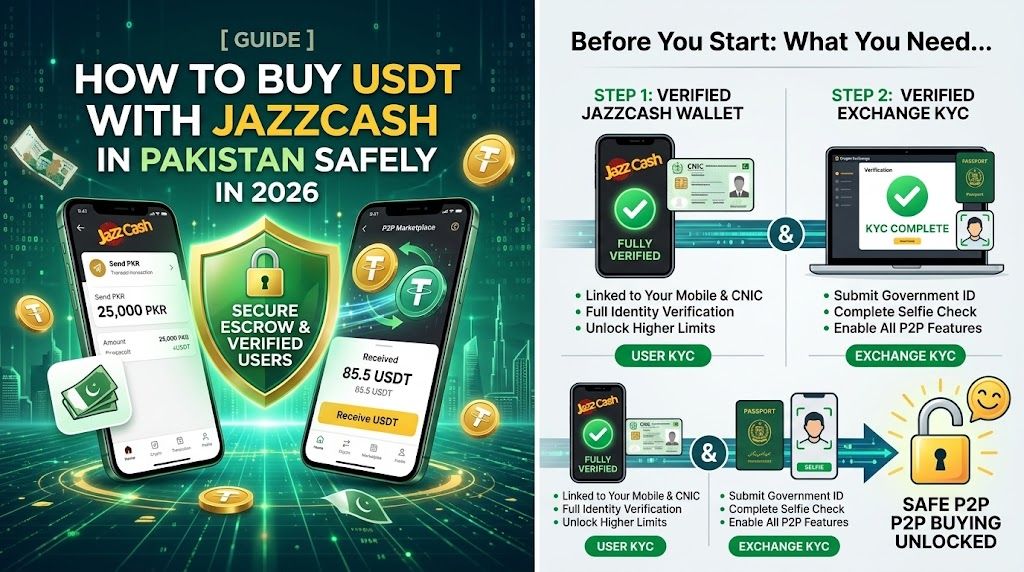
Before You Start: What You Need to Buy USDT with JazzCash
A safe JazzCash-to-USDT purchase requires two separate verifications completed in advance: a fully verified JazzCash mobile wallet linked to your own CNIC, and a verified account on whichever exchange's P2P marketplace you plan to use. Skipping either step doesn't just slow you down, it removes the identity trail that protects you if a trade goes wrong.
Verifying Your JazzCash Account
JazzCash accounts are tied to your mobile number and CNIC (Pakistan's national identity card), and full verification typically unlocks higher transaction limits than a newly opened, minimally verified wallet. Since P2P sellers can see whether a buyer's payment is coming from a fully verified account, using an unverified or partially verified JazzCash wallet can itself make sellers hesitant to trade with you, on top of leaving you with lower transfer limits.
Completing Exchange-Side KYC
Separately, the exchange hosting the P2P marketplace will require its own identity verification before granting access to trading, typically involving a government ID and sometimes a selfie or liveness check. This second layer of verification exists independently of JazzCash's own KYC, and completing it fully before your first trade avoids the frustrating experience of finding a good seller only to discover your account isn't yet eligible to trade.
Step-by-Step: How to Buy USDT Using JazzCash
- Open the P2P marketplace on your chosen exchange and filter the buy-side listings specifically for JazzCash as the payment method, since not every seller accepts it.
- Compare sellers by more than price. Sort by completion rate and order count rather than jumping straight to whoever shows the lowest PKR-per-USDT rate.
- Check the seller's stated limits and average release time, both shown on their listing, to confirm your intended trade size fits comfortably within what they normally handle.
- Place the order and let escrow lock the USDT. Once you confirm the trade, the platform automatically moves the seller's USDT into escrow, where neither side can touch it until the trade completes.
- Open your JazzCash app separately and send the exact PKR amount to the account details shown inside the trade chat, matching the name and number precisely.
- Mark the payment as sent inside the platform, which notifies the seller to check their JazzCash balance.
- Wait for the seller to confirm and release escrow. Once they verify the funds landed, the USDT transfers to your exchange wallet, usually within minutes given how fast JazzCash settlement is.
- Move the USDT to a personal wallet if you intend to hold it for any length of time, rather than leaving it sitting on the exchange.
How to Vet a Seller Before You Buy
The single most useful filter available to a buyer is a seller's completion rate combined with their total order count, since a high percentage on a small number of trades is far less reliable than the same percentage across hundreds of completed orders. A seller advertising a rate noticeably better than everyone else on the same page is one of the more common lures used to draw in buyers before a scam attempt, so treat an unusually generous rate as a reason to look closer, not a reason to skip your other checks.
| Screening Factor | What a Strong Seller Looks Like | Warning Sign |
|---|---|---|
| Completion rate | 98% or higher | Below 95%, or newly listed with no history |
| Order volume | Hundreds of completed trades | Very few completed orders |
| Response and release speed | Fast, consistent confirmation times | Long delays or repeated excuses |
| Communication | Stays inside the platform's official chat | Pushes you toward WhatsApp or another app |
-- Price
What Security Risks Are Specific to JazzCash Accounts in 2026
Beyond P2P trading scams themselves, JazzCash accounts have also seen a documented rise in broader mobile wallet fraud in Pakistan, including unauthorized loan applications and account takeovers tied to leaked identity data. JazzCash has publicly acknowledged this rise in scam activity and launched awareness campaigns alongside regulators, which is a useful signal that this isn't a rare or isolated risk for account holders.
Rising Mobile Wallet Fraud and Why It Matters for Crypto Buyers
Reports investigated by Pakistani media and the Federal Investigation Agency have documented cases where leaked CNIC and identity data were used to bypass verification steps and take actions on a victim's account without their knowledge. For a crypto buyer, this matters directly: if someone gains unauthorized access to your JazzCash wallet, they could interfere with a P2P trade in progress or drain funds you were about to use for a purchase, which is a risk that exists independently of anything the exchange side does correctly.
Protecting Your JazzCash PIN and CNIC Details
Never share your JazzCash PIN, one-time passwords, or CNIC details with anyone claiming to be JazzCash support, an exchange representative, or a P2P counterparty, since legitimate parties on any side of a crypto trade never need this information directly from you. Enabling any additional security features JazzCash offers, such as biometric authentication where available, and staying alert to unexpected loan or transaction notifications, are reasonable ongoing habits given the documented rise in mobile wallet fraud specifically targeting Pakistani users.
What to Do With USDT After You Buy It
Leaving purchased USDT sitting in an exchange wallet long-term carries different risks than the purchase process itself, since exchange accounts remain a target for account takeovers and, in Pakistan's current environment, none of the platforms facilitating these trades hold a full PVARA operating license yet. Moving USDT to a personal, self-custodied wallet after a purchase, and keeping the exchange balance limited to what you're actively trading with, is a standard practice among more experienced users specifically to reduce this exposure.
Is This Legal? Quick Regulatory Refresher for 2026
Holding and trading cryptocurrency is generally treated as legal activity by Pakistani authorities, but the exchanges facilitating P2P trades are operating without full PVARA licenses as of 2026, even though the regulator has begun issuing early-stage No Objection Certificates to a small number of global platforms. JazzCash itself is a fully licensed, regulated payment service doing exactly what it's designed to do, moving money between two mobile wallets, so the regulatory uncertainty here sits with the crypto trading layer, not with JazzCash as a payment method.
Buying USDT safely with JazzCash ultimately comes down to treating identity verification, seller vetting, and payment confirmation as three separate, non-negotiable steps rather than shortcuts to skip when a trade looks convenient. Applying that same discipline consistently, regardless of which platform or seller is involved, remains the most reliable way to avoid the fraud patterns currently affecting Pakistan's mobile wallet and P2P crypto market.
Frequently Asked Questions About Buying USDT with JazzCash
1. What is the safest way to buy USDT with JazzCash for a first-time buyer
The safest approach for a first-time buyer is starting with a small trade size, choosing a seller with hundreds of completed orders and a 98%+ completion rate, and keeping all communication inside the platform's official chat rather than moving to another app.
Starting small lets you learn the payment confirmation and escrow release process without exposing a large amount to a mistake made while still unfamiliar with how the flow works.
2. Why did a JazzCash P2P seller ask me to send payment to a different account name
A request to send payment to an account name that doesn't match the seller's verified details on the platform is a significant warning sign and should not be followed, since it breaks the identity trail escrow protection depends on.
Legitimate sellers receive payment through the exact account details displayed inside the official trade chat, and any deviation from that should be treated as a reason to cancel the trade and report it.
3. Can I get my money back if I send a JazzCash payment and the seller disappears
Most regulated P2P marketplaces offer a dispute process where a buyer can submit proof of payment if a seller fails to release escrowed USDT, though the outcome depends on the platform reviewing evidence submitted through its official system.
This is a key reason to always keep payment confirmations and chat history inside the platform itself, since evidence sent through outside channels like WhatsApp is much harder to verify during a dispute.
4. How much USDT can I buy with JazzCash in a single transaction
Limits vary by both your JazzCash verification tier and the individual seller's own posted trading limits, so there is no single fixed cap that applies to every user.
Checking a seller's listed minimum and maximum trade size before placing an order avoids the common frustration of an order that can't complete because it falls outside what that specific seller is set up to handle.
5. Is it safer to buy USDT with JazzCash or with a bank transfer in Pakistan
Both can be safe when escrow protection and proper seller vetting are used, but JazzCash's near-instant settlement gives buyers and sellers less time to worry about payment clearing delays compared to standard bank transfers.
The underlying safety principles, verifying payment before releasing escrow and vetting sellers by history rather than price alone, apply equally regardless of which payment method is used.
This content is provided for general informational purposes only and doesn't constitute financial, investment, legal, or tax advice. Any events, rewards, online promotions, or related information mentioned herein should not be considered a recommendation, solicitation, or invitation to purchase, sell, trade, or otherwise deal in any crypto assets. Crypto assets are highly volatile and may result in loss. The availability of WEEX services, products, and related events may vary by region. You are responsible for ensuring that your participation is in accordance with applicable local laws and regulations.
You may also like

How to Log In to MetaMask: Unlock, Troubleshooting and Recovery (2026)
WEEX Mini App Launch Rewards: Trial Funds, BTC Airdrops, and an iPhone 17 Pro Giveaway Explained
JazzCash Crypto Guide: How PKR-to-USDT P2P Payments Work in Pakistan
H/USDT After the Unlock: What Humanity Protocol’s New Supply Means for Traders
Why Is DGrid AI (DGAI) Trending After Its Exchange Debut?
XSolut Coin Extends Its Decline to 7 Straight Days: What Continued Selling Pressure Actually Signals
MORTY After Viral Meme Rally: Overvalued or Growth Story?
SPCX Stock Keeps Swinging Around Its $135 IPO Price : What the Lockup Schedule Still Ahead Actually Means
What Is TermMax (TMX)? Inside the New Fixed-Rate DeFi Token Launching Today
What Is XST Coin? Why There Are Multiple Tokens Using the XSolut Name on Coinbase
What Is IMX Crypto? How Immutable's Layer 2 Became the Largest Web3 Gaming Blockchain
Michael Saylor Sold 1,690 Bitcoin at a Loss: What Strategy Inc.'s August Bitcoin Sale Actually Reveals
How High Can Sandisk Stock Go? 2026 Price Target and Analyst Outlook
CLARITY Act: What Happens in the Senate's September Window
Is WEEX Safe? Verify the Reserves and 1,000 BTC Fund Yourself
How to Call a Crypto Exchange API Without Getting Blocked
Crypto Exchange API: Permissions, Signing and Rate Limits
What Is a Crypto Exchange API and Which Permissions to Enable
WEEX Daily Lucky Wheel and Event Airdrops: How the Rewards Actually Work
What Is ISOR Coin (Iran Strategic Oil Resource)? Facts, Risks and Where It Trades
How to Earn WXT Rewards with WEEX Trade to Earn S6 Futures Event
Roblox Stock Is Down 68% in the Past Year: What Age Verification and Sands Capital's Exit Actually Signal
Is XST Crypto a Long-Term Opportunity or Short-Term Hype?
Meta Stock Price Is Down 30% From Its 52 Week High: Is META a Buy After the Child Safety Trial Drop
How to Log In to MetaMask: Unlock, Troubleshooting and Recovery (2026)
WEEX Mini App Launch Rewards: Trial Funds, BTC Airdrops, and an iPhone 17 Pro Giveaway Explained
JazzCash Crypto Guide: How PKR-to-USDT P2P Payments Work in Pakistan
H/USDT After the Unlock: What Humanity Protocol’s New Supply Means for Traders
Why Is DGrid AI (DGAI) Trending After Its Exchange Debut?
XSolut Coin Extends Its Decline to 7 Straight Days: What Continued Selling Pressure Actually Signals


