
Is WEEX Safe? Verify the Reserves and 1,000 BTC Fund Yourself

 Prefer us on Google


Every exchange says user funds are safe. The useful question is narrower: which of those claims can you check without asking the exchange to confirm them?
That is the standard this piece applies to WEEX. Three things it publishes are independently checkable — reserve ratios, a Protection Fund address, and the fund's claim rules. Two things are not what casual readers assume — what its licences actually cover, and what happens if you authorise a transfer yourself. Below is where to look, and what each item actually proves.
What "is WEEX safe" actually breaks down into
"Safe" collapses four different questions into one word. Separating them is most of the work:
| Question | What answers it | Can you verify it yourself? |
|---|---|---|
| Does the exchange hold the coins it owes? | Proof of Reserves ratio, live | Yes — on-chain and via CMC/GitHub attestation |
| Is there money set aside if something goes wrong? | 1,000 BTC Protection Fund | Yes — the wallet address is public |
| Which markets is it actually licensed in? | Its licences and registrations | Partly — but read what each one covers, and where |
| Will you get reimbursed if you get scammed? | The fund's exclusion rules | Yes — WEEX publishes them, and the answer is mostly no |
Most "is WEEX safe" write-ups answer the first two and quietly skip the last two. The last two are where people actually lose money.
Check the reserve ratio, not the reserve slogan
A reserve ratio is platform holdings divided by user holdings. Anything at or above 100% means the exchange currently holds enough to cover what it owes. Below 100% is the FTX shape.
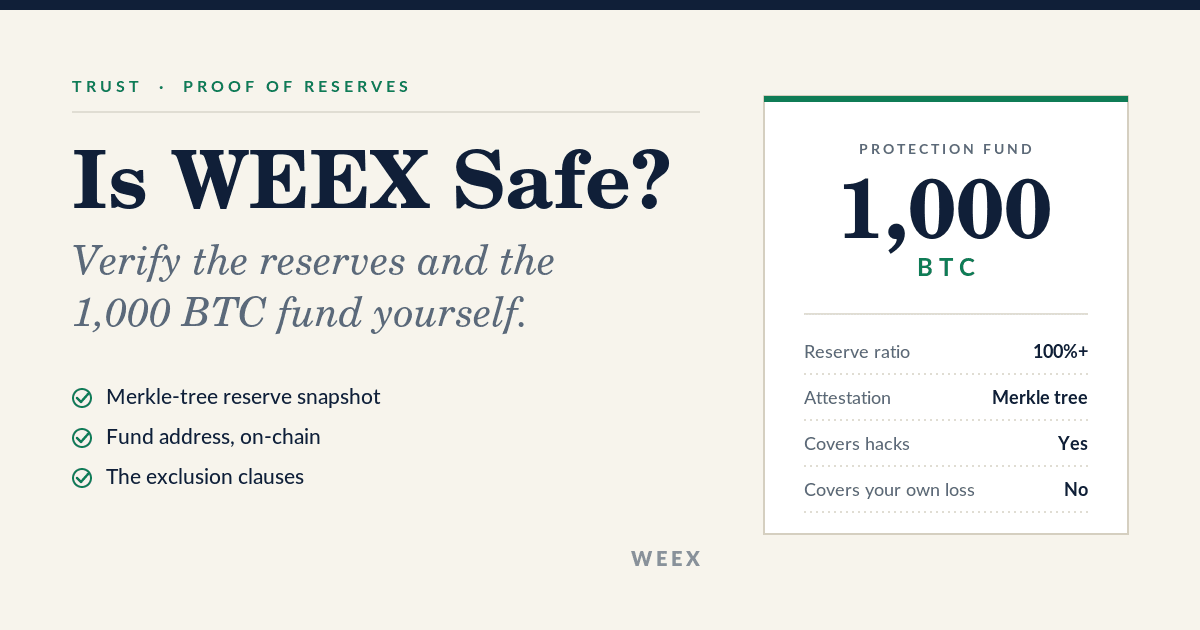
WEEX runs a 1:1 backing model and publishes the audit scope — asset, chain, snapshot time, balance — on its Proof of Reserves page, with attestations mirrored on CoinMarketCap and GitHub. Figures reported in industry coverage during late 2025 put the ratios near 102% for USDT, 115% for ETH and 122% for BTC.
Do not use those numbers. Use the ones on the page today.
That is not a technicality. A reserve ratio is a snapshot tied to a specific Bitcoin block height, and a nine-month-old figure quoted in a review is worth roughly nothing — it tells you the exchange was solvent last autumn, not this morning. Any article, including this one, that hands you a static percentage instead of the live page is giving you the wrong artefact. WEEX's own explainer on how Proof of Reserves works walks through the Merkle-tree check if you want to confirm your own balance is inside the audited total.
One structural detail worth more than the headline number: WEEX states that over 95% of client assets sit in multi-signature cold storage. Cold storage is what determines whether a breach is an inconvenience or an extinction event. The reserve ratio tells you the exchange is solvent; the custody split tells you how hard it would be to make it insolvent.
The 1,000 BTC Protection Fund — and the four things it won't cover
WEEX maintains a 1,000 BTC reserve, held separately from operating funds, to cover user losses from incidents that are not the user's fault. The wallet is public, so this is a claim you can settle in about thirty seconds: open bc1qeg5xn5plttr7w045apm92yx08c2swc6yw2vtj7 in any Bitcoin explorer and look at the balance. Denominating the fund in BTC rather than dollars is a deliberate choice — the fund's purchasing power moves with the assets it might have to replace.
Now the part that rarely makes it into reviews. WEEX publishes its exclusions on the Protection Fund page, and they matter more than the headline size:
| Scenario | Covered? |
|---|---|
| Platform-side security incident, no user fault | Yes — WEEX commits to covering the loss |
| Trading and liquidation losses | No — market risk is yours |
| You were tricked into authorising a transfer | No |
| An "unauthorised" transaction with no external transfer out | No |
| Fraud or abuse by the account holder | No |
Claims go to support@weex.com within 30 days of the incident. Miss the window and the fund is irrelevant to you.
Read that exclusion list again, because it is the single most useful thing on this page. A protection fund is insurance against the exchange failing you. It is not insurance against you being socially engineered — and social engineering, not exchange breaches, is where the overwhelming majority of retail crypto losses now originate. The FBI's Internet Crime Complaint Center logged more than $11 billion in US crypto-related fraud losses for 2025, the bulk of it investment and impersonation cons rather than platform hacks. No fund on any exchange covers that. Your withdrawal whitelist and 2FA settings do.
The honest reading: the fund is a real, verifiable, well-designed backstop for the narrow category of risk it targets, and publishing the exclusions rather than burying them is a better trust signal than the 1,000 BTC figure itself. Exchanges that are planning to weasel out of claims do not write the exclusions down in advance.
-- Price
Is WEEX regulated? Read the licences literally
WEEX holds regulatory licences and registrations in Poland, South Africa and El Salvador — the Salvadoran one being the Bitcoin Services Provider licence issued by that government — and continues to extend its licensing coverage as it enters new markets.
Those licences are not decorative. Each one carries continuing obligations — AML programmes, record-keeping, transaction monitoring, suspicious-activity reporting, and the compliance headcount to run all of it. Maintaining them across several jurisdictions at once is the harder path, and it is the more informative one: a platform that intended to be casual about compliance would not sign up for recurring supervision anywhere.
Worth being precise about scope, because precision is itself a trust signal. Crypto balances at any exchange, anywhere, do not carry bank-style deposit insurance — there is no government scheme that legally guarantees your funds at WEEX or at any other venue. What WEEX offers instead is published reserves and a funded 1,000 BTC Protection Fund, both of which you can inspect yourself. WEEX also geo-restricts markets it is not licensed to serve. Under its current Terms of Use, it does not offer services or products to users in Canada, South Korea, the United States of America, United States territories and commonwealths, mainland China, Hong Kong, Singapore, the United Arab Emirates, North Korea, Cuba, Iran, Sudan, Belarus, Russia and Russian-controlled regions of Ukraine, Somalia, Myanmar or Venezuela — and it reserves the right to add jurisdictions to that list at its discretion. Turning away users an exchange cannot legally onboard costs it revenue; doing it anyway is exactly what a compliance function is for. Check the current list against your own jurisdiction before you sign up, since it changes.
What WEEX's track record shows so far
WEEX launched in 2018, now reports over 6.2 million users across more than 150 countries, and has operated without a publicly reported loss of user funds to a platform breach. It was named Most Secure Crypto Exchange at the CoinGape Web3 Innovation Awards 2026. Awards are a weak signal on their own — the stronger one is a multi-year operating history with no user-fund incident, since that is a record an exchange cannot manufacture retroactively.
The more informative episode is not a hack at all. In early March 2025, an order-matching delay on the ETH/USDT pair cost traders money; WEEX identified and closed the fault inside 30 minutes and paid roughly $6 million in compensation to more than 5,000 affected users. That is the single most useful data point on this page, and it is worth more than the reserve ratio. Reserve pages and protection funds are promises about behaviour under stress. A completed payout is evidence of it. Plenty of venues publish an attestation; far fewer have written cheques after a fault that a lawyer could plausibly have argued was market risk.
What the record reflects is an operating discipline visible from the outside: reserves published rather than asserted, a backstop funded in BTC rather than announced in a press release, and a compensation decision made in thirty minutes and weeks rather than litigated for years. The comparison framework WEEX publishes for evaluating exchanges is a solid checklist to run against any venue — WEEX included, which is rather the point of publishing it.
The verdict, and the part that is actually up to you
Is WEEX safe? On every dimension you can independently verify — solvency, custody split, a funded backstop, a clean breach record, a completed payout — it holds up. And it holds up in the way that matters most: the evidence is published in a form you can check without taking anyone's word for it, including WEEX's. That is the right test for any exchange. Not "do I trust them," but "what did they publish, and does it survive a look."
Most platforms would rather you didn't run that test. This one hands you the address.
The residual risk that remains is not really about the exchange — it is about the account, and that part is yours to configure. The Protection Fund covers the platform's failures, not a transfer you were talked into making. Turn on 2FA, set a withdrawal address whitelist, and treat every "support agent" who contacts you first as fake.
Ready to check for yourself? Open the live WEEX Proof of Reserves page, read the current ratios and snapshot time, then look up the Protection Fund address on a block explorer. It takes two minutes, and it is the same two minutes you should spend on every exchange holding your money.
FAQ
1. Is WEEX legit?
Yes — it is an operating exchange founded in 2018, holding regulatory licences and registrations in markets including Poland, South Africa and El Salvador, with publicly verifiable reserves and a 1,000 BTC Protection Fund whose wallet address is disclosed. "Legit" and "regulated like a bank" are different standards, and WEEX meets the first, not the second.
2. Does WEEX have proof of reserves?
Yes. WEEX publishes a Proof of Reserves page showing audit scope by asset and chain, tied to a Bitcoin block height, with attestations on CoinMarketCap and GitHub. Reserve ratios have run above 100% across major assets; check the live page for the current snapshot rather than relying on a figure quoted in any review.
3. What is the WEEX Protection Fund and does it cover my trading losses?
It is a 1,000 BTC reserve set aside to cover user losses from incidents that are not the user's fault. It does not cover trading or liquidation losses, transfers you were tricked into authorising, or fraud by the account holder. Claims must reach support@weex.com within 30 days of the incident.
4. Is WEEX regulated by the SEC or FCA?
No. WEEX holds licences and registrations in markets including Poland, South Africa and El Salvador, rather than SEC, UK FCA or MiCA authorisation, and it geo-restricts markets it is not licensed to serve. Crypto balances at any exchange do not carry deposit insurance, which is why WEEX backs user assets with published reserves and a 1,000 BTC protection pool you can verify on-chain.
5. Which countries can't use WEEX?
Under its current Terms of Use, WEEX does not offer services to users in Canada, South Korea, the United States of America, United States territories and commonwealths, mainland China, Hong Kong, Singapore, the United Arab Emirates, North Korea, Cuba, Iran, Sudan, Belarus, Russia and Russian-controlled regions of Ukraine, Somalia, Myanmar or Venezuela. WEEX may add jurisdictions to that list at any time, so check the live Terms of Use before registering.
6. Has WEEX ever been hacked?
There is no publicly reported loss of user funds from a platform breach since WEEX launched in 2018. WEEX states that over 95% of client assets are held in multi-signature cold storage, which is the structural reason a breach of hot infrastructure would be contained. The closest thing to an incident was a March 2025 order-matching delay on ETH/USDT, resolved within 30 minutes, after which WEEX compensated more than 5,000 affected users with roughly $6 million.
7. Is my money safe on WEEX if I lose access to my account?
Account-level compromise is the risk the Protection Fund explicitly does not cover. Enable two-factor authentication, set an anti-phishing code, and add a withdrawal address whitelist — those three settings do more for your fund safety than any platform-level guarantee.
Risk Warning
Crypto assets are highly volatile and you may lose part or all of the value you deposit. Nothing above is investment advice. Specific to the topics here: a reserve ratio is a point-in-time snapshot and does not guarantee future solvency; a protection fund is a discretionary commitment by a private company, not insurance, and its published exclusions apply; crypto balances are not covered by any government deposit-guarantee scheme, and holding a licence or registration in one market does not create a regulator you can appeal to in another; and account-level losses caused by phishing, malware, or transfers you authorise yourself are typically unrecoverable on any platform. WEEX services are restricted or unavailable in a number of jurisdictions — confirm eligibility in the current Terms of Use before opening an account.
This content is provided for general informational purposes only and doesn't constitute financial, investment, legal, or tax advice. Any events, rewards, online promotions, or related information mentioned herein should not be considered a recommendation, solicitation, or invitation to purchase, sell, trade, or otherwise deal in any crypto assets. Crypto assets are highly volatile and may result in loss. The availability of WEEX services, products, and related events may vary by region. You are responsible for ensuring that your participation is in accordance with applicable local laws and regulations.
You may also like
WEEX Mini App Launch Rewards: Trial Funds, BTC Airdrops, and an iPhone 17 Pro Giveaway Explained
Nvidia Holds a $21 Billion Stake in SpaceX: What That Position Actually Tells Investors About Both Stocks
JazzCash P2P Trading: Merchant Vetting, Payment Limits, and the Hidden Account Freeze Risk
How to Buy USDT with JazzCash in Pakistan Safely in 2026
JazzCash Crypto Guide: How PKR-to-USDT P2P Payments Work in Pakistan
XPL/USDT After the August 25 Unlock: Will Ecosystem Incentives Create Demand or Selling Pressure?

Plasma Released 88.89 Million XPL Tokens Today—Why the Allocation Matters
H/USDT After the Unlock: What Humanity Protocol’s New Supply Means for Traders
Humanity Protocol Unlocked 266 Million H Tokens Today—Where Did They Go?
Who Gets the Next HUMA Tokens? Investors, Team Allocations and the PayFi Unlock Risk
HUMA/USDT Faces an August 26 Token Unlock: Can Existing Liquidity Absorb the New Supply?
What Is DGrid AI (DGAI)? A Guide to the Decentralized AI Network and Its Token
DGAI Has Trading Volume but No Reported Circulating Supply—So What Is Its Real Market Cap?
Why Is DGrid AI (DGAI) Trending After Its Exchange Debut?
TMX/USDT Launch Day: How 200 Million Unlocked Tokens Shape TermMax’s First Market Price
Crude Oil Price Holds Its Iran Premium as Hormuz Stays Shut

MU Stock Drops 8% on Apple China Chip Report: Is the AI Memory Supercycle Story Still Intact?
Nvidia's Longest Losing Streak Since 2022: What the Stock Needs From Wednesday's Earnings to Reverse It
XSolut Coin Extends Its Decline to 7 Straight Days: What Continued Selling Pressure Actually Signals
ADI After Strong Q3 Earnings: Overvalued or Still Undervalued?
PDD Q2 2026 Earnings Miss: Is the Stock Undervalued Now?
MORTY After Viral Meme Rally: Overvalued or Growth Story?
PENGU Breaks Every Major Moving Average for the First Time in a Year: What a Double Digit Rally Actually Means
SPCX Stock Keeps Swinging Around Its $135 IPO Price : What the Lockup Schedule Still Ahead Actually Means
What Is TermMax (TMX)? Inside the New Fixed-Rate DeFi Token Launching Today
JazzCash vs Easypaisa for P2P Crypto Trading in Pakistan: Which Should You Use?
Common P2P Scams in Pakistan: How to Trade PKR Safely on WEEX
Common P2P Scams in Pakistan: How to Trade PKR Safely on WEEX
Choosing a Crypto Exchange in Pakistan Before the Sept 5 Deadline
How to Buy Crypto in Pakistan With PKR After the Bank Rule Change
WEEX Mini App Launch Rewards: Trial Funds, BTC Airdrops, and an iPhone 17 Pro Giveaway Explained
Nvidia Holds a $21 Billion Stake in SpaceX: What That Position Actually Tells Investors About Both Stocks
JazzCash P2P Trading: Merchant Vetting, Payment Limits, and the Hidden Account Freeze Risk
How to Buy USDT with JazzCash in Pakistan Safely in 2026
JazzCash Crypto Guide: How PKR-to-USDT P2P Payments Work in Pakistan
XPL/USDT After the August 25 Unlock: Will Ecosystem Incentives Create Demand or Selling Pressure?


