
How to Build a Crypto Trading Bot With WEEX API: A Beginner’s Guide

 Prefer us on Google
Crypto trading bots have become increasingly popular because they can automate repetitive trading operations and help traders execute predefined strategies more consistently.
However, a trading bot is not a tool that automatically generates profits. It is a program that follows a set of rules. If the strategy is poorly designed, the bot will simply execute those decisions faster.
A reliable crypto trading bot requires several components working together:
Market data → Strategy logic → Trading signals → API execution → Risk management
For beginners, the goal should not be building a complex system immediately. A simple but understandable trading bot is often more useful because it is easier to test, improve, and control.
How Does a Crypto Trading Bot Work?
A trading bot connects a trading strategy with an exchange through an API.
The process usually begins with market data. The program receives information such as cryptocurrency prices, candlestick data, trading volume, or order book changes. The strategy module then analyzes this information and decides whether certain conditions are met.
For example, a simple trend-following strategy may define: “When BTC price moves above a specific moving average, generate a buy signal.”
The bot does not predict future prices. It only checks whether current market conditions match predefined rules. Once a signal is generated, the program sends an order request through an exchange API. The exchange processes the request and returns the execution result. This means the API is not the “brain” of the trading bot. It is the connection layer that allows the strategy to interact with the exchange.
What Do You Need to Build a Crypto Trading Bot?
Building a basic trading bot does not require a professional trading background, but users need to understand several fundamentals.
The first is programming knowledge. Python is commonly used in quantitative trading because it has many tools for processing data, calculating indicators, and connecting with APIs.
The second is market knowledge. Before automating a strategy, traders should understand concepts such as spot trading, futures trading, order types, trading fees, and risk management.
The third is access to exchange infrastructure. A trading bot needs a reliable connection to receive market data and execute orders.
Without understanding these foundations, adding more advanced technology usually does not improve results.
Step 1: Connect Your Trading Bot to an Exchange API
The API is the bridge between a trading program and an exchange.
Through an API connection, a program can request market data, check account information, and submit trading orders.
For developers building automated systems, the typical process is: Review API documentation → Create API credentials → Connect market data → Test order execution.
The WEEX API provides API resources that developers can use to connect their own trading programs with exchange services.
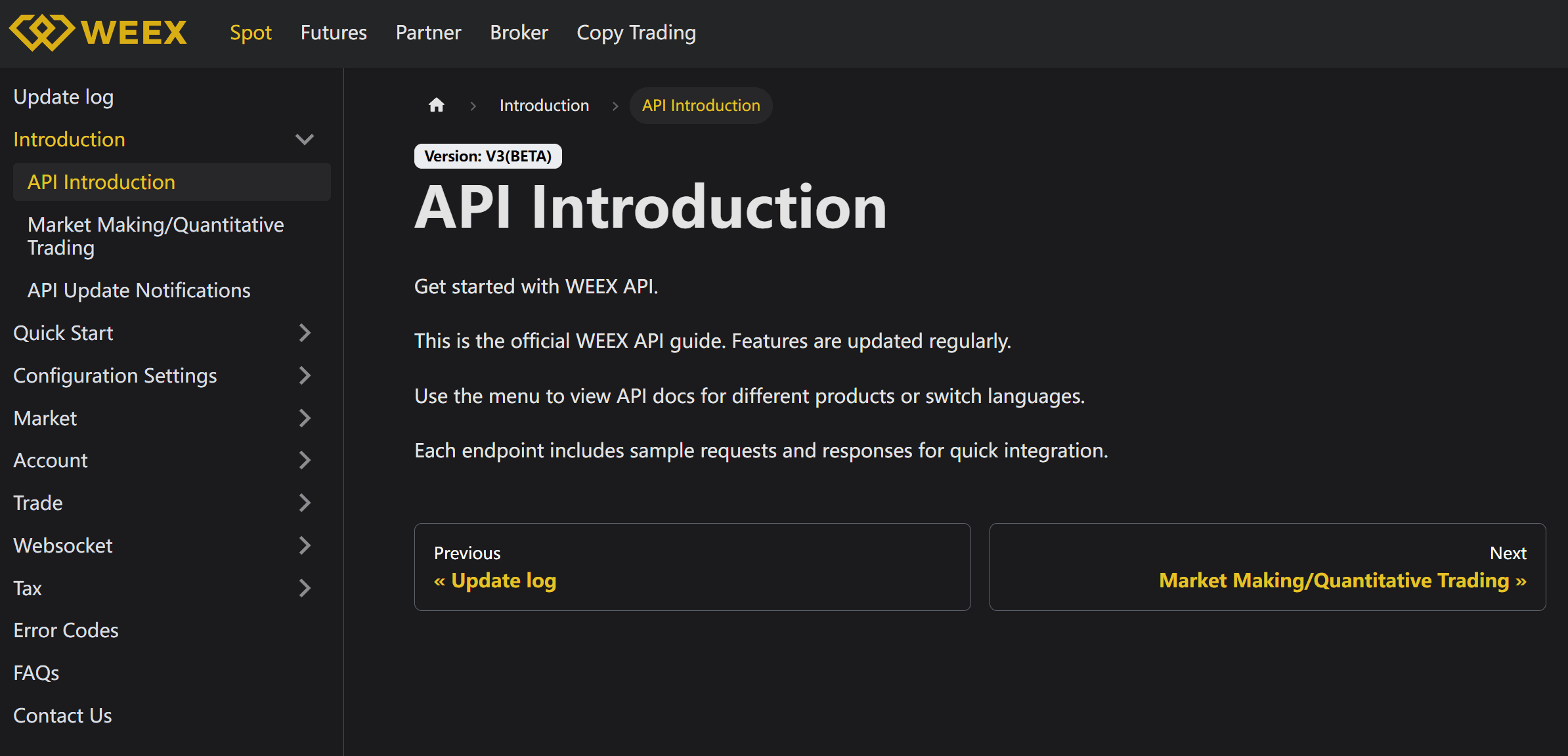
When creating API access, users should configure permissions based on their actual needs. For example, a market monitoring tool may only require public data access, while an automated trading system may require spot or futures trading permissions.
Using unnecessary permissions increases security risks. A program should only have access to the functions it actually needs.
-- Price
Step 2: Collect Market Data and Build Trading Logic
A trading bot needs accurate data before it can make decisions. Depending on the strategy, the program may use price data, candlestick information, trading volume, or order book updates.
For example, a grid trading bot needs continuous price updates to determine when the market reaches different grid levels. An arbitrage bot needs fast market information to compare prices between different platforms.
When connecting market data through an API, technical details matter. Developers need to use the correct trading pair format, such as BTCUSDT, and handle API responses properly. After receiving data, the strategy determines what action should happen.
A simple strategy may only contain a few rules, while more advanced systems may combine multiple indicators or statistical models. The important point is that complexity does not always mean better performance. A strategy that can be clearly explained and tested is usually easier to maintain.
Step 3: Execute Orders and Handle Trading Errors
After a strategy generates a signal, the trading bot needs to send an order request.
A typical workflow looks like this:
The program identifies a trading opportunity, creates an order request, sends it through the API, and receives the execution result.
In real trading environments, execution is not always perfect. Orders may fail because of network problems, incorrect parameters, insufficient balance, or market changes. For this reason, a professional trading bot needs error-handling mechanisms.
When integrating with WEEX API, developers should pay attention to order management details. For example, order identifiers such as newClientOrderId should be managed correctly to avoid conflicts between different orders.
A stable trading system is not only about sending orders successfully. It must also know how to respond when something goes wrong.
Step 4: Test Your Trading Bot Before Using Real Funds
One of the biggest mistakes beginners make is moving directly from coding to live trading. A strategy that looks profitable in historical testing may perform differently in real markets because of execution delays, fees, liquidity changes, and unexpected volatility. A more practical approach is to test gradually.
First, evaluate the strategy with historical data.
Then, test whether the program can correctly receive data and generate signals.
Finally, run the system with a small amount of capital and compare real performance with backtesting results.
During testing, traders should pay attention not only to returns but also to drawdown, trading frequency, and execution quality.
How to Keep a Crypto Trading Bot Secure?
Security is a critical part of automated trading because the bot needs access to exchange accounts.
The most important rule is protecting API credentials. API Keys and Secret Keys should never be shared publicly or stored in insecure locations.
Users should also avoid giving trading programs unnecessary permissions. For example, a bot designed for order execution usually does not need withdrawal access.
When using WEEX API or other exchange APIs, developers should follow basic security practices:
Use only required API permissions, protect Secret information, monitor API activity, and remove compromised credentials immediately.
A secure trading system depends not only on code quality but also on proper account management.
Common Challenges When Building Crypto Trading Bots
Many beginners focus heavily on automation but underestimate the importance of strategy quality.
A fast trading bot cannot compensate for a weak strategy. If the rules are unsuitable for current market conditions, automation may simply execute incorrect decisions more efficiently.
Trading costs are another important factor. Strategies with frequent transactions must consider fees, spreads, and slippage. A strategy that appears profitable before costs may produce very different results after real trading expenses are included.
Another common problem is building systems that are too complicated too early. Beginners often add too many indicators or functions before proving whether the basic strategy works.
A better approach is to start with a simple model, test it carefully, and improve it gradually.
Is Building a Crypto Trading Bot Worth It?
Building a trading bot can be valuable for users who want to learn quantitative trading, automate repetitive tasks, or create systematic trading workflows.
However, automation does not remove market uncertainty. A successful trading system still requires:
A reasonable strategy, reliable data, stable execution, and effective risk control.
The purpose of a trading bot is not to replace decision-making completely, but to help traders execute a well-tested plan more consistently.
Conclusion
Building a crypto trading bot requires more than connecting an API and writing code.
A complete system needs market data, strategy logic, API integration, testing, and security management.
WEEX API can provide the technical connection between trading programs and exchange services, allowing developers to build automated workflows. However, the API itself does not determine trading performance.
For beginners, the most practical approach is to start with simple strategies, test carefully, manage API security, and gradually improve the system based on real performance.
This content is provided for general informational purposes only and doesn't constitute financial, investment, legal, or tax advice. Any events, rewards, online promotions, or related information mentioned herein should not be considered a recommendation, solicitation, or invitation to purchase, sell, trade, or otherwise deal in any crypto assets. Crypto assets are highly volatile and may result in loss. The availability of WEEX services, products, and related events may vary by region. You are responsible for ensuring that your participation is in accordance with applicable local laws and regulations.
You may also like

Bybit Japan Service Termination: The Complete Timeline and What Happens on July 22, 2026

Bitcoin Price Over 10 Years: Historical Recap and Long-Horizon Outlook
JazzCash vs Easypaisa for P2P Crypto Trading in Pakistan: Which Should You Use?
Common P2P Scams in Pakistan: How to Trade PKR Safely on WEEX

Common P2P Scams in Pakistan: How to Trade PKR Safely on WEEX

How to Buy Crypto in Pakistan With PKR After the Bank Rule Change
How to Buy USDT with PKR on WEEX P2P: A Step-by-Step Guide for Pakistan
How to Sell USDT for PKR Safely on WEEX P2P
How to Buy USDT with Easypaisa in Pakistan: P2P Trading and Safety Guide
Is WEEX P2P Safe in Pakistan? What PKR Traders Should Know

How to Choose a Reliable P2P Merchant for PKR Trades in Pakistan

Can Bitcoin Reach $80,000 in August? BTC Price Prediction, Key Resistance Levels, and Market Outlook
Michael Saylor Sold 1,690 Bitcoin at a Loss: What Strategy Inc.'s August Bitcoin Sale Actually Reveals
MSTR Stock Surges 12% in a Single Session: What Strategy Inc's Bitcoin Treasury Model Actually Amplifies

Bitcoin Security or Commodity? How CLARITY Act Could Impact BTC
Crypto Security vs Commodity: What CLARITY Act Means for Bitcoin and Tokens

Bitcoin Has Broken $66,000, $70,000, and $75,000 in Three Days: What Sequential Resistance Breaks Actually Mean
Bitcoin at $75,000: Anatomy of a $3 Billion Short Squeeze

XRP Price Surges With Bitcoin and Ethereum: What Is Driving the August 20 Crypto Rally

Is WEEX Safe? Verify the Reserves and 1,000 BTC Fund Yourself
Is Bitcoin Overvalued After CLARITY Act? 2026 BTC Valuation Analysis
Bitcoin Price Surges 11% Past $70,000 for the First Time Since June: What the Three Catalysts Actually Drove the Move

Bitcoin Price Prediction 2026: What Reclaiming $70,000 Means for the Path Back to $126,000

Is the Trump $500 Billion XST Investment Real? What the Viral Claim About XSolut and Nvidia Actually Is
How to Earn WXT Rewards with WEEX Trade to Earn S6 Event
How to Earn WXT Rewards with WEEX Trade to Earn S6 Futures Event
Crypto Broker vs Stock Broker: What Is the Difference and Which Do You Need
How to Use Crypto Trading APIs? A Beginner’s Guide
Crypto Quantitative Trading Tools: How Data, Backtesting, and APIs Build Automated Strategies
How Much Money Do You Need to Start Crypto Quantitative Trading?
Bybit Japan Service Termination: The Complete Timeline and What Happens on July 22, 2026
Bitcoin Price Over 10 Years: Historical Recap and Long-Horizon Outlook
JazzCash vs Easypaisa for P2P Crypto Trading in Pakistan: Which Should You Use?
Common P2P Scams in Pakistan: How to Trade PKR Safely on WEEX
Common P2P Scams in Pakistan: How to Trade PKR Safely on WEEX
How to Buy Crypto in Pakistan With PKR After the Bank Rule Change
Contents
Popular coins
Latest articles