
Crypto Security vs Commodity: What CLARITY Act Means for Bitcoin and Tokens

 Prefer us on Google

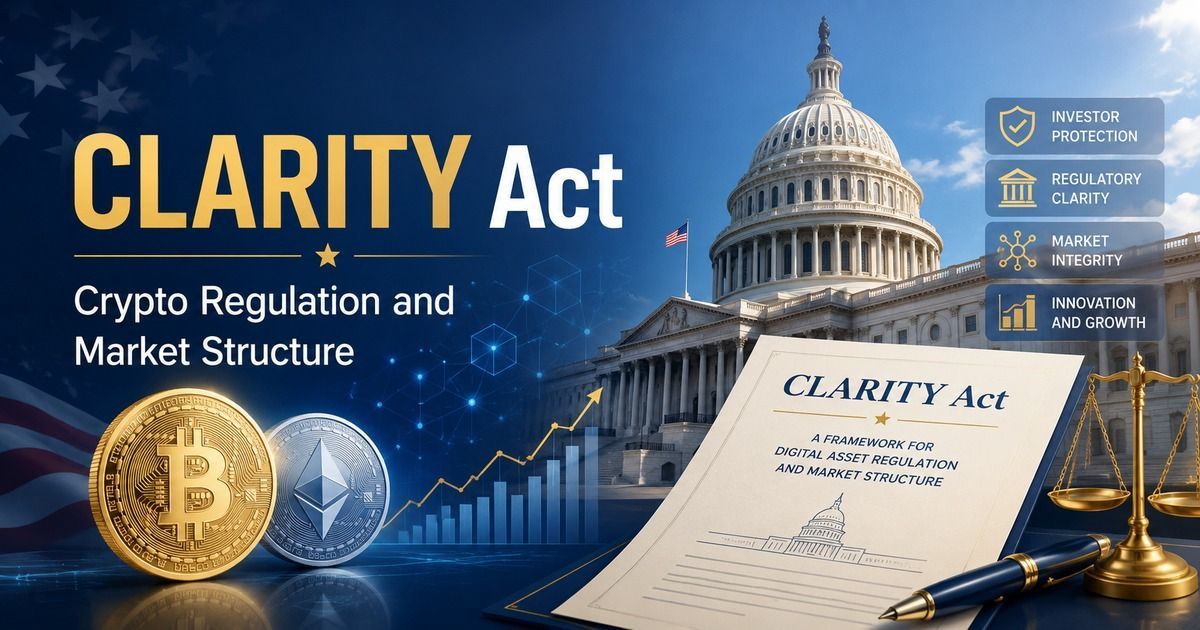
Crypto regulation has long been stuck on one basic question: should a token be treated like a security or a commodity? That uncertainty has affected exchanges, developers, and large investors that want clearer rules before expanding exposure to Bitcoin, Ethereum, and other digital assets. The U.S. CLARITY Act has pushed the debate back to the center of the market by trying to draw firmer lines between SEC and CFTC authority. For BTC especially, the issue matters because institutional adoption is already growing through spot ETFs, corporate treasuries, and regulated trading products. This article explains what the bill is trying to do, why Bitcoin is often treated differently, and what investors should watch next.
At a Glance
- The CLARITY Act focuses on who regulates digital assets, mainly the SEC or the CFTC.
- BTC is generally seen as closer to a commodity because it has no central issuer and a long operating history.
- Clearer rules could help exchanges, brokers, and institutions assess compliance more consistently.
- Not every token benefits equally; decentralized networks may fare better than highly centralized or low-transparency projects.
Why Does It Matter Whether Crypto Is a Security or Commodity?
For investors, classification is not just a legal label. It can affect where a token trades, what disclosures are required, how a project raises capital, and whether institutions feel comfortable participating. If a token is treated as a security, the project and platforms listing it may face a much stricter compliance framework. If it is treated more like a commodity, the market structure can look different, especially in spot and derivatives trading.
| Classification | Main Regulator | Potential Impact |
|---|---|---|
| Security | SEC | More disclosure requirements and securities compliance |
| Commodity | CFTC | Commodity market framework and derivatives oversight |
A token classified as a security may face registration requirements, ongoing securities law obligations, and listing restrictions for exchanges that are not set up to operate under securities rules. That can affect liquidity, trading volume, and market access. A commodity-style classification can offer clearer trading rules and may be easier for institutions to fit into existing portfolio and risk frameworks. That distinction is one reason the CLARITY Act matters so much: it aims to reduce the regulatory gap that has left many crypto businesses operating in a gray zone.
What Is the CLARITY Act and How Could It Change Crypto Regulation?
The CLARITY Act is not mainly about inventing a brand-new asset category. Its bigger goal is more practical: setting clearer rules for deciding which regulator has authority over a digital asset or related market activity. That matters because the SEC and CFTC approach markets differently, and the crypto industry has spent years navigating the overlap.
Defining SEC and CFTC Responsibilities
The SEC focuses on securities markets and investor disclosures. The CFTC oversees commodity markets and has historically treated Bitcoin as a commodity for derivatives purposes. The CLARITY Act attempts to create clearer boundaries between those roles. For investors, that could mean fewer surprises around enforcement and a more understandable framework for judging risk across the blockchain ecosystem.
Establishing Rules for Exchanges and Crypto Businesses
Exchanges, brokers, and digital asset issuers have all been affected by uncertain classification standards. If a law offers more predictable compliance rules, platforms such as Coinbase, Robinhood, and other trading venues may have a clearer basis for deciding which assets they can list and how they should structure custody, reporting, and market access. That could improve liquidity conditions over time, although it would not remove compliance costs.
Improving Investor Protection
The bill also matters because clearer rules often come with clearer disclosure expectations. That could include more transparency around tokenomics, governance control, circulating supply, unlock schedule, and the role of insiders or foundations. Better disclosure does not make a token safe, but it gives investors a better chance to compare projects on facts rather than marketing.
-- Price
Bitcoin vs Other Tokens: Who Could Benefit From Clearer Rules?
Not all digital assets sit in the same regulatory position. BTC already has a stronger case for commodity-like treatment than many newer tokens, while other sectors still face open questions tied to governance, issuance, and control.
| Asset Type | Potential Regulatory Impact |
|---|---|
| Bitcoin (BTC) | Lower uncertainty due to commodity-like status |
| Ethereum (ETH) | Market watches classification under future rules |
| L1 Tokens (SOL, etc.) | Could benefit from clearer decentralization standards |
| L2 Tokens | Depends on network structure and governance |
| DeFi Tokens | Depends on decentralization and control mechanisms |
| Meme Coins | Higher pressure from disclosure requirements |
That table shows why the market often responds differently across sectors. A large-cap asset with deeper liquidity and broader exchange support may benefit more quickly from regulatory clarity than a token with unclear governance or thin trading volume. In practice, the CLARITY Act could make the biggest difference for assets that are widely traded but still legally uncertain.
Why Bitcoin Is Often Viewed Differently From Other Crypto Assets
Bitcoin stands apart because its network is highly decentralized, it has no central issuer, and its supply mechanism is fixed by protocol rather than managed by a company. It also has the longest operating history among major cryptocurrencies. These traits help explain why BTC is often discussed differently from tokens launched by foundations, venture-backed teams, or tightly governed protocols.
That distinction is especially relevant in 2026 because institutional participation in Bitcoin has become more visible. According to Pantera Capital, about 17.9% of BTC holdings were in the hands of publicly traded and private companies, ETFs, and countries by December 15, 2026. Amberdata reported Bitcoin ETF assets under management near $135 billion, with BlackRock holding about $72 billion, or 53% market share, and Fidelity about $33 billion, or 24%. These numbers suggest that BTC is increasingly treated as a mainstream portfolio allocation rather than only a speculative trade.
The CFTC’s historical view of Bitcoin as a commodity in derivatives markets also gives BTC a stronger starting point than many altcoins. By contrast, the CLARITY Act could be more important for ETH, L1 tokens, L2 tokens, DeFi governance assets, and meme coins where the classification debate is still more active.
How Could CLARITY Act Impact Crypto Markets?
The first likely impact is on confidence, not certainty. When large investors can better understand the rulebook, they are more willing to build products, expand custody, and allocate capital. That does not guarantee higher prices, but it can improve market structure.
More Institutional Participation
Institutional capital already plays a larger role in BTC than retail sentiment alone. Investing.com reported that when Bitcoin crossed $80,000 on May 4, 2026, U.S. spot Bitcoin ETFs had logged nine consecutive trading days of net inflows totaling about $2.7 billion over three weeks. That kind of ETF absorption matters because institutions tend to respond strongly to regulatory clarity. Clearer law could help asset managers, banks, and trading firms evaluate digital asset exposure with less headline risk.
More Predictable Token Listings
Exchanges may benefit from clearer standards for assessing whether a token belongs under securities-style obligations or commodity-style trading treatment. In simple terms, listing decisions could become more rule-based and less dependent on guessing future enforcement. That would matter for liquidity access across the market, especially for mid-cap tokens that struggle to maintain broad listings.
Growth of Blockchain Infrastructure
Clearer regulation can also support parts of the market beyond spot trading. L1 and L2 networks, custody providers, tokenization platforms, and compliant DeFi-facing infrastructure may all benefit if legal boundaries become easier to understand. The recent U.S. policy sequence also supports that view. On August 19, 2026, Trump met with crypto executives and urged Congress to advance the CLARITY Act, reinforcing the market’s belief that crypto regulation is moving toward more detailed rulemaking rather than broad political slogans alone.
Risks and Challenges Investors Should Watch
It is easy to assume that clearer rules will help the whole market equally. That is unlikely. Regulation usually creates winners and losers.
Legislative Uncertainty
The CLARITY Act still faces Senate process risk, political disagreement, and timeline uncertainty. Even with support from the White House and industry leaders, bills can be revised, delayed, or weakened. Investors should also watch whether administrative action by the SEC and CFTC moves faster than Congress. In some cases, practical enforcement direction matters more in the short term than the bill itself.
Not Every Token Will Benefit
Regulatory clarity may favor projects with stronger disclosures, cleaner governance, and more decentralized network design. It may create more pressure on anonymous teams, low-transparency meme coins, and highly centralized tokens where supply, treasury control, or governance power remains concentrated. In those cases, regulation can expose weaknesses in tokenomics rather than support them.
Bitcoin and Crypto Regulation Outlook in 2026
For beginners and experienced traders alike, the best approach is to track a small set of indicators instead of reacting to every headline. BTC remains the clearest case study because it sits at the intersection of commodity treatment, ETF demand, and institutional adoption.
| Factor | Why It Matters |
|---|---|
| CLARITY Act progress | Determines regulatory framework |
| SEC/CFTC actions | Shows enforcement direction |
| Institutional adoption | Measures market confidence |
| Exchange compliance | Affects liquidity access |
There is also a useful screening framework investors can apply before evaluating any crypto asset. Ask whether the network is decentralized, whether a central team controls supply or governance, whether credible disclosures are available, and whether demand comes from real usage or mainly speculation. Those questions can reveal regulatory risk well before a formal classification decision arrives.
For BTC specifically, institutional signals remain important. The SEC’s public participation in industry events, including its chairman’s scheduled appearance at Bitcoin 2026 in April, suggests ongoing contact between regulators and the market rather than complete disengagement. At the same time, the available research still does not provide a full 2026 picture on tax policy or all enforcement details, so investors should avoid assuming that every major regulatory question is already settled.
Security-versus-commodity classification remains one of the most important issues in crypto because it affects who can issue, trade, custody, and promote digital assets under U.S. law. Bitcoin may have less uncertainty than most tokens, but the broader market still depends on how lawmakers and regulators define decentralization, disclosure, and market structure. For investors, the smartest move is to treat regulation as part of the investment thesis, alongside adoption, liquidity, token design, and long-term network utility.
This content is provided for general informational purposes only and doesn't constitute financial, investment, legal, or tax advice. Any events, rewards, online promotions, or related information mentioned herein should not be considered a recommendation, solicitation, or invitation to purchase, sell, trade, or otherwise deal in any crypto assets. Crypto assets are highly volatile and may result in loss. The availability of WEEX services, products, and related events may vary by region. You are responsible for ensuring that your participation is in accordance with applicable local laws and regulations.
You may also like

Bybit Japan Service Termination: The Complete Timeline and What Happens on July 22, 2026

Bitcoin Price Over 10 Years: Historical Recap and Long-Horizon Outlook

JazzCash vs Easypaisa for P2P Crypto Trading in Pakistan: Which Should You Use?
Common P2P Scams in Pakistan: How to Trade PKR Safely on WEEX

Common P2P Scams in Pakistan: How to Trade PKR Safely on WEEX

How to Buy Crypto in Pakistan With PKR After the Bank Rule Change
How to Buy USDT with PKR on WEEX P2P: A Step-by-Step Guide for Pakistan
How to Sell USDT for PKR Safely on WEEX P2P
How to Buy USDT with Easypaisa in Pakistan: P2P Trading and Safety Guide
Is WEEX P2P Safe in Pakistan? What PKR Traders Should Know

How to Choose a Reliable P2P Merchant for PKR Trades in Pakistan

Can Bitcoin Reach $80,000 in August? BTC Price Prediction, Key Resistance Levels, and Market Outlook
Michael Saylor Sold 1,690 Bitcoin at a Loss: What Strategy Inc.'s August Bitcoin Sale Actually Reveals
MSTR Stock Surges 12% in a Single Session: What Strategy Inc's Bitcoin Treasury Model Actually Amplifies
Bitcoin Security or Commodity? How CLARITY Act Could Impact BTC

Bitcoin Has Broken $66,000, $70,000, and $75,000 in Three Days: What Sequential Resistance Breaks Actually Mean
Bitcoin at $75,000: Anatomy of a $3 Billion Short Squeeze
XRP Price Surges With Bitcoin and Ethereum: What Is Driving the August 20 Crypto Rally

Is WEEX Safe? Verify the Reserves and 1,000 BTC Fund Yourself
Is Bitcoin Overvalued After CLARITY Act? 2026 BTC Valuation Analysis
Bitcoin Price Surges 11% Past $70,000 for the First Time Since June: What the Three Catalysts Actually Drove the Move

Bitcoin Price Prediction 2026: What Reclaiming $70,000 Means for the Path Back to $126,000
Is the Trump $500 Billion XST Investment Real? What the Viral Claim About XSolut and Nvidia Actually Is
How to Earn WXT Rewards with WEEX Trade to Earn S6 Event
How to Earn WXT Rewards with WEEX Trade to Earn S6 Futures Event
Crypto Broker vs Stock Broker: What Is the Difference and Which Do You Need
How to Use Crypto Trading APIs? A Beginner’s Guide
How to Build a Crypto Trading Bot With WEEX API: A Beginner’s Guide
Crypto Quantitative Trading Tools: How Data, Backtesting, and APIs Build Automated Strategies
How Much Money Do You Need to Start Crypto Quantitative Trading?
Bybit Japan Service Termination: The Complete Timeline and What Happens on July 22, 2026
Bitcoin Price Over 10 Years: Historical Recap and Long-Horizon Outlook
JazzCash vs Easypaisa for P2P Crypto Trading in Pakistan: Which Should You Use?
Common P2P Scams in Pakistan: How to Trade PKR Safely on WEEX
Common P2P Scams in Pakistan: How to Trade PKR Safely on WEEX
How to Buy Crypto in Pakistan With PKR After the Bank Rule Change
Contents
Popular coins
Latest articles