
How Much Money Do You Need to Start Crypto Quantitative Trading?

 Prefer us on Google
Many beginners assume that quantitative trading requires a large amount of capital, expensive software, or professional infrastructure.
That is not always true.
For individuals, the cost of starting crypto quantitative trading depends on the goal. Building and testing a strategy requires much less money than running a large-scale automated trading system.
The more important question is not: “How much money can I invest?”
but: “How much money do I need to properly test and operate my strategy?”
A practical quantitative trading journey usually includes four stages: Learning → Backtesting → Small-scale testing → Larger deployment
Each stage requires different resources.
Can You Start Crypto Quantitative Trading With a Small Amount of Money?
Yes, but expectations should be realistic. A beginner does not need thousands of dollars just to learn how quantitative trading works. During the early stage, most work happens without real capital:
- Learning Python or strategy concepts;
- Collecting market data;
- Building simple models;
- Running historical backtests.
At this stage, the main investment is time rather than money.
For example, a beginner can create a BTCUSDT trend-following strategy and test it using historical data before risking any real funds.
However, when moving from testing to live trading, some capital is needed because real markets involve factors that backtests cannot fully reproduce, such as execution delays, liquidity changes, and trading fees.
A Realistic Starting Capital Range for Different Goals
There is no universal amount required for quantitative trading. The suitable amount depends on what you want to achieve.
| Goal | Suggested Capital Range | Suitable Scenario |
|---|---|---|
| Learning and testing | $0–$100 | Backtesting strategies, learning APIs, paper trading |
| First live experiments | $100–$500 | Testing simple strategies with small positions |
| Developing a stable personal system | $500–$5,000 | Running strategies and evaluating real performance |
| Larger-scale deployment | $5,000+ | More flexible position sizing and multiple strategies |
These numbers are not profit targets or guarantees. They are practical ranges for understanding the difference between learning, testing, and operating a system.
Scenario 1: Learning Quantitative Trading With Almost No Capital
For beginners, the first goal should be understanding the system rather than making money. A user with $0–$100 can already learn important parts of quantitative trading:
- How market data works;
- How indicators are calculated;
- How strategies are backtested;
- How APIs connect programs with exchanges.
For example, a beginner may build a simple moving average strategy: “When the short-term average crosses above the long-term average, generate a buy signal.”
The strategy can first be tested with historical BTC data.
At this stage, adding more money does not improve learning speed. Understanding the logic behind the system is more important.
-- Price
Scenario 2: Starting Live Testing With $100–$500
After a strategy has been tested, some traders choose to run it with a small amount of real capital.
A $100–$500 range is often enough to test whether a system works in real market conditions.
The purpose is not to generate significant income.
Instead, users can observe:
- Whether orders execute correctly;
- Whether fees affect results;
- Whether the strategy behaves differently from backtests.
For example, a grid trading bot may perform well in historical data but produce different results in live trading because of market volatility and transaction costs.
Small-scale testing helps identify these differences without exposing too much capital.
Scenario 3: Building a More Complete Personal Quant System With $500–$5,000
For users who want to operate multiple strategies, a larger capital base provides more flexibility. For example:
A trader may allocate part of the account to:
- BTC trend strategies;
- ETH grid strategies;
- Market-neutral strategies.
With more capital, users can better manage position sizes and avoid making every trade too small.
However, larger capital does not automatically create better performance. A poorly tested strategy with $5,000 can still lose money faster than a well-designed strategy with $500. The quality of the system matters more than the account size.
Why Trading Fees Matter in Quantitative Trading
Many beginners underestimate transaction costs.
Unlike long-term investors, quantitative strategies may execute many trades. Even small fees can significantly affect results over time.
For example, a strategy that trades several times per day must consider:
- Trading fees;
- Spread;
- Slippage;
- Funding costs for futures strategies.
According to WEEX public fee information, maker fees and taker fees are currently different, with maker fees at 0.02% and taker fees at 0.08%. Traders building automated strategies should include these costs when evaluating performance.
A strategy that looks profitable before fees may become much less effective after realistic trading costs are included.
How Much Does the Technology Cost?
Capital is only one part of quantitative trading costs.
A personal system may also involve:
Data Costs
Many basic strategies can start with publicly available market data.
More advanced strategies may require specialized datasets.
Server Costs
A trading bot running 24/7 may require a cloud server.
For simple systems, a low-cost server may be enough. More complex systems may require stronger infrastructure.
Development Costs
Users who build their own systems need time to learn programming, testing, and maintenance.
For example, connecting a trading bot to an exchange usually requires:
- API documentation review;
- API Key setup;
- Market data connection;
- Order testing.
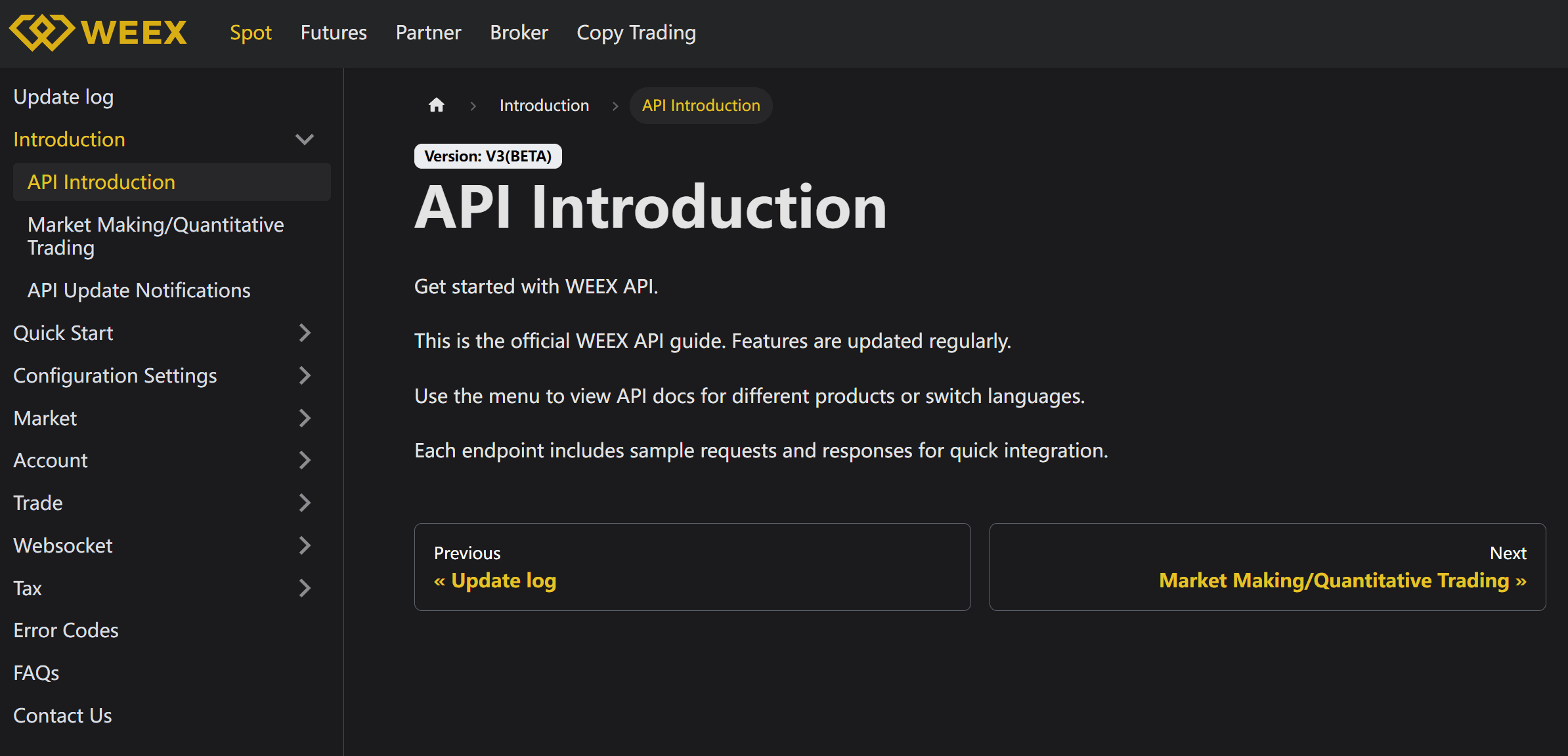
Developers can use the WEEX API to connect their own trading programs with exchange services. The API provides technical access, but the strategy design and risk management remain the responsibility of the developer.
Does More Capital Mean Higher Quantitative Trading Returns?
Not necessarily. More capital provides advantages, but it also introduces new challenges.
A larger account may have:
- Greater flexibility in position sizing;
- Better ability to diversify strategies.
However, it may also face:
- Larger drawdowns;
- More execution challenges;
- Higher psychological pressure.
Professional traders usually focus on risk-adjusted performance rather than simply increasing capital.
Important metrics include:
- Maximum drawdown;
- Risk per trade;
- Strategy consistency;
- Execution quality.
Common Mistake: Using Too Much Money Too Early
One of the biggest mistakes beginners make is moving directly from backtesting to large-scale trading.
A backtest cannot fully simulate:
- Market changes;
- Order execution problems;
- API failures;
- Unexpected volatility.
A better approach is:
Start small → Compare live results with backtests → Improve the system → Increase gradually.
This process reduces the cost of mistakes.
Conclusion
There is no fixed amount of money required to start crypto quantitative trading.
A beginner can start learning with almost no capital, test strategies with a few hundred dollars, and gradually increase funds after building confidence in the system.
The most important investment is not only money but also:
- Understanding market data;
- Building reliable strategies;
- Testing realistic conditions;
- Managing risk.
Quantitative trading is not about having the largest account. It is about building a system that can be tested, controlled, and improved over time.
This content is provided for general informational purposes only and doesn't constitute financial, investment, legal, or tax advice. Any events, rewards, online promotions, or related information mentioned herein should not be considered a recommendation, solicitation, or invitation to purchase, sell, trade, or otherwise deal in any crypto assets. Crypto assets are highly volatile and may result in loss. The availability of WEEX services, products, and related events may vary by region. You are responsible for ensuring that your participation is in accordance with applicable local laws and regulations.
You may also like

Bybit Japan Service Termination: The Complete Timeline and What Happens on July 22, 2026
Bitcoin Price Over 10 Years: Historical Recap and Long-Horizon Outlook
JazzCash vs Easypaisa for P2P Crypto Trading in Pakistan: Which Should You Use?
Common P2P Scams in Pakistan: How to Trade PKR Safely on WEEX

Common P2P Scams in Pakistan: How to Trade PKR Safely on WEEX

How to Buy Crypto in Pakistan With PKR After the Bank Rule Change
How to Buy USDT with PKR on WEEX P2P: A Step-by-Step Guide for Pakistan
How to Sell USDT for PKR Safely on WEEX P2P
How to Buy USDT with Easypaisa in Pakistan: P2P Trading and Safety Guide
Is WEEX P2P Safe in Pakistan? What PKR Traders Should Know
How to Choose a Reliable P2P Merchant for PKR Trades in Pakistan

Can Bitcoin Reach $80,000 in August? BTC Price Prediction, Key Resistance Levels, and Market Outlook
Michael Saylor Sold 1,690 Bitcoin at a Loss: What Strategy Inc.'s August Bitcoin Sale Actually Reveals
MSTR Stock Surges 12% in a Single Session: What Strategy Inc's Bitcoin Treasury Model Actually Amplifies

Bitcoin Security or Commodity? How CLARITY Act Could Impact BTC
Crypto Security vs Commodity: What CLARITY Act Means for Bitcoin and Tokens
Bitcoin Has Broken $66,000, $70,000, and $75,000 in Three Days: What Sequential Resistance Breaks Actually Mean
Bitcoin at $75,000: Anatomy of a $3 Billion Short Squeeze
XRP Price Surges With Bitcoin and Ethereum: What Is Driving the August 20 Crypto Rally

Is WEEX Safe? Verify the Reserves and 1,000 BTC Fund Yourself
Is Bitcoin Overvalued After CLARITY Act? 2026 BTC Valuation Analysis
Bitcoin Price Surges 11% Past $70,000 for the First Time Since June: What the Three Catalysts Actually Drove the Move

Bitcoin Price Prediction 2026: What Reclaiming $70,000 Means for the Path Back to $126,000

Is the Trump $500 Billion XST Investment Real? What the Viral Claim About XSolut and Nvidia Actually Is
How to Earn WXT Rewards with WEEX Trade to Earn S6 Event
How to Earn WXT Rewards with WEEX Trade to Earn S6 Futures Event
Crypto Broker vs Stock Broker: What Is the Difference and Which Do You Need
How to Use Crypto Trading APIs? A Beginner’s Guide
How to Build a Crypto Trading Bot With WEEX API: A Beginner’s Guide
Crypto Quantitative Trading Tools: How Data, Backtesting, and APIs Build Automated Strategies
Bybit Japan Service Termination: The Complete Timeline and What Happens on July 22, 2026
Bitcoin Price Over 10 Years: Historical Recap and Long-Horizon Outlook
JazzCash vs Easypaisa for P2P Crypto Trading in Pakistan: Which Should You Use?
Common P2P Scams in Pakistan: How to Trade PKR Safely on WEEX
Common P2P Scams in Pakistan: How to Trade PKR Safely on WEEX
How to Buy Crypto in Pakistan With PKR After the Bank Rule Change
Contents
Popular coins
Latest articles