
What Is Minswap (MIN)? A Complete Guide

 Prefer us on Google
Minswap has established itself as a foundational decentralized exchange (DEX) within the Cardano ecosystem, distinguished by its commitment to permissionless trading and community-driven governance. The platform operates on principles of open access and equitable value distribution, creating a financial infrastructure that prioritizes user participation over centralized control.
Setting itself apart from conventional DeFi projects, Minswap deliberately avoided venture capital funding, opting instead for community-focused distribution methods. This strategic approach has fostered strong user loyalty while ensuring the platform's growth remains aligned with community interests rather than investor returns.
The exchange enables seamless token swapping and liquidity provision, allowing users to earn proportional rewards from transaction fees. Through its innovative mechanisms and community-first design, Minswap continues to attract users exploring decentralized finance on the Cardano network while introducing novel concepts that advance the ecosystem's capabilities.
What is Minswap?
Minswap functions as a fully permissionless decentralized exchange where users can trade various token pairs without intermediary approval. Each transaction incurs a small fee that's distributed to liquidity providers, creating a sustainable economic model that rewards active participants.
The platform's fundamental differentiator lies in its equitable value distribution. Rather than concentrating benefits among private investors, Minswap ensures that value generated through protocol activity is shared across its entire community, establishing a reputation for transparency and fairness.
What Is Minswap (MIN)?
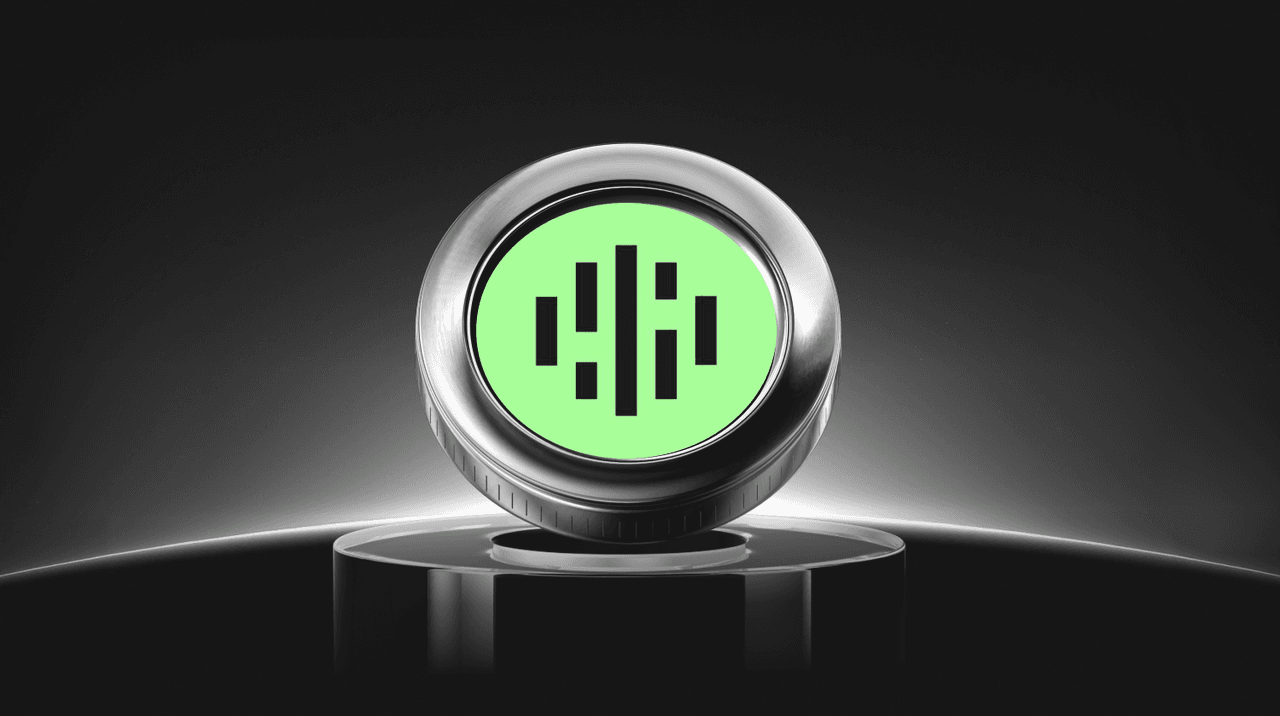
MIN, the native token of the Minswap decentralized exchange, has several utilities in the Cardano ecosystem. MIN tokens can be staked to earn ADA, with yields coming directly from trading fees. Holders of $MIN obtain discounts on trading fees. $MIN also serves as the governance token for Minswap, allowing participants to make decentralized decisions regarding the exchange.
The MIN token distribution model represents a radical departure from conventional approaches. By eliminating venture capital allocations and private investor advantages, Minswap ensured tokens reached genuine community members through transparent and accessible distribution mechanisms.
Minswap has also brought several important ideas to the Cardano ecosystem.
The platform introduced several groundbreaking concepts to Cardano, including:
- Fair Initial Stake Offering (FISO): A novel token distribution method that rewards Cardano stake pool operators and delegators while ensuring fair MIN allocation
- Protocol Owned Liquidity: A sustainability mechanism where the protocol accumulates its own liquidity, reducing dependence on temporary incentives
- Permissionless Listing: Open access for any project to list tokens without gatekeeping or approval processes
- Launch Bowl: A dedicated environment for early-stage projects to bootstrap liquidity organically
- Laminar: An innovative batching solution that enhances efficiency for stake pool operators
Minswap (MIN) Tokenomics
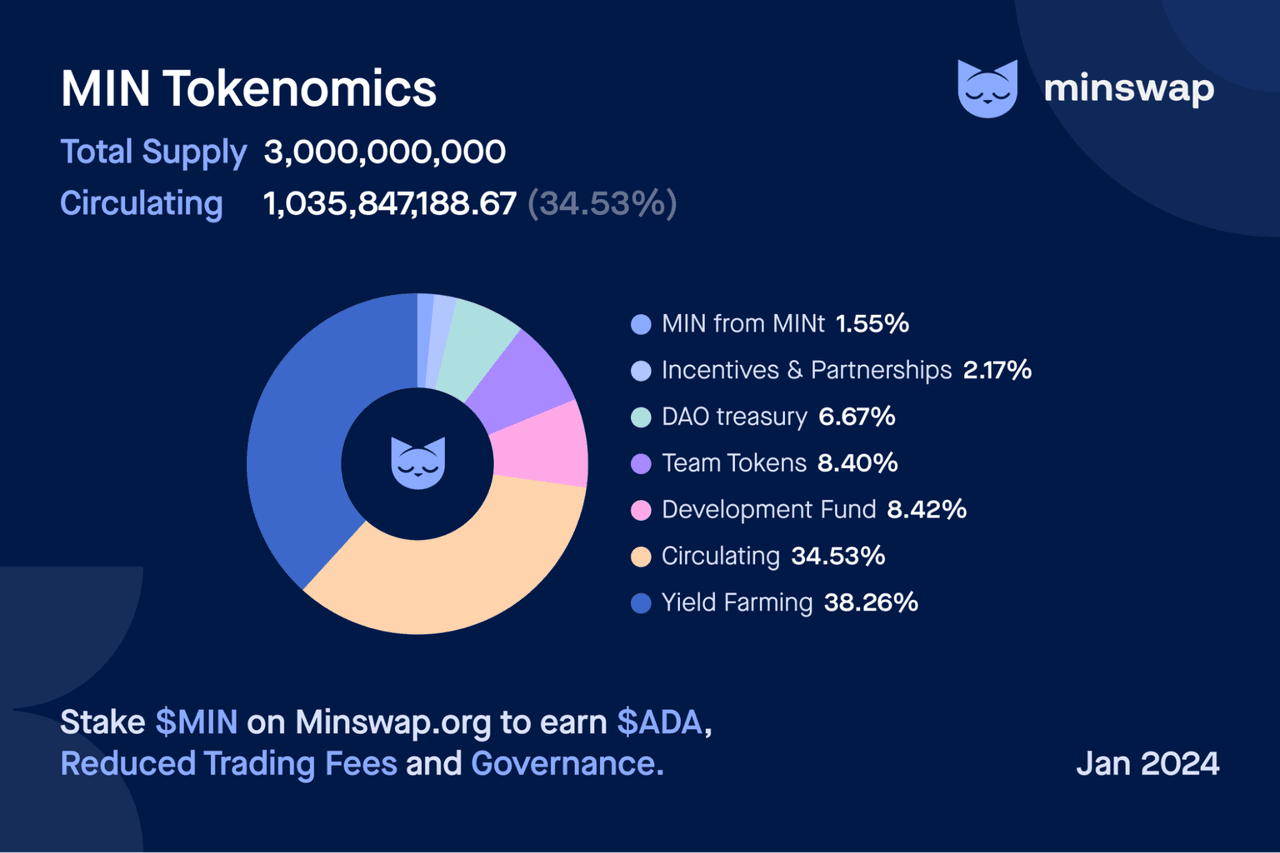
The MIN token serves as the governance and utility backbone of the Minswap ecosystem. With a total supply of 3 billion tokens, the current circulating supply stands at approximately 1.04 billion MIN, representing 34.53% of the total allocation.
The token distribution model emphasizes long-term sustainability and community participation:
- Yield Farming Rewards: 38.26% dedicated to incentivizing liquidity providers
- Circulating Supply: 34.53% allocated for general ecosystem participation
- Development Fund: 8.42% reserved for ongoing protocol development
- Team Allocation: 8.40% vested to ensure team commitment
- DAO Treasury: 6.67% for community-governed initiatives
- Partnership Incentives: 2.17% for strategic ecosystem growth
- MINt Mechanism: 1.55% for specific protocol functions
-- Price
Minswap (MIN) Utility
The MIN token provides multiple practical functions within the ecosystem:
- Staking Rewards: Users can stake MIN tokens to earn ADA rewards derived from protocol trading fees
- Trading Discounts: Token holders receive reduced fees for swapping and liquidity provision activities
- Governance Rights: MIN holders participate in key decisions, including ADA staking strategies and Catalyst participation
- Protocol Incentives: The token facilitates various economic mechanisms that sustain platform operations
Conclusion
Minswap has solidified its position as a fundamental component of Cardano's DeFi landscape through its unwavering commitment to community governance, permissionless access, and equitable value distribution. The platform's innovative approaches to token distribution and protocol-owned liquidity have set new standards for decentralized exchanges.
The MIN token's multifaceted utility—encompassing governance, staking rewards, and fee reduction—creates a sustainable economic model that aligns with the platform's community-focused vision. As Cardano's ecosystem continues to evolve, Minswap's foundation of transparency and user empowerment positions it as a enduring fixture in the decentralized finance landscape.
For participants seeking engagement with a genuinely community-driven exchange, Minswap offers a compelling case study in how decentralized platforms can prioritize fairness while maintaining robust functionality and sustainable growth.
Further Reading
Disclaimer: The opinions expressed in this article are for informational purposes only. This article does not constitute an endorsement of any of the products and services discussed or investment, financial, or trading advice. Qualified professionals should be consulted prior to making financial decisions.
FAQ
Q1: What is Minswap?
A: Minswap operates as a leading decentralized exchange within the Cardano ecosystem, enabling users to trade digital assets without intermediaries while participating in a community-owned liquidity protocol.
Q2: What is the total supply of MIN?
A: The maximum supply of MIN tokens is fixed at 3 billion, with current circulating supply representing approximately 34.5% of the total allocation.
Q3: What are the main utilities of MIN?
A: MIN tokens provide triple utility: holders can stake to earn ADA rewards from protocol fees, receive discounts on trading activities, and participate in governance decisions shaping the platform's future development.
Q4: Why is Minswap popular on Cardano?
A: The platform has gained significant traction due to its fair token distribution model, dedicated community support, and groundbreaking features including the Fair Initial Stake Offering (FISO) and protocol-owned liquidity mechanisms.
This content is provided for general informational purposes only and doesn't constitute financial, investment, legal, or tax advice. Any events, rewards, online promotions, or related information mentioned herein should not be considered a recommendation, solicitation, or invitation to purchase, sell, trade, or otherwise deal in any crypto assets. Crypto assets are highly volatile and may result in loss. The availability of WEEX services, products, and related events may vary by region. You are responsible for ensuring that your participation is in accordance with applicable local laws and regulations.
You may also like
New Zealand Crypto Tax 2025: A Complete Guide

Cardano (ADA) Price Prediction: It's the Right Time to Buy Cardano (ADA)?
Cardano (ADA) Price Prediction for October 2025: Can $ADA Hit $1?
Crypto Coins and Tokens: What’s the Difference?

ADA Price Prediction: Where Could ADA Be by 2025, 2026 and 2030?
How To Make Money in Crypto As A Beginner In 2025?
WEEX Mini App Launch Rewards: Trial Funds, BTC Airdrops, and an iPhone 17 Pro Giveaway Explained
Nvidia Holds a $21 Billion Stake in SpaceX: What That Position Actually Tells Investors About Both Stocks

JazzCash P2P Trading: Merchant Vetting, Payment Limits, and the Hidden Account Freeze Risk
How to Buy USDT with JazzCash in Pakistan Safely in 2026
JazzCash Crypto Guide: How PKR-to-USDT P2P Payments Work in Pakistan
XPL/USDT After the August 25 Unlock: Will Ecosystem Incentives Create Demand or Selling Pressure?

Plasma Released 88.89 Million XPL Tokens Today—Why the Allocation Matters
H/USDT After the Unlock: What Humanity Protocol’s New Supply Means for Traders
Humanity Protocol Unlocked 266 Million H Tokens Today—Where Did They Go?
Who Gets the Next HUMA Tokens? Investors, Team Allocations and the PayFi Unlock Risk
HUMA/USDT Faces an August 26 Token Unlock: Can Existing Liquidity Absorb the New Supply?
What Is DGrid AI (DGAI)? A Guide to the Decentralized AI Network and Its Token
DGAI Has Trading Volume but No Reported Circulating Supply—So What Is Its Real Market Cap?
Why Is DGrid AI (DGAI) Trending After Its Exchange Debut?
TMX/USDT Launch Day: How 200 Million Unlocked Tokens Shape TermMax’s First Market Price
Crude Oil Price Holds Its Iran Premium as Hormuz Stays Shut
MU Stock Drops 8% on Apple China Chip Report: Is the AI Memory Supercycle Story Still Intact?
Nvidia's Longest Losing Streak Since 2022: What the Stock Needs From Wednesday's Earnings to Reverse It
XSolut Coin Extends Its Decline to 7 Straight Days: What Continued Selling Pressure Actually Signals
ADI After Strong Q3 Earnings: Overvalued or Still Undervalued?
PDD Q2 2026 Earnings Miss: Is the Stock Undervalued Now?
MORTY After Viral Meme Rally: Overvalued or Growth Story?
PENGU Breaks Every Major Moving Average for the First Time in a Year: What a Double Digit Rally Actually Means
SPCX Stock Keeps Swinging Around Its $135 IPO Price : What the Lockup Schedule Still Ahead Actually Means
New Zealand Crypto Tax 2025: A Complete Guide
Cardano (ADA) Price Prediction: It's the Right Time to Buy Cardano (ADA)?
Cardano (ADA) Price Prediction for October 2025: Can $ADA Hit $1?
Crypto Coins and Tokens: What’s the Difference?
ADA Price Prediction: Where Could ADA Be by 2025, 2026 and 2030?
How To Make Money in Crypto As A Beginner In 2025?
Contents
Popular coins
Latest articles


