
Crude Oil Price Holds Its Iran Premium as Hormuz Stays Shut

 Prefer us on Google


Oil sold off on the day Washington unveiled the largest Iran sanctions package of the year, then firmed the next morning. That sequence is the market in miniature: the crude oil price is no longer trading on sanctions headlines. It is trading on how many tankers actually clear the Strait of Hormuz.
Brent traded at $92.73 early on Tuesday, August 25, 2026, up 0.6%, with WTI at $85.72, up 0.8%. A day earlier both benchmarks fell roughly 2.5% as the U.S. Treasury rolled out its plan. Both are still up more than 40% year to date.
For anyone holding CRUDEOIL on WEEX, or the CL/USDT perpetual that tracks WTI, the useful question is not whether sanctions are "bullish." It is which supply channel — Iranian barrels or the strait itself — is doing the price work, and what that means for how you size and finance a position. This piece works through the sanctions mechanics, the Hormuz numbers, the $100 debate, and the specific operational traps in trading oil exposure on a 24/7 crypto venue.
Why the Crude Oil Price Fell on the Sanctions Headline
Oil fell because the package was broader than it was sharp.
Treasury Secretary Scott Bessent announced "Operation Economic Outcast" at a Monday press conference, saying the administration would act against every "node, facilitator and network" that has helped Iran move oil and evade sanctions. Countries were given a defined but unspecified timeline to shut down Iran-related activity, with entities facilitating Iranian money laundering or evasion facing a cut-off from the U.S. financial system. Bessent had earlier described the effort as an "economic D-Day." China, the buyer that matters, was explicitly not exempt.
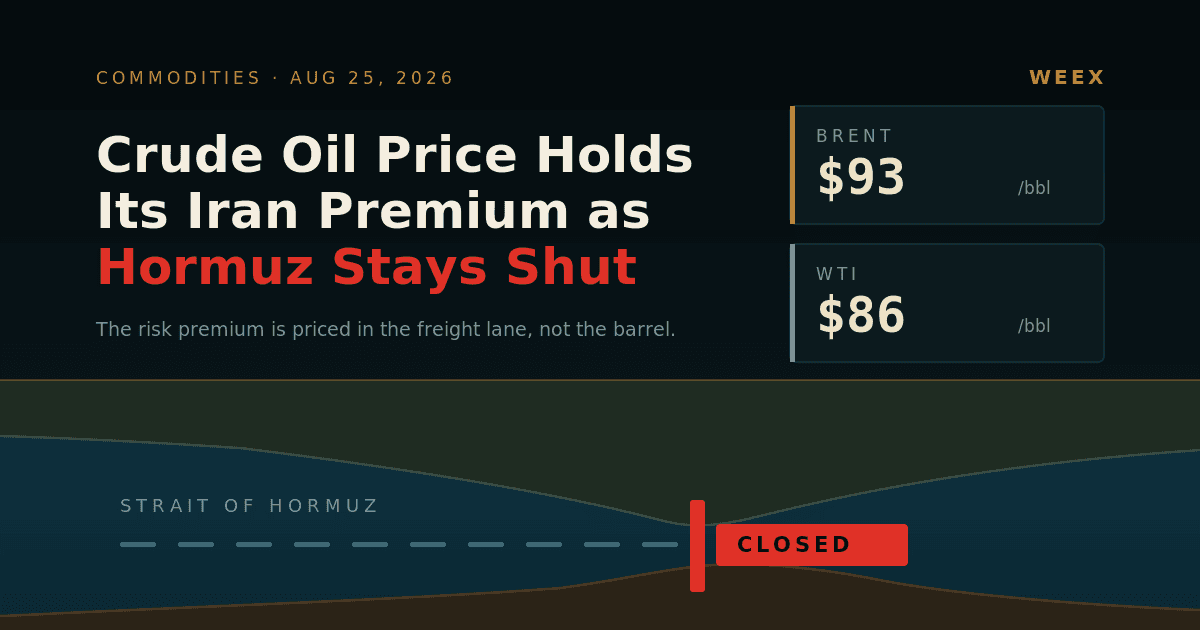
Prices went the other way. By 2:17 p.m. ET Monday, Brent was down 2.56% at $91.97 and WTI down 2.58% at $84.81. The reason sits in what Treasury did not do: it expanded designations without targeting major Chinese banks — the single measure that would most effectively strand Iranian cargoes. Commerzbank's Barbara Lambrecht had flagged that the package would likely center on Iran's remaining buyers. The market read the announcement, saw scope without immediate teeth, and took profits after two strong weeks. Brent settled Friday at $94.39 and WTI at $87.06, both up more than 5% on the week.
The better reading is that Monday priced the announcement's ceiling, not its floor. Enforcement timelines were left unspecified, which means the sanctions story is a slow-burn supply risk rather than a single-day repricing event.
Hormuz, Not the Sanctions List, Is the Binding Constraint
The harder number is shipping.
Kpler data showed only four commodity vessels crossed the Strait of Hormuz on Sunday, August 23, and 13 on Saturday. UK maritime authorities estimate AIS-detected traffic is running roughly 90% below pre-conflict levels. Lloyd's List Intelligence counted 73 transits between August 10 and 16, down from 91 the week before — and that was a comparatively busy stretch.
The EIA puts crude and petroleum-liquid flows through the strait at an average of 4.9 million barrels a day in the second quarter of 2026, against 21.6 million in late 2025. Hormuz handled close to a fifth of global oil flows before the conflict. Iranian crude reaching Chinese refiners had fallen to about 534,000 barrels a day in August, versus a 1.4 million b/d average in 2025.
One detail in that flow data is worth more than the headline volumes: Iranian cargoes that used to clear at a discount are now being offered at a premium. When a sanctioned, hard-to-place barrel starts trading rich, the constraint has stopped being political and become physical. That is the signal to watch, and it is why a sanctions package that spares Chinese banks did not break the rally.
Will Crude Oil Hit $100 a Barrel in 2026?
Possible, but it is not the base case in most published forecasts — the bar is a further deterioration in shipping, not a continuation of the current one.
The EIA has lifted its 2026 Brent forecast to $87 a barrel, citing prolonged Hormuz constraints. Commonwealth Bank of Australia expects Brent to trade between $70 and $100 through the second half. BloombergNEF has modelled Brent averaging around $91 in the fourth quarter if Iranian exports stay off the market through year-end. Analysts generally put the geopolitical risk premium currently embedded in the price at roughly $4 to $10 a barrel — meaningful, but smaller than the move oil has already made.
What separates the bull case from the bear case is refined product, not crude. Asian imports of light and middle distillates are down about 21% from pre-conflict averages, and Singapore gasoil margins have surged as diesel and jet fuel tighten. Crude can be rerouted and inventories can be drawn. Refinery configurations and specific crude grades cannot be swapped out on a few weeks' notice. That asymmetry is what has kept Brent above $90 through repeated profit-taking sessions.
The bear catalyst is equally concrete. Iran's president signalled on August 21 that Tehran wants the war to end soon, and analysts have estimated that restoring even 50% to 60% of pre-war Hormuz volumes would be enough to revive expectations of an oversupplied global market. A credible reopening does not need to be complete to collapse the premium — it only needs to be believed.
-- Price
What CRUDEOIL and CL/USDT Actually Track
WEEX lists two ways to take oil exposure without touching a futures broker. The CRUDEOIL/USDT spot pair went live on February 6, 2026. Alongside it sits the CL/USDT perpetual contract, whose underlying is labelled WTI Crude Oil and which supports leverage of up to 100×.
Neither is a claim on a barrel. Both are synthetic exposure quoted against their own index and order book — a distinction that matters more than most explainers of tokenized oil and oil-backed RWAs admit. The practical consequence: your fill is set by the venue's index and depth, not by the NYMEX screen you are reading on a news site.
That gap is observable. The WEEX CL/USDT contract page showed a last price of 79.21 when checked on August 25, 2026, while CME front-month WTI was trading near $86. Whether that reflects a delayed quote, a different reference index, or a thin book, the operating lesson is the same: verify the mark price and the index source on the contract page before you size a position off a headline number. Traders who assume tick-for-tick parity with NYMEX are the ones surprised by their entry.
How to Trade the Crude Oil Premium on WEEX Without Getting Squeezed
The mechanics are short: fund the account with USDT, open the CRUDEOIL/USDT spot pair for unleveraged exposure or CL/USDT for a leveraged directional view, set leverage deliberately, and use limit orders rather than market orders in a book that is thinner than BTC/USDT.
The part that costs people money is everything after entry.
Funding is the first tax. A geopolitical long is a crowded trade by definition, and on a perpetual contract a crowded long pays the short side continuously. Hold a "sanctions escalation" thesis for six weeks and funding can consume most of the move you were right about.
Timing is the second. Oil headlines break on a physical-market clock — a Treasury press conference, a tanker transit count, an OPEC statement — while a perpetual liquidates you 24/7, including through weekends when the underlying futures market is closed. Monday's 2.5% drop was not a change in the supply picture, but it was more than enough to end a highly leveraged position that would have been profitable by Tuesday morning.
The recurring pattern in this trade is being directionally right and structurally wrong: correct on Hormuz, over-levered, funded into a loss, stopped out on a profit-taking day. Position size is the variable that fixes it. The availability of 100× leverage is a product specification, not a recommendation.
What Matters Most for Crude Oil Traders This Week
Rank the drivers honestly. Hormuz transit counts move the crude oil price more than the sanctions list does; distillate margins tell you whether tightness is real; and Iranian barrels trading at a premium instead of a discount is the cleanest evidence that the squeeze is physical. Sanctions headlines are the noise layered on top.
That framing also sets the risk. The single largest downside catalyst is not a policy reversal but a shipping recovery — and it does not have to be full to hurt a leveraged long. If you want that exposure in a crypto account, WEEX offers both spot CRUDEOIL and the CL/USDT perpetual, with the index, funding, and leverage terms visible on the contract page before you commit. Check them, size accordingly, and start with the account funded rather than the thesis maxed out.
FAQ
1. Why did the crude oil price fall when the U.S. announced new Iran sanctions?
Because the package expanded designations without targeting major Chinese banks, which is the measure most likely to actually strand Iranian cargoes. Enforcement timelines were also left unspecified. Combined with profit-taking after two weekly gains, that pushed Brent and WTI down about 2.5% on August 24, 2026.
2. How much oil is currently flowing through the Strait of Hormuz?
The EIA estimates crude and petroleum-liquid flows averaged 4.9 million barrels a day in the second quarter of 2026, down from 21.6 million in late 2025. UK maritime authorities put AIS-detected traffic roughly 90% below pre-conflict levels as of late August 2026.
3. What is CRUDEOIL on WEEX, and is it backed by physical oil?
CRUDEOIL is a tradable token quoted against USDT on WEEX spot, listed February 6, 2026. It gives price exposure to crude oil, not a redeemable claim on a physical barrel. WEEX also lists a CL/USDT perpetual contract whose underlying is WTI crude.
4. Will Brent reach $100 a barrel in 2026?
It is within the range some banks model but is not the consensus base case. The EIA forecasts $87 Brent for 2026, CBA sees a $70 to $100 range in the second half, and BloombergNEF has modelled roughly $91 in Q4 if Iranian exports remain offline. Reaching $100 would likely require Hormuz conditions to worsen further.
5. Is trading CRUDEOIL different from trading oil futures?
Yes. A perpetual has no expiry and charges a funding rate instead, it trades continuously including weekends when NYMEX is closed, and it prices off the venue's own index and order book rather than the CME settlement. Those three differences change the cost and the liquidation profile of an otherwise identical directional view.
Risk Warning
Crude oil is one of the most headline-sensitive assets in global markets, and tokenized or perpetual oil products inherit that volatility while adding crypto-market risks on top. Prices can move sharply on a single shipping report, sanctions announcement, or ceasefire signal, and losses may be partial or total. Specific risks in this trade include leverage and liquidation risk on perpetual contracts, ongoing funding costs on crowded directional positions, reference-price and basis risk where the venue index diverges from CME WTI, order-book liquidity and slippage risk in a market thinner than major crypto pairs, gap risk over weekends when the underlying futures market is closed, and regulatory or counterparty risk around synthetic commodity exposure. Nothing here is investment advice. Verify contract specifications and index sources before trading, and do not commit capital you cannot afford to lose.
This content is provided for general informational purposes only and doesn't constitute financial, investment, legal, or tax advice. Any events, rewards, online promotions, or related information mentioned herein should not be considered a recommendation, solicitation, or invitation to purchase, sell, trade, or otherwise deal in any crypto assets. Crypto assets are highly volatile and may result in loss. The availability of WEEX services, products, and related events may vary by region. You are responsible for ensuring that your participation is in accordance with applicable local laws and regulations.
You may also like

Eiffage Stock (FGR): The Two Engines, the Motorway Concession End Dates and the 26 August 2026 Half-Year Results

USDC Use Cases Explained: Payments, DeFi, Cross-Border Transfers, and Key Risks

WEEX Mini App Launch Rewards: Trial Funds, BTC Airdrops, and an iPhone 17 Pro Giveaway Explained

Nvidia Holds a $21 Billion Stake in SpaceX: What That Position Actually Tells Investors About Both Stocks
JazzCash P2P Trading: Merchant Vetting, Payment Limits, and the Hidden Account Freeze Risk
How to Buy USDT with JazzCash in Pakistan Safely in 2026
JazzCash Crypto Guide: How PKR-to-USDT P2P Payments Work in Pakistan
XPL/USDT After the August 25 Unlock: Will Ecosystem Incentives Create Demand or Selling Pressure?
Plasma Released 88.89 Million XPL Tokens Today—Why the Allocation Matters
H/USDT After the Unlock: What Humanity Protocol’s New Supply Means for Traders
Humanity Protocol Unlocked 266 Million H Tokens Today—Where Did They Go?
Who Gets the Next HUMA Tokens? Investors, Team Allocations and the PayFi Unlock Risk
HUMA/USDT Faces an August 26 Token Unlock: Can Existing Liquidity Absorb the New Supply?
What Is DGrid AI (DGAI)? A Guide to the Decentralized AI Network and Its Token
DGAI Has Trading Volume but No Reported Circulating Supply—So What Is Its Real Market Cap?
Why Is DGrid AI (DGAI) Trending After Its Exchange Debut?
TMX/USDT Launch Day: How 200 Million Unlocked Tokens Shape TermMax’s First Market Price
MU Stock Drops 8% on Apple China Chip Report: Is the AI Memory Supercycle Story Still Intact?
Nvidia's Longest Losing Streak Since 2022: What the Stock Needs From Wednesday's Earnings to Reverse It
XSolut Coin Extends Its Decline to 7 Straight Days: What Continued Selling Pressure Actually Signals
ADI After Strong Q3 Earnings: Overvalued or Still Undervalued?
PDD Q2 2026 Earnings Miss: Is the Stock Undervalued Now?
MORTY After Viral Meme Rally: Overvalued or Growth Story?
PENGU Breaks Every Major Moving Average for the First Time in a Year: What a Double Digit Rally Actually Means
SPCX Stock Keeps Swinging Around Its $135 IPO Price : What the Lockup Schedule Still Ahead Actually Means
What Is TermMax (TMX)? Inside the New Fixed-Rate DeFi Token Launching Today

JazzCash vs Easypaisa for P2P Crypto Trading in Pakistan: Which Should You Use?
Common P2P Scams in Pakistan: How to Trade PKR Safely on WEEX
Common P2P Scams in Pakistan: How to Trade PKR Safely on WEEX
Choosing a Crypto Exchange in Pakistan Before the Sept 5 Deadline
Eiffage Stock (FGR): The Two Engines, the Motorway Concession End Dates and the 26 August 2026 Half-Year Results
USDC Use Cases Explained: Payments, DeFi, Cross-Border Transfers, and Key Risks
WEEX Mini App Launch Rewards: Trial Funds, BTC Airdrops, and an iPhone 17 Pro Giveaway Explained
Nvidia Holds a $21 Billion Stake in SpaceX: What That Position Actually Tells Investors About Both Stocks
JazzCash P2P Trading: Merchant Vetting, Payment Limits, and the Hidden Account Freeze Risk
How to Buy USDT with JazzCash in Pakistan Safely in 2026


