
- Buy Crypto
- Markets
 Futures
- Spot
- Copy Trade
- Earn
- More
Three Key Events Shaping the 2026 Market

The year 2025 has come to an end, and it can be said that the financial markets had a mixed year.
Benefiting from the Fed's rate cuts and a significant rise in AI investments, global stock markets saw almost their largest annual gain in six years. Gold, silver, and platinum repeatedly hit all-time highs, delivering an impressive performance for traditional assets.
However, the crypto market emerged as the biggest loser of this celebration. Bitcoin closed 2025 below its opening price, marking the first annual decline after a halving in history. The once-touted "digital gold" Bitcoin lagged behind in this round of major asset appreciation.
The debate on Bitcoin's long-term cycle structure continues to widen. Some say the halving narrative has failed, breaking the four-year cycle, while others believe this is just a temporary adjustment, and the real bull market is yet to come.
Just at the beginning of 2026, while wishing everyone a happy new year, the rhythmic editor also wants to discuss with you some important monetary policy and political events in 2026 to see how they will impact the crypto industry.
Market Betting on the Fed to Cut Rates 3 Times
After the Fed's final meeting of the year, the released interest rate projection is quite conservative, indicating a possible single rate cut of 25 basis points in 2026.
However, most institutions and economists are not so pessimistic. Due to the political pressure of the midterm elections and changes in the Fed's leadership, they believe the Fed's rate cuts in 2026 may exceed market expectations, with 2 to 3 rate cuts being more appropriate during 2026.
Major institutions like Goldman Sachs, Morgan Stanley, and Bank of America are mostly betting on 2 rate cuts, which would bring the interest rate down from the current 3.50%-3.75% to around 3%-3.25%. Citigroup and China Galaxy Securities are more daring, suggesting 3 rate cuts, totaling 75 basis points.
Currently, the highest probability of the number of rate cuts in 2026 on Polymarket is 2.
Regarding the specific months for rate cuts, there are various market analyses.
For incumbents, low interest rates help stimulate the economy, thereby increasing election prospects. Therefore, to demonstrate policy effects before the midterm elections on November 26, 2026, the Trump administration needs the Fed to cut rates significantly before that date. Considering the lag in monetary policy transmission to the real economy, rate cuts need to be completed before October 28, 2026; hence, the December rate meeting is too late for the elections.
Therefore, major institutions have mostly predicted a rate cut in the first half of 2026.
For example, Nomura Securities predicts specific months as June and September; Goldman Sachs believes it will be March and June; Citigroup and Dutch Bank predict the time points as January, March, and September.
Currently, a rate cut in June seems to be a significant consensus because the new Fed chair will chair the FOMC meeting for the first time on June 17-18, 2026. Institutions are betting heavily that this meeting will announce a rate cut, as the new chair needs to express loyalty to the White House.
The Fed Resumes "Buy, Buy, Buy"
Speaking of rate cuts, let's also talk about another important move the Fed made at the last meeting in 2025: they resumed buying Treasury bonds through a mechanism called Reserves Management Purchases (RMP).
Starting on December 12, 2025, the New York Fed will buy approximately $40 billion of short-term Treasury securities every month. Officially, this is considered a "technical operation" rather than a monetary policy to ensure there are "ample reserves" in the banking system and to prepare for the tax season in April next year when money flows from banks to the Treasury.
The Fed's balance sheet is currently around $6.54 trillion. With a monthly purchase of $40 billion until April next year, it will add approximately $160 billion in assets.
In addition to buying Treasury bonds, another data point to watch is the Treasury General Account (TGA), which can be thought of as the government's checking account at the Fed.
The last time the U.S. government shutdown occurred, the TGA balance reached a peak of $959 billion, with a large amount of cash accumulation in the Treasury's account.
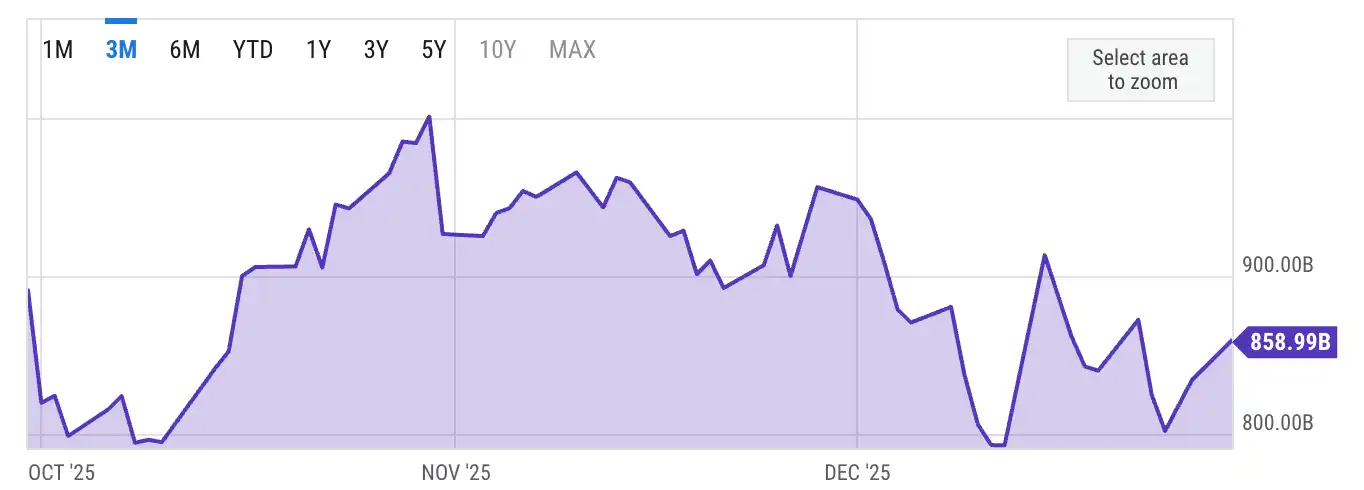
TGA Balance Change
It has been a month and a half since the U.S. government reopened, and the current TGA balance is approximately $850 billion. This means that $100 billion has already been spent, providing significant liquidity to the market.
For the cryptocurrency market, the key is whether total liquidity is increasing or decreasing.
Therefore, optimistically, the RMP purchases + a significant drop in the TGA balance + the issuance of some form of tariff dividend by the end of 2026 may, when combined, give global liquidity a significant boost, potentially helping the crypto market rally.
Why Is Japan So Keen on Raising Interest Rates?
After discussing the Fed, let's shift our focus to Japan across the Pacific.
The minutes of the Bank of Japan's December meeting show that policymakers are debating the need to continue raising interest rates, with some members calling for "timely" action to control inflation. A Bloomberg survey indicates that economists believe the Bank of Japan will probably raise interest rates again in six months, with most people thinking that this round of rate hikes will ultimately settle at 1.25%. Former Bank of Japan executive Hideo Hayakawa even stated that by early 2027, interest rates could rise to 1.50%.
While global markets are cutting interest rates, why is Japan so intent on raising them?
We need to start with Japan's situation. For the past few decades, Japan has been struggling with deflation, with interest rates near zero or even negative for a long time. But now, things have changed. Inflation has picked up, wages have started to rise, and the Bank of Japan finally has the opportunity to normalize its monetary policy.
However, Japan is burdened with a massive amount of debt, with government debt accounting for around 200% of GDP, and Japanese government bond yields have now fallen to pre-2008 levels. With such a high level of debt, if interest rates rise too quickly, the government's interest expenses will skyrocket, and the bond market may not be able to handle it.
Adding to the trouble is the Japanese yen. Prior to the meeting, the yen had already fallen to its weakest level in 10 months, approaching the key level of 160 yen to the dollar. The last time it fell to this level, the Japanese government directly intervened in the foreign exchange market. In theory, raising interest rates should strengthen the currency, but the yen has instead continued to weaken.
The core dilemma lies here: the Japanese economy is in a dilemma—either rescue the bond market or rescue the yen, but you can't rescue both at the same time. While the Bank of Japan says it wants to raise interest rates to control inflation, it also has to buy a large amount of Japanese government bonds to stabilize the bond market. Raising interest rates should make the yen more expensive, but at the same time, pumping water into the system by buying bonds is a bit like fighting against oneself.
Currently, Japanese government bond yields have fallen to pre-2008 levels, yet the yen against the dollar is almost at its lowest point in 35 years. So, it can be said that the Bank of Japan is actually "sacrificing the yen to save the bond market."
Furthermore, the negative impact of Japan's interest rate hike on the crypto market is directly visible. In the past, whenever Japan raised interest rates, the crypto market would experience a sharp decline. The reasons have been discussed in our previous articles "Why did Japan raise interest rates, yet Bitcoin crashed?" and "From yen interest rate hikes to mining closures, why is Bitcoin still falling?." In simple terms, Wall Street and global speculators borrow yen in Japan at almost 0% cost, exchange it for dollars, and invest it in high-yield assets such as Bitcoin and US stocks. It's like someone lending you money for free to invest in cryptocurrency with no interest. How cool is that? This way, trillions of US dollars have been lent out.
When Japan suddenly raises interest rates, the cost of borrowing in Japanese Yen increases, prompting these institutions to unwind their positions. They sell off risk assets, including Bitcoin, to exchange back into Yen to repay the loan.
So, if Japan raises interest rates in the new year, will we see a repeat of the previous sell-off scenario? DCF-News believes not necessarily. There are several reasons:
First, the market has already priced in the anticipated rate hike in Japan for the new year. The impact of Japan's new year rate hike will not be as surprising, as the market has already begun to focus on this factor and started discussing it months in advance. Position adjustments have been made early, unlike last year's situation of being caught off guard.
Secondly, as mentioned earlier, the Fed is cutting rates on the other end. If the Fed really cuts rates 2-3 times in 2026, the US-Japan interest rate spread will narrow, diminishing the attractiveness of carry trades, which was already decreasing. A 0.25% rate hike in Japan may not have such a significant impact.
Third, the overall direction of liquidity is more important. As also mentioned earlier, the Fed leadership change, RRP bond purchases, continued liquidity release from the TGA account, and even the tariff windfall are all part of the equation. After all, no one is more eager than Trump to boost economic data before the midterm elections. If the faucet is turned on wide in the US, the tightening effect in Japan may be offset for the most part.
Of course, there will still be short-term fluctuations. If the Bank of Japan suddenly accelerates the pace of interest rate hikes, or if the Fed does not cut rates as aggressively as expected, short-term panic in the market is still possible. However, from a medium- to long-term perspective, the overall direction of global liquidity is the key variable determining the cryptocurrency market.
If the Democrats Win the Midterm Elections?
After discussing so much about monetary policy, there is actually another factor in 2026 that will more directly impact the cryptocurrency industry, which is the November US midterm elections.
Trump and his Treasury Secretary Benson understand very well that in order to maintain the Republican seats in Congress during the midterm elections, they must make the American people feel real economic benefits before voting. This is why they are so eager to push for rate cuts, issue tariff windfalls, and implement these policies, all in an effort to stimulate the economy before the midterms.
After all, at present, the Democrats still have the upper hand. The recent local elections in the past month or two have given the Democrats a boost. They have won several key elections, such as the Mayor of New York City, the Governor of New Jersey, the Governor of Virginia, and even made breakthroughs in some traditionally red states.
For example, in a conservative district in Georgia, which historically voted Republican, it unexpectedly turned blue. Remember, in last year's presidential election, Trump won there with a 12-percentage-point lead. Even in the mayoral election in Miami, the Democrats won for the first time in 30 years. Even in deep red states like Tennessee, the Republicans only won by 8%; in the past, they wouldn't even dare to claim victory with less than a 20% margin. The victories in local elections are not coincidences; they indicate that voters are dissatisfied with the current economic situation. If this trend continues into next year, the Republicans could really lose control of Congress.
Former House Speaker Pelosi recently expressed confidence in an interview, predicting that the Democratic Party will retake the House of Representatives in the 2026 midterm elections. The entire Democratic Party is now filled with optimism.
On the Republican side, however, there are many challenges:
Even if the Trump administration is now starting to adjust tariff policies and push for interest rate cuts, it is difficult to see results in the short term. With the midterm elections coming up in November and considering the policy transmission time span of a few months, the window of opportunity for Trump is already very tight.
Trump has recently been calling on Senate Republicans to abolish the "lengthy debate" rule, where senators can continuously speak to delay or prevent a bill from being voted on. Trump wants to expedite his policies through this method on one hand, and also prevent the possibility of another government shutdown on January 30 due to Democratic non-cooperation. However, there are also many internal opposition views within the party. Many Republican senators are concerned that once the precedent is set, the Democratic Party, when it becomes the majority party in the future, will mimic Trump's behavior.
Just at the beginning of 2026, it is still too early to judge the outcome of the midterm elections, with too many variables. But there are a few points that are certain: in order to retain congressional seats, Trump will use all means, interest rate cuts, fiscal stimulus, tariff benefits—all possible measures will be taken. In the short term, this is bullish for risk assets, including cryptocurrencies.
Therefore, from an investment perspective, the author of the article believes that there may still be many opportunities and time windows for action in the first half of 2026. However, as the latter half of the year approaches the midterm elections, uncertainty will sharply rise. If polls show the Democratic Party in the lead, the market may prematurely price in this expectation, and the cryptocurrency industry may also face adjustment pressure.
You may also like

Crypto Price Prediction Today 18 February – XRP, Bitcoin, Ethereum
Key Takeaways XRP’s potential as a replacement for SWIFT is bolstered by regulatory approvals, potentially driving its price…

XRP Price Prediction: XRP is Outpacing Solana and Targeting Binance Coin Next – Should You Invest Now?
Key Takeaways XRP Ledger has moved into the sixth place by tokenized real-world asset value, surpassing Solana and…

New AI Predicts the Price of XRP, Dogecoin, and Solana By 2026
Key Takeaways ChatGPT anticipates significant price increases for XRP, Dogecoin, and Solana by the end of 2026. XRP…

Arthur Hayes Shares Two Scenarios for Bitcoin Price, Calling for a Major Crypto Rally
Key Takeaways Arthur Hayes predicts a significant crypto rally fueled by a $572 billion liquidity injection from the…

Bitcoin Price Prediction: Abu Dhabi Gov Funds Buy $1 Billion in BTC – What Do They Know?
Key Takeaways Abu Dhabi has revealed a $1 billion stake in Bitcoin through major ETF investments, signaling strong…

Bitcoin’s Divergence From Nasdaq Signals Dollar Liquidity Risk, Says Arthur Hayes
Key Takeaways Arthur Hayes highlights a concerning divergence between Bitcoin and the Nasdaq, pointing to a potential dollar…

Lagarde’s Possible Early Exit Could Alter Digital Euro Plans and Stablecoin Oversight
Key Takeaways Christine Lagarde’s potential departure as ECB president may disrupt the digital euro timeline and stablecoin policies.…
HYLQ Strategy Invests in Hyperliquid Quantum Solutions Pioneer qLABS, Acquires 18,333,334 qONE Tokens
Key Takeaways HYLQ Strategy Corp has made a strategic investment in qLABS, purchasing over 18 million qONE tokens…

WLFI Crypto Surges Toward $0.12 as Whale Purchase Precedes Trump-Linked Forum
Key Takeaways Whale accumulation has spurred a rally in WLFI crypto prices, reaching towards $0.12 ahead of a…
Cathie Wood Reverses Path with $6.9 Million Purchase in Coinbase Stock – Is ARK Strategizing a Rebound?
Key Takeaways ARK Invest acquires 41,453 shares of Coinbase, showing renewed interest post recent divestment. This acquisition by…
Crypto Lobby Establishes Working Group to Advocate for Prediction Market Regulatory Clarity
Key Takeaways The Digital Chamber announced the Prediction Markets Working Group to promote federal oversight of prediction markets.…

Peter Thiel Discreetly Withdraws from Ethereum Treasury Venture ETHZilla – A Cautionary Note for the DAT Model?
Key Takeaways Peter Thiel and Founders Fund have completely exited their position in ETHZilla. Thiel’s withdrawal raises questions…

Coin Center Advocates Protecting Crypto Developer Liability
Key Takeaways Coin Center is actively lobbying the U.S. Senate to safeguard crypto developer liability protections. The ongoing…

$150B in US Tax Refunds Could Catalyze Fresh Crypto Inflows, Historical Trends Indicate
Key Takeaways The IRS anticipates distributing approximately $150 billion in tax refunds to U.S. consumers by the end…

Oracle Error Leads DeFi Lender Moonwell to $1.8 Million in Bad Debt
Key Takeaways A critical oracle pricing glitch caused Moonwell to incur nearly $1.8 million in bad debt. The…
Crypto Price Prediction Today 18 February – XRP, Solana, Dogecoin
Key Takeaways XRP targets a $5 move, driven by its role as an alternative to SWIFT for cross-border…

China’s DeepSeek AI Predicts the Price of XRP, PEPE, and Shiba Inu By the End of 2026
Key Takeaways DeepSeek AI suggests significant potential price increases for XRP, PEPE, and Shiba Inu by 2026. XRP…

XRP Battles Key Support Amid Grayscale Sentiment Surge
Key Takeaways XRP has experienced a 29% price drop recently, creating a tense atmosphere among traders eyeing key…
Crypto Price Prediction Today 18 February – XRP, Bitcoin, Ethereum
Key Takeaways XRP’s potential as a replacement for SWIFT is bolstered by regulatory approvals, potentially driving its price…
XRP Price Prediction: XRP is Outpacing Solana and Targeting Binance Coin Next – Should You Invest Now?
Key Takeaways XRP Ledger has moved into the sixth place by tokenized real-world asset value, surpassing Solana and…
New AI Predicts the Price of XRP, Dogecoin, and Solana By 2026
Key Takeaways ChatGPT anticipates significant price increases for XRP, Dogecoin, and Solana by the end of 2026. XRP…
Arthur Hayes Shares Two Scenarios for Bitcoin Price, Calling for a Major Crypto Rally
Key Takeaways Arthur Hayes predicts a significant crypto rally fueled by a $572 billion liquidity injection from the…
Bitcoin Price Prediction: Abu Dhabi Gov Funds Buy $1 Billion in BTC – What Do They Know?
Key Takeaways Abu Dhabi has revealed a $1 billion stake in Bitcoin through major ETF investments, signaling strong…
Bitcoin’s Divergence From Nasdaq Signals Dollar Liquidity Risk, Says Arthur Hayes
Key Takeaways Arthur Hayes highlights a concerning divergence between Bitcoin and the Nasdaq, pointing to a potential dollar…


 App
App