
Renowned Crypto Influencer Embroiled in "Donation Fraudgate," Accused of Faking Hong Kong Fire Donation Receipt, Sparking Public Outcry

 Prefer us on Google

A serious fire at Wang Fuk House in Tai Po, Hong Kong, has caused hundreds of casualties and property damage. Charitable organizations such as Yan Chai Hospital promptly set up an emergency relief fund to support the affected residents. The cryptocurrency industry has also seen many companies and individuals providing assistance, including industry giants like Binance and Matrixport donating millions of Hong Kong dollars. However, on December 1, a prominent figure in the cryptocurrency community, known as KOL @Elizabethofyou, found herself embroiled in a "Donation Fraud" scandal when the community noticed that the proof of her HK$200,000 donation appeared to be photoshopped.
A "Expose the Fraud" Movement Triggered by a Screenshot
On December 1, Elizabeth, a cryptocurrency influencer with 130,000 followers, posted a tweet on the social media platform X (formerly Twitter), stating that she had donated HK$200,000 to Yan Chai Hospital to support the victims of the Tai Po fire. The tweet included a screenshot of the transaction confirmation and a caption urging others to "show kindness in the face of disaster." The act of kindness quickly garnered over 600,000 views and 1500 likes, initially being seen as a demonstration of positive energy in the industry.
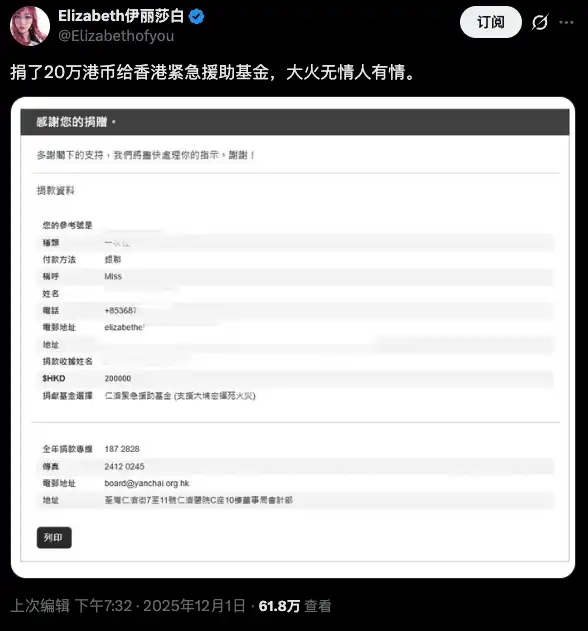
However, public opinion took a sharp turn within hours. Several members of the crypto community on the Twitter platform, such as @CryptoNyaRu and @abyssofgambling, analyzed the screenshot and pointed out multiple suspicious elements:
1. Irregular Font: The number "2" in the amount "200,000" in the screenshot had a noticeably thinner font, inconsistent with the font style of the "Annual Donation Hotline" number below.
2. Misalignment: The amount line and the text below could not be aligned, showing a significant discrepancy in pixel height typical of image editing software (such as Photoshop) manipulation.
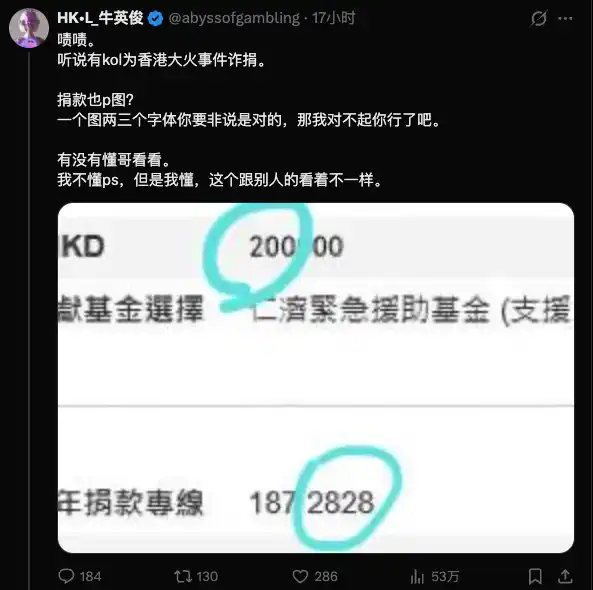
The suspicions quickly escalated, turning the likes into dislikes. The community believed that if this was indeed a fraud, using a significant tragedy to deceive people's compassion was incredibly heinous, and they hoped Elizabeth could provide evidence to prove the authenticity of her donation.
Response from the Involved Party and Escalation of Public Opinion
Faced with overwhelming doubts, Elizabeth released a response video on the evening of the 1st. In the video, she insisted that she had "donated with a clear conscience" and stated that this would be her final response. She then displayed another screenshot as evidence.
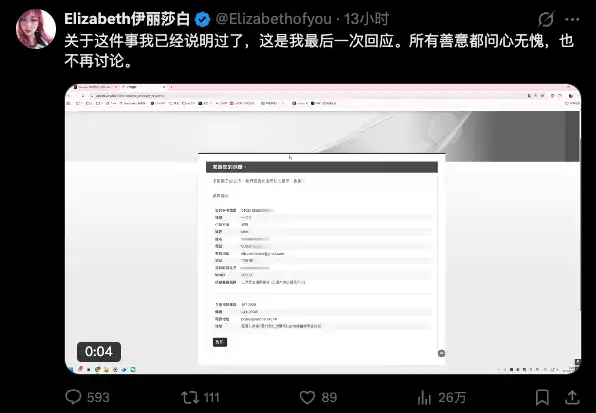
This screenshot is different from the first one. The phone number is different, and the video demonstration is of a static webpage without dynamic refreshing. Additionally, netizens believe that the evidence she provided is not convincing as there is no bank transaction record or an official receipt from Renji Hospital.
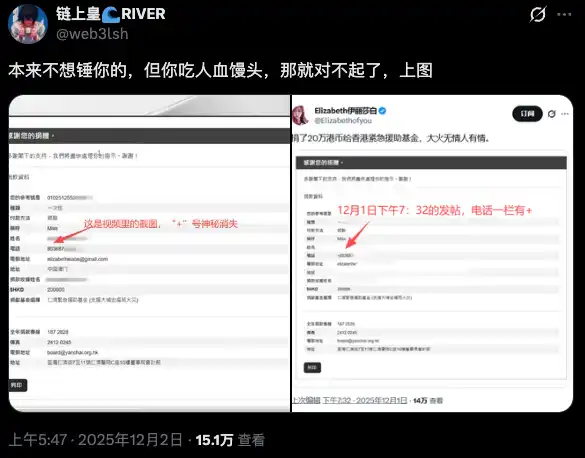
After releasing a response, Elizabeth ignored numerous requests for self-verification in the comments and continued to post commercial ad tweets. This handling of the situation further enraged the public.
According to the Hong Kong Theft Ordinance, if misleading the public through false statements to gain benefits (including advertising collaboration opportunities due to traffic, brand image enhancement, etc.), it may constitute "fraud" or "obtaining property by deception." Upon conviction for such offenses, the maximum penalty can be 10 to 14 years of imprisonment. Netizens have started reaching out to donation organizations for verification and believe that if the fraudulent donation is confirmed, there should be legal consequences. Some Key Opinion Leaders (KOLs) have also compared donation verification evidence for authenticity. As of now, there has been no latest response from donation organizations regarding Elizabeth.
Historical Warning: The Cost of Celebrity "Donation Fraud"
Using charity for false publicity is not uncommon in the history of public figures.
One of the most famous cases is international actress Zhang Ziyi. During the 2008 Wenchuan earthquake, Zhang Ziyi claimed to donate 1 million RMB. However, in 2010, netizens discovered that the actual amount received was only 840,000 RMB, and the whereabouts of the millions of dollars she claimed to have raised in Cannes were unknown.
After the incident broke out, Zhang Ziyi's public image plummeted, facing an unprecedented crisis of trust. Eventually, her agent apologized for "management negligence," made up the shortfall, and hired an auditing firm to audit and disclose the foundation's accounts. Despite taking remedial measures, the "donation fraud" label followed her for many years.
In 2015, well-known actress Yang Mi promised to donate typewriters and white canes to a special education school in Chengdu while promoting the movie "I Am a Witness." However, it wasn't until 2018 that the school stated they never received the supplies.
Yang Mi's studio explained that it was due to the negligence of an "intermediary" that the donation was not fulfilled, and they promptly donated the supplies and publicly apologized. Although it was not legally classified as fraud, the incident was characterized by the public as "hypocritical," greatly undermining her integrity as a public figure.
-- Price
This content is provided for general informational purposes only and doesn't constitute financial, investment, legal, or tax advice. Any events, rewards, online promotions, or related information mentioned herein should not be considered a recommendation, solicitation, or invitation to purchase, sell, trade, or otherwise deal in any crypto assets. Crypto assets are highly volatile and may result in loss. The availability of WEEX services, products, and related events may vary by region. You are responsible for ensuring that your participation is in accordance with applicable local laws and regulations.
You may also like

Gold vs Bitcoin in 2026: Which Market Is Giving Traders Better Opportunities?

Best Oil Trading Platform for Crypto Users in 2026

BlackRock is Buying Ethereum in Bulk. Will ETH Outpace Bitcoin in the New Bull Market?

Ethereum: Gnosis Chain Abandons Its Status as an Independent Blockchain to Become a Rollup

Cryptocurrency Scammers and Wallet Graphs: How the Central Bank Tracks Shadow Chains
Court Orders Bithumb Client to Return $140,400 for Accidentally Sent Bitcoins

Barcelona Embraces AI: The AI Summit Concludes a Busy September

50% Tariff on Canada: What Changes with the 1930 Law
The SEC is reviewing automatic filing pathways after exotic crypto and event-linked ETF proposals flooded the market
Digital Trust: A Strategic Asset in the Financial System

Evernorth’s XRP strategy hinges on one number after Nasdaq vote
How Can Bitcoin Withstand Quantum Computers? A Comparison of Three Lattice-Based Signature Schemes

Ethena Perpetual Equity Contracts: Ethena Seeks New Yield for USDe in Perpetual Equity Contracts

Cyberattack in Manchester: 8.7 Million Travelers Compromised by Free Airport Wi-Fi

Cryptocurrency Platforms Lost $3.63 Billion Due to Cyberattacks

Google Creates WikiSkill for AI Agents to Remember Their Mistakes and Improve
UK police seize $1.4M tied to darknet market activity

Lambda Raises $1 Billion in Debt to Purchase Nvidia Chips
Chinese Automakers Bet on Humanoid Robots as a New Source of Profit
A Founder’s Reflection: Why Did Fomo Run Further Than Us from the Same Starting Point?

GOLD token crashes 99% after Trump-linked post, $1M dump

Hyperliquid gets first HIP-4 outcome DEX with OUT
The B Side of bStocks: Competing for Pricing Power with Perp Instead of Being a Better Nasdaq

XRP ETFs gain ground in two US fund filings

RWA: CZ Wants States to Tokenize Everything to Attract Foreign Capital
Dollar, Rates, and Inflation: Why September Could Be a Key Month in This Race

New debit account payment system launches, but banks anticipate limited use

NFT sales fall 44.7% to $63.3M as Ethereum leads

Polygon Labs issues urgent client upgrade notice following Austin and Kyoto hardforks
Automakers Become Indispensable in the Second Half of Embodied Intelligence
Gold vs Bitcoin in 2026: Which Market Is Giving Traders Better Opportunities?
Best Oil Trading Platform for Crypto Users in 2026
BlackRock is Buying Ethereum in Bulk. Will ETH Outpace Bitcoin in the New Bull Market?
Ethereum: Gnosis Chain Abandons Its Status as an Independent Blockchain to Become a Rollup
Cryptocurrency Scammers and Wallet Graphs: How the Central Bank Tracks Shadow Chains
Court Orders Bithumb Client to Return $140,400 for Accidentally Sent Bitcoins


