
Strategic Petroleum Reserve 2026: What's Left and What It Can Do

 Prefer us on Google
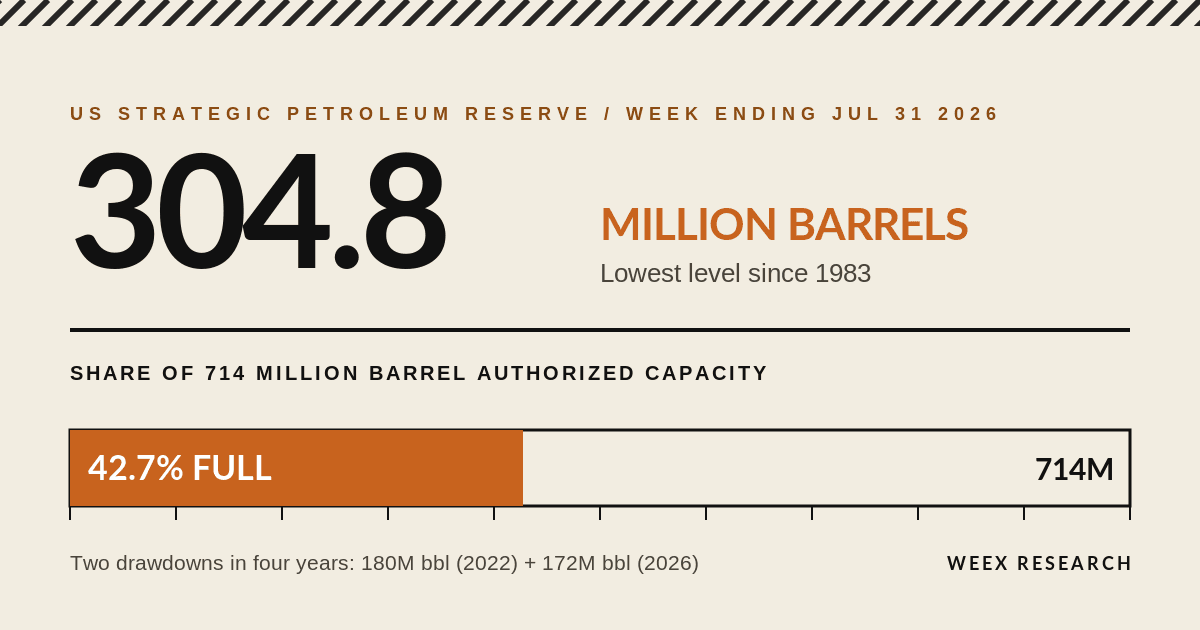
The Strategic Petroleum Reserve held 304.8 million barrels of crude oil in the week ending July 31, 2026 — the lowest reading since 1983 and less than half of its 714-million-barrel authorized capacity. Two emergency drawdowns in four years did that: 180 million barrels after Russia's invasion of Ukraine in 2022, and 172 million barrels released during the closure of the Strait of Hormuz in early 2026.
The barrel count is the number everyone quotes. It is not the number that matters most. A reserve's usefulness is measured in how fast it can push oil into the market during a crisis, and on that measure the SPR has degraded faster than the inventory figure suggests.
How much oil is in the Strategic Petroleum Reserve right now?
Roughly 305 million barrels, as of the last weekly reading before publication. The figure moves every week, and you will see several different numbers depending on which source you check — because the Department of Energy and the Energy Information Administration publish on different schedules and different bases.
| Measure | Value | As of | Source |
|---|---|---|---|
| Weekly inventory | 304.8 million bbl | July 31, 2026 | EIA weekly petroleum status |
| Weekly inventory | 308 million bbl | July 24, 2026 | EIA |
| DOE site-level inventory | 336.8 million bbl | June 25, 2026 | DOE SPR Quick Facts |
| Authorized storage capacity | 714 million bbl | Current | DOE |
| All-time high inventory | 726.6 million bbl | Dec 27, 2009 | DOE |
| Year-end 2025 inventory | 411 million bbl | Dec 31, 2025 | DOE |
The DOE site table and the EIA weekly series disagree by about 30 million barrels. That is not an error — it is a five-week gap during an active drawdown. If you are citing a Strategic Petroleum Reserve number, cite the date with it.
Broken down by site, as of DOE's June 25, 2026 accounting:
| Site | State | Sweet | Sour | Combined | Caverns |
|---|---|---|---|---|---|
| Bryan Mound | Texas | 66.2 MMB | 89.2 MMB | 155.4 MMB | 19 |
| Big Hill | Texas | 27.5 MMB | 61.6 MMB | 89.1 MMB | 14 |
| West Hackberry | Louisiana | 31.9 MMB | 21.2 MMB | 53.1 MMB | 22 |
| Bayou Choctaw | Louisiana | 2.7 MMB | 36.5 MMB | 39.2 MMB | 6 |
| Total | — | 128.3 MMB | 208.5 MMB | 336.8 MMB | 61 |
Note the sweet/sour split. Only 38% of the remaining crude is light sweet — the grade most easily refined into gasoline. A reserve that is disproportionately sour is a less flexible reserve, because not every refinery can take it.
Why the SPR's 4.4 million b/d headline no longer holds
DOE's published maximum drawdown rate is 4.4 million barrels per day. That figure gets repeated constantly and it is close to meaningless at current inventory levels.
The caverns work by displacement: DOE pumps water in, oil floats out. Flow rate depends on reservoir pressure, and pressure depends on how full the cavern is. When the SPR sits near capacity, oil comes out fast. When it is half-empty, it does not. Former Energy Secretary Ernest Moniz put the effective rate at low stock levels at roughly 1 to 1.4 million barrels a day — under a third of the headline number.
| Metric | Headline figure | Reality at 2026 stock levels |
|---|---|---|
| Maximum drawdown rate | 4.4 million b/d | ~1–1.4 million b/d |
| Time to first market delivery | 13 days from presidential order | 13 days, plus 6–18 days transit |
| Sustained supply at max rate | ~69 days at 305 MMB | ~7–10 months at effective rate |
The practical reading: the SPR at 305 million barrels is not "half a reserve." It is a slower reserve. Volume and velocity fell together, and velocity is what a supply shock actually tests. That is the single most underreported fact about the reserve's current condition, and it is why the Government Accountability Office has pressed DOE and Congress for a unified long-term plan rather than another round of emergency releases.
Who orders a release, and how long the oil takes to arrive
Under the 1975 Energy Policy and Conservation Act, the president may order a drawdown in response to a "severe energy supply interruption," or to meet US obligations to the International Energy Agency. Congress has no direct release power under that provision — but it routinely legislates SPR sales to raise revenue, which is a separate and much larger source of depletion than emergencies have been.
There are four distinct ways oil leaves the reserve, and conflating them is the most common error in coverage of the topic:
| Release type | Who authorizes | Purpose | Repaid? |
|---|---|---|---|
| Emergency sale | President | Severe supply interruption | No |
| Exchange (loan) | DOE | Short-term company supply gap | Yes, plus premium barrels |
| Congressionally mandated sale | Congress | Federal revenue | No |
| Test sale | DOE, under congressional authorization | Verify system readiness | No |
Once a drawdown is ordered, DOE sells barrels by competitive auction to the highest bidder, mostly to US companies. Oil enters the market about 13 days after the presidential decision, with another 6 to 18 days of transit depending on destination. Anyone expecting an SPR announcement to move pump prices next week is misreading the mechanism — the announcement moves the futures curve immediately, but the physical barrels take roughly a month to matter.
-- Price
Every major SPR drawdown, from Desert Storm to the Hormuz release
Emergency use of the reserve was rare for its first 45 years. It has not been rare since 2022.
| Year | Event | Volume released | Type |
|---|---|---|---|
| 1991 | Operation Desert Storm | ~17 million bbl | Emergency sale |
| 2005 | Hurricane Katrina | 20.8 million bbl (11M sold, 9.8M loaned) | Sale + exchange |
| 2011 | Libya supply disruption | 30.6 million bbl | Emergency sale, IEA action |
| 2022 | Russia–Ukraine war | 180 million bbl | Emergency sale, IEA action |
| 2026 | Strait of Hormuz closure | 172 million bbl announced | Emergency release, IEA action |
The three pre-2022 emergencies combined released fewer barrels than either of the last two events did on its own. The reserve has been used more heavily in the past five years than in the four decades before them — a shift in practice that never went through a corresponding shift in statute or funding.
Since the US–Iran conflict escalated in late February 2026, the SPR has shed more than 104 million barrels.
Refilling the Strategic Petroleum Reserve at $80 oil
Refilling is a stated administration priority. It is also arithmetic that nobody has solved.
DOE's historical average purchase price for oil in the reserve is $29.70 a barrel. WTI settled at $82.13 and Brent at $87.72 on August 10, 2026, with the Strait of Hormuz still not fully reopened. Every barrel bought back now costs roughly 2.8 times what the average barrel in storage originally cost.
| Refill scenario | Barrels needed | Approx. cost at $82/bbl |
|---|---|---|
| Back to 714 MMB capacity | ~409 million | ~$33.5 billion |
| Back to 500 MMB | ~195 million | ~$16.0 billion |
| Back to year-end 2025 level (411 MMB) | ~106 million | ~$8.7 billion |
Energy Secretary Chris Wright has reportedly sought about $20 billion for replenishment — enough for roughly 244 million barrels at current prices, which would not reach capacity. Total federal investment in the reserve to date, facilities and crude combined, is about $25.7 billion. A full refill at today's prices would cost more than the entire program has cost in 50 years.
There is a second obstacle. The Bipartisan Budget Act of 2018 and related legislation still direct mandated sales, with roughly 92.6 million barrels of revenue-raising sales scheduled through 2031 as of May 2026. Filling the reserve while statute requires selling from it needs congressional action, not just appropriations. Buying and selling the same asset in the same fiscal year is the kind of thing that looks like a rounding error in a budget document and shows up as a real hole in a crisis.
The one genuinely favorable structure is the exchange program: DOE plans to recover a large share of the 2026 release through contracts requiring repayment in barrels plus a premium reported in the 18–24% range. Those barrels come back without new appropriations — but on the counterparties' schedule, not the government's.
How US reserves compare with China, Japan and Europe
The US no longer holds the world's largest strategic stockpile, and has not for some time.
| Holder | Estimated reserves | As of | Notes |
|---|---|---|---|
| China | ~1.4 billion bbl | End 2025 (EIA estimate) | Not disclosed publicly; split government/commercial |
| United States | ~305 million bbl | July 31, 2026 | Crude only, no refined products |
| Japan | 263 million bbl | Dec 2025 | Includes refined products |
| OECD Europe | 179 million bbl | Dec 2025 | Includes refined products |
Two structural differences matter more than the raw totals. First, the US stores crude only, while Japan and European members hold gasoline, diesel, kerosene and fuel oil — the products consumers actually buy. A crude reserve cannot help if the bottleneck is refining capacity, which is exactly what happened after Hurricane Katrina. Second, the US is now the world's largest oil producer at over 21 million b/d of crude and condensate and a net exporter of petroleum products, a position no other large reserve-holder occupies. The reserve was built in 1975 for an importing country in decline. The country it now serves is a different one.
Whether that argues for a smaller reserve or a differently constituted one is a live policy fight. The case for keeping it large is that production capacity is not the same as delivered supply when a chokepoint closes — 2026 demonstrated that a top producer can still face a price shock it cannot produce its way out of.
What this means for anyone watching oil markets
Track three things, not one. The weekly EIA inventory number tells you the trend. The sweet/sour mix tells you how usable what remains is. The refill appropriations fight tells you whether the trend reverses.
For traders, the reliable pattern is that SPR headlines move the futures curve well before they move physical supply, which creates a gap between announcement and delivery that reliably gets mispriced in both directions. Oil prices swung more than 20% in a month during the 2026 Hormuz episode on exactly that kind of headline flow. If you are expressing a view on crude rather than on policy, understanding the WTI benchmark and how it diverges from Brent during regional disruptions matters more than the reserve number itself — WTI is US-centric and inventory-driven, Brent is seaborne and chokepoint-driven, and the Strategic Petroleum Reserve sits squarely on the WTI side of that split.
The Strategic Petroleum Reserve is not empty and it is not obsolete. It is smaller, slower and more expensive to rebuild than at any point in its history, and those three facts move together.
FAQ
1. How much oil is in the Strategic Petroleum Reserve?
About 304.8 million barrels as of the week ending July 31, 2026, against an authorized capacity of 714 million barrels. That is the lowest level since 1983. The figure updates weekly through EIA's petroleum status report.
2. Who can order oil released from the Strategic Petroleum Reserve?
The president, under the 1975 Energy Policy and Conservation Act, in response to a severe energy supply interruption or an IEA obligation. Congress separately legislates SPR sales to raise federal revenue, and DOE can arrange short-term exchanges that companies repay in barrels.
3. How long would the Strategic Petroleum Reserve last?
At the effective drawdown rate of roughly 1–1.4 million barrels per day at current stock levels, about seven to ten months of continuous release. The often-quoted 4.4 million b/d maximum applies when caverns are near full and is not achievable today.
4. Why is the Strategic Petroleum Reserve so low in 2026?
Two large emergency releases — 180 million barrels in 2022 after Russia's invasion of Ukraine and 172 million barrels in early 2026 during the Strait of Hormuz closure — plus congressionally mandated revenue sales that continued through both periods. Replenishment after 2022 was incomplete when the 2026 release began.
5. Will the Strategic Petroleum Reserve be refilled?
Refilling to capacity is a stated Department of Energy priority, but it requires roughly $33.5 billion at August 2026 prices and congressional action to cancel remaining mandated sales. Reported funding requests of around $20 billion would cover roughly 244 million barrels, short of capacity.
6. Where is the Strategic Petroleum Reserve stored?
In 61 underground salt caverns across four Gulf Coast sites: Bryan Mound and Big Hill in Texas, and West Hackberry and Bayou Choctaw in Louisiana. Bryan Mound is the largest, holding 155.4 million barrels as of June 25, 2026.
Risk Warning
Crude oil is one of the most geopolitically sensitive assets traded, and prices can reverse direction within days on a single headline about supply chokepoints, OPEC+ policy or reserve releases. Oil markets are volatile and positions may result in partial or total loss. Leveraged instruments such as XTI/USDT perpetual futures amplify losses as well as gains, and thin liquidity during volatile macro windows can produce severe slippage on entry and exit. Inventory and price data in this article are dated and change weekly. Nothing here is investment advice. Verify current figures against EIA and DOE publications before acting on them, and never commit more capital than you can afford to lose.
This content is provided for general informational purposes only and doesn't constitute financial, investment, legal, or tax advice. Any events, rewards, online promotions, or related information mentioned herein should not be considered a recommendation, solicitation, or invitation to purchase, sell, trade, or otherwise deal in any crypto assets. Crypto assets are highly volatile and may result in loss. The availability of WEEX services, products, and related events may vary by region. You are responsible for ensuring that your participation is in accordance with applicable local laws and regulations.
You may also like
Nike Stock and the China Sales Collapse: What a 30% Revenue Drop and Cutting Thousands of Distributors Actually Signals

BTC to MYR: Why the Ringgit Price of Bitcoin Has Two Legs

Logista Stock (LOG): The August 2026 Interim Dividend, the Four Dates That Decide Who Is Paid and What the Company Is
Manta Network (MANTA) Token Unlock: Supply Details, Allocation Breakdown and Price Risks

ETHFI Price Today: Why Ether.fi Is in Focus Ahead of Its Token Unlock

Santander Reveals a $4.3 Million Bitcoin Investment: What Europe's Biggest Bank Buying IBIT Actually Signals

SNDK Stock and the $93.9 Billion NBM Agreements: What SanDisk's New Business Model Actually Changes

Is Reddit Stock a Buy After Falling From Its Highs? What the S&P 500 Inclusion Actually Changes

Reddit Stock Jumps 11% After S&P 500 Inclusion: What Joining the Index on August 18 Actually Changes
Santander Stock and the Webster Acquisition: What the Federal Reserve Approval Actually Changes
What Is IREN? How the AI Data Center Company Behind Microsoft's $9.7 Billion Contract Actually Works

IREN Stock and the Microsoft Delivery: What Completing Horizon 1 and Getting Nvidia's Exemplar Status Actually Mean
MU Stock After the 28% Drop: What Micron's HBM Backlog Says
Is OpenAI Publicly Traded? The Foundation That Controls It, and the Ticker That Isn't Theirs
Is HIMS Stock a Buy After the Earnings Selloff? What the Full-Year Guidance Raise Actually Implies

CRWV Stock After Q2: Demand Is Fine, the Interest Bill Isn't
Is Bitcoin Preparing for a Bullish Breakout? Key Technical Indicators and On-Chain Data
MSFT Stock and the 30 Million Copilot Seats Milestone: What Growing From 20 Million Actually Changes
RKLB Stock After Q2: Record Revenue, Wider Loss, Narrower Window
Apple Stock and CXMT: What Testing Chinese Memory Chips for iPhone Actually Means for AAPL
Jensen Huang Stock Advice: What He Said and What It Returned
Metaplanet (3350): What the Japanese Retail Boards Argue About — and How to Check Each Claim
KGHM Stock Forum: Copper, Silver, and the Argument the Thread Keeps Getting Backwards
JSW Stock Forum: What the Threads Are Actually Arguing About — and What They Cannot Tell You
What Is Phantom Wallet? How to Install the Official Version Safely and Use It
How Zero Knowledge Proofs Are Used in Blockchain Today
What Is Zero Knowledge Proof? A Beginner's Guide
PGP vs End-to-End Encryption: What's the Difference?
Roblox Stock Price Prediction 2026-2027: Can RBLX Recover After Pulling Full-Year Guidance?
Is RBLX Stock a Buy After Falling 74% From Its All-Time High?
Nike Stock and the China Sales Collapse: What a 30% Revenue Drop and Cutting Thousands of Distributors Actually Signals
BTC to MYR: Why the Ringgit Price of Bitcoin Has Two Legs
Logista Stock (LOG): The August 2026 Interim Dividend, the Four Dates That Decide Who Is Paid and What the Company Is
Manta Network (MANTA) Token Unlock: Supply Details, Allocation Breakdown and Price Risks
ETHFI Price Today: Why Ether.fi Is in Focus Ahead of Its Token Unlock
Santander Reveals a $4.3 Million Bitcoin Investment: What Europe's Biggest Bank Buying IBIT Actually Signals
Contents
Popular coins
Latest articles


