
MU Stock After the 28% Drop: What Micron's HBM Backlog Says

 Prefer us on Google
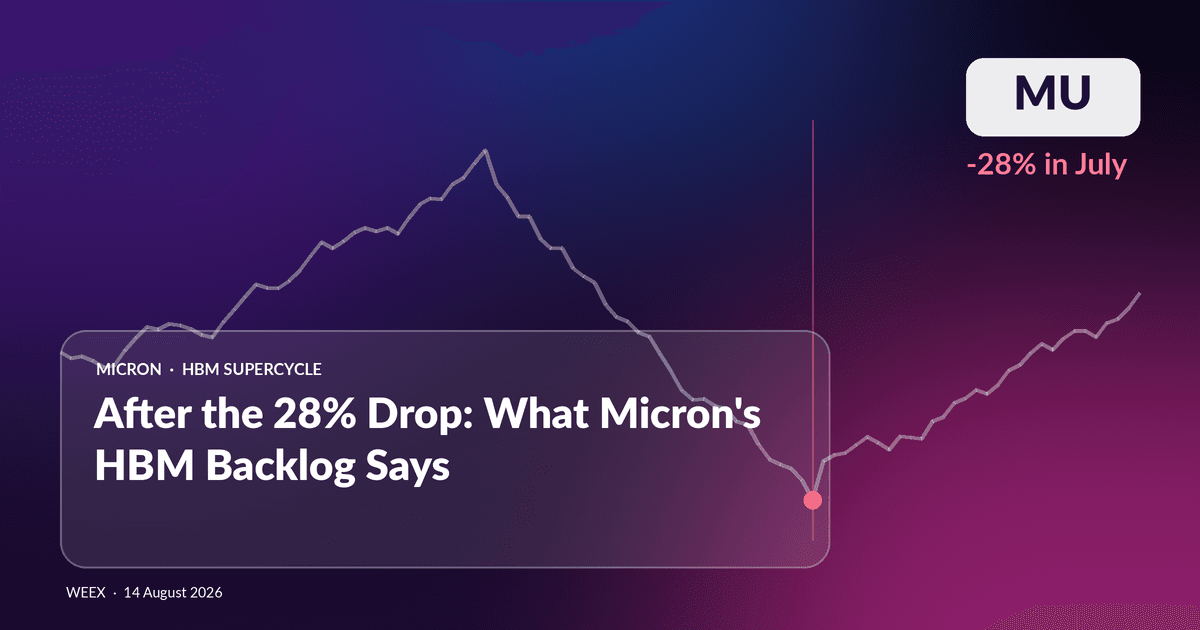
MU stock closed at $949.83 on August 13, 2026 — roughly 22% below the $1,213.37 record close set on June 25, and roughly 16% above the $820.53 low printed on July 28. Both of those moves happened in about five weeks. That is the shape of Micron Technology right now: a $1 trillion memory company whose order book is booked out through 2027, trading like a momentum name.
The fundamental story is not in dispute. The disagreement is over how long the pricing cycle lasts, and that disagreement is being settled in price, in violent increments, during a session that lasts six and a half hours a day.
Why MU stock fell 28% in July while DRAM prices hit a 10-year peak
Micron's July drawdown was not a fundamentals event. DRAM average selling prices reached a 10-year peak of $1.17 during the same window, and CEO Sanjay Mehrotra had locked in multi-year supply agreements. The stock fell anyway, from $1,145.28 on June 29 to $820.53 on July 28.
Three things drove it:
- The CXMT overhang. ChangXin Memory Technologies' IPO revived the argument that Chinese DRAM capacity eventually compresses margins. The timeline is contested; the headline risk is not.
- Hyperscaler capex skepticism. Any wobble in AI infrastructure spending expectations transmits directly into memory pricing assumptions.
- Inventory normalization signals. Industry data pointed to enterprise and cloud inventories rebuilding faster than expected — historically the tell that a DRAM pricing cycle is nearing its peak.
The better reading is that the market was not selling Micron's current earnings. It was re-pricing the duration of 80%-plus gross margins. Those are different trades, and they call for different holding periods.
| Date (2026) | MU price | Context |
|---|---|---|
| Jun 25 | $1,213.37 | Record closing high |
| Jun 29 | $1,145.28 | Start of the July drawdown |
| Jul 28 | $820.53 | Trough, ~28% below Jun 29 |
| Aug 5 | $892.15 | Rebound underway |
| Aug 13 | $949.83 | Close; intraday range $886.05–$935.80 |
| Aug 14 | 953.61 | MU/USDT perpetual last price on WEEX |
Equity prices from public market data; MU/USDT perpetual price from WEEX as of August 14, 2026.
What Micron's HBM backlog actually locks in
Micron is the only major US-based memory manufacturer, and HBM has changed what that means financially. Fiscal Q3 2026 revenue came in at $41.46 billion against $23.86 billion the prior quarter, with GAAP net income of $28.24 billion and diluted EPS of $24.67 ($25.11 non-GAAP). Market capitalization crossed $1 trillion on the back of it.
The forward book matters more than the print. Micron has secured roughly $100 billion in binding multi-year AI memory contracts, effectively selling out HBM supply through 2026 and into 2027. HBM4 entered volume production for Nvidia's Vera Rubin platform; HBM4e ramps in 2027. Management is targeting 20–25% HBM share by late 2026, leaning on yield and US packaging capacity.
What that backlog does not do is fix the price of commodity DRAM and NAND, which still swing with the cycle and still carry most of the volume. That is the seam bears keep pointing at.
Is MU stock a buy at $950? Read the spread, not the average
Consensus is bullish and unusually wide. Analysts polled by S&P Global carry a Strong Buy consensus with an average target near $1,500; roughly 89% rate it a Buy. But the published range runs from $361 to $2,200 — a low estimate about 62% below the current price and a high about 130% above it.
A 6x spread between the lowest and highest target is not a forecast. It is a statement that the memory cycle's shape is genuinely unknown, and that the analyst community is expressing cycle-timing views through a single ticker.
| Scenario | Implied view | Rough target zone |
|---|---|---|
| Supercycle extends past 2027 | HBM scarcity + 80% margins persist | $1,500–$2,200 |
| Cycle peaks late 2026 | Margins normalize as CXMT supply lands | $900–$1,200 |
| Sharp cyclical unwind | DRAM ASPs revert, inventory glut returns | $361–$700 |
The next scheduled catalyst is fiscal Q4 results, due after the close in late September 2026 (calendars show September 23–29; check Micron's investor relations page before positioning). Free cash flow guidance above $30 billion for the quarter is the number to watch.
-- Price
The MU stock trading-hours problem
Here is the practical issue that most MU coverage skips. Micron trades on Nasdaq from 9:30 a.m. to 4:00 p.m. ET. Its two largest 2026 moves — the earnings reaction and the July capitulation — both began outside that window or gapped through it.
If you hold the underlying equity, a stop placed at 3:59 p.m. does not protect you from a 4:05 p.m. earnings release. You get filled at the open, wherever the open happens to be. For a stock that has moved 10% in a single session multiple times this year, that gap is the real risk, not the direction.
This is the specific gap that USDT-margined MU perpetual futures on WEEX are built to close: the contract tracks Micron's price but stays open around the clock, so a position can be reduced, hedged, or exited while the cash equity market is shut. Liquidity thins on weekends and US market holidays — that is a real constraint, not a footnote — but the venue does not close.
How to trade MU on WEEX TradFi
WEEX TradFi lists stocks, gold, silver and oil as perpetual futures settled in USDT. No brokerage account, no bank wire, no separate sub-account — margin comes from the USDT already in your spot or futures wallet.
Concretely:
- Open and verify a WEEX account.
- Deposit USDT on-chain, via OTC, or by internal transfer.
- Move funds into the futures account.
- Open Futures → TradFi and select MU/USDT.
- Set leverage before sizing. Tokenized stocks support up to 100×; that ceiling is a capability, not a recommendation.
| Parameter | MU/USDT perpetual on WEEX |
|---|---|
| Last price (Aug 14, 2026) | 953.61 |
| Margin asset | USDT only |
| Max leverage (tokenized stocks) | Up to 100× |
| Trading hours | 24/7, thinner on weekends/holidays |
| Fees | Zero fees on TradFi stock, gold and oil pairs |
| Underlying | Micron Technology, Inc. (NASDAQ: MU) |
Source: WEEX product pages, August 14, 2026. Parameters can change — confirm on the contract page before trading.
WEEX is currently running a Global market rewards promotion with a $100,000 prize pool for gold and stock trading; note that zero-fee TradFi volume does not count toward it, which is worth knowing before you build a strategy around the leaderboard.
What traders usually miss on leveraged single-stock perps
The mistake is not being wrong on Micron. It is sizing a 100×-capable instrument as if it were the equity.
At 100× leverage, a 1% adverse move against a fully-levered position is a liquidation. MU has posted single-session moves above 10% this year and a 28% drawdown in a month. Anything past roughly 5–10× on this name is a bet on not getting a normal Tuesday.
Three other frictions worth pricing in:
- Funding. Perpetuals charge funding between longs and shorts. Holding a directional position through a strongly one-sided market costs money independent of price direction.
- Weekend liquidity. The market stays open when Nasdaq is closed, but the order book is thinner. Slippage on a stop during a Saturday news event can be materially worse than the quoted spread suggests.
- No shareholder rights. A perpetual gives you price exposure. It does not give you a share, a vote, or a dividend claim. If Micron announces a buyback or dividend, you get the price reaction, not the distribution.
The bottom line on MU stock
Micron's near-term earnings are close to locked in — HBM is contracted, supply is tight, and Q3 already printed record numbers. The open question is 2027 margins, and that question will not be resolved by anything visible today.
If you are trading MU rather than owning it, the constraint that binds is timing, not thesis. The stock's biggest 2026 moves happened in hours when the cash market was closed. That argues for either a position small enough to survive a gap, or an instrument that lets you act during one. Sizing solves more of this problem than conviction does.
FAQ
1. Why is MU stock trading near $950 in August 2026?
Micron's fiscal Q3 2026 revenue reached $41.46 billion with GAAP EPS of $24.67, and the company holds roughly $100 billion in binding multi-year AI memory contracts. The stock rallied on the HBM supercycle, then gave back about 28% in July on concerns about Chinese DRAM supply and inventory normalization before rebounding.
2. What are analysts' MU stock price targets?
Consensus is Strong Buy with an average target near $1,500, but the published range runs from $361 to $2,200. The width of that range reflects disagreement over when the memory pricing cycle peaks, not disagreement about current earnings.
3. When does Micron report next?
Fiscal Q4 2026 results are expected after the US close in late September 2026, with calendars listing September 23–29. Confirm the date on Micron's investor relations site, since companies do move it.
4. Can I trade MU stock 24/7?
Not as a Nasdaq-listed share — that trades 9:30 a.m. to 4:00 p.m. ET. MU/USDT perpetual futures on WEEX TradFi track the price and remain open around the clock, though liquidity is thinner outside US market hours.
5. Is a MU perpetual future the same as owning Micron shares?
No. A perpetual gives leveraged price exposure settled in USDT. It carries no ownership, no voting rights, and no dividend entitlement, and it can be liquidated if margin falls below the maintenance requirement.
6. What leverage is available on MU/USDT?
Tokenized stock pairs on WEEX support up to 100×. Given that MU has posted double-digit single-session moves in 2026, high leverage substantially raises liquidation probability.
Risk Warning
Trading MU perpetual futures carries risk of partial or total loss of capital. Micron is a cyclical semiconductor stock that fell roughly 28% in a single month in July 2026 and has repeatedly moved more than 10% in one session; leveraged positions in an instrument offering up to 100× can be liquidated by moves far smaller than that. Specific risks include earnings gap risk (Micron reports after the US close, when the cash equity market is shut), thin weekend and holiday liquidity that can widen slippage on stops, funding costs that accrue against directional positions, and counterparty and custody risk associated with holding USDT margin on an exchange. A perpetual contract does not confer share ownership, dividends, or voting rights. Prices, fees, leverage limits and event terms cited here are current as of August 14, 2026 and may change. Nothing here is investment advice — size positions to the loss you can absorb, and verify contract parameters on the platform before trading.
This content is provided for general informational purposes only and doesn't constitute financial, investment, legal, or tax advice. Any events, rewards, online promotions, or related information mentioned herein should not be considered a recommendation, solicitation, or invitation to purchase, sell, trade, or otherwise deal in any crypto assets. Crypto assets are highly volatile and may result in loss. The availability of WEEX services, products, and related events may vary by region. You are responsible for ensuring that your participation is in accordance with applicable local laws and regulations.
You may also like

Nike Stock and the China Sales Collapse: What a 30% Revenue Drop and Cutting Thousands of Distributors Actually Signals

BTC to MYR: Why the Ringgit Price of Bitcoin Has Two Legs

Logista Stock (LOG): The August 2026 Interim Dividend, the Four Dates That Decide Who Is Paid and What the Company Is
Manta Network (MANTA) Token Unlock: Supply Details, Allocation Breakdown and Price Risks

ETHFI Price Today: Why Ether.fi Is in Focus Ahead of Its Token Unlock

Santander Reveals a $4.3 Million Bitcoin Investment: What Europe's Biggest Bank Buying IBIT Actually Signals

SNDK Stock and the $93.9 Billion NBM Agreements: What SanDisk's New Business Model Actually Changes

Is Reddit Stock a Buy After Falling From Its Highs? What the S&P 500 Inclusion Actually Changes

Reddit Stock Jumps 11% After S&P 500 Inclusion: What Joining the Index on August 18 Actually Changes
Santander Stock and the Webster Acquisition: What the Federal Reserve Approval Actually Changes
What Is IREN? How the AI Data Center Company Behind Microsoft's $9.7 Billion Contract Actually Works

IREN Stock and the Microsoft Delivery: What Completing Horizon 1 and Getting Nvidia's Exemplar Status Actually Mean
Is OpenAI Publicly Traded? The Foundation That Controls It, and the Ticker That Isn't Theirs
Is HIMS Stock a Buy After the Earnings Selloff? What the Full-Year Guidance Raise Actually Implies

CRWV Stock After Q2: Demand Is Fine, the Interest Bill Isn't
Is Bitcoin Preparing for a Bullish Breakout? Key Technical Indicators and On-Chain Data
MSFT Stock and the 30 Million Copilot Seats Milestone: What Growing From 20 Million Actually Changes
RKLB Stock After Q2: Record Revenue, Wider Loss, Narrower Window
Strategic Petroleum Reserve 2026: What's Left and What It Can Do
Apple Stock and CXMT: What Testing Chinese Memory Chips for iPhone Actually Means for AAPL
Jensen Huang Stock Advice: What He Said and What It Returned
Metaplanet (3350): What the Japanese Retail Boards Argue About — and How to Check Each Claim
KGHM Stock Forum: Copper, Silver, and the Argument the Thread Keeps Getting Backwards
JSW Stock Forum: What the Threads Are Actually Arguing About — and What They Cannot Tell You
What Is Phantom Wallet? How to Install the Official Version Safely and Use It
How Zero Knowledge Proofs Are Used in Blockchain Today
What Is Zero Knowledge Proof? A Beginner's Guide
PGP vs End-to-End Encryption: What's the Difference?
Roblox Stock Price Prediction 2026-2027: Can RBLX Recover After Pulling Full-Year Guidance?
Is RBLX Stock a Buy After Falling 74% From Its All-Time High?
Nike Stock and the China Sales Collapse: What a 30% Revenue Drop and Cutting Thousands of Distributors Actually Signals
BTC to MYR: Why the Ringgit Price of Bitcoin Has Two Legs
Logista Stock (LOG): The August 2026 Interim Dividend, the Four Dates That Decide Who Is Paid and What the Company Is
Manta Network (MANTA) Token Unlock: Supply Details, Allocation Breakdown and Price Risks
ETHFI Price Today: Why Ether.fi Is in Focus Ahead of Its Token Unlock
Santander Reveals a $4.3 Million Bitcoin Investment: What Europe's Biggest Bank Buying IBIT Actually Signals
Contents
Popular coins
Latest articles


