
Who is Satoshi Nakamoto, the creator of Bitcoin?

The world of Bitcoin has been fascinating since its inception in 2009. But behind this financial revolution lies an enigma that continues to captivate: the identity of Satoshi Nakamoto, its anonymous creator. To understand the importance of this question, it is crucial to ask why Bitcoin was created. It was not just to invent a new digital currency, but to offer a decentralized alternative free from traditional financial systems. Over the years, many potential candidates have been suggested, each with their own arguments.
Why Bitcoin?
Bitcoin was born from an ideal of freedom and privacy in the digital age. Its anonymous creator, Satoshi Nakamoto, observed that the web, once an opening to the world, had become a tool of control, where our personal data was the raw material of a new economy.
This explains why Bitcoin was created: to design a universal and decentralized currency, free from the influence of central banks, corporations, and states—that was the goal. Bitcoin solved the "double-spending" problem, a form of digital counterfeiting that made it impossible to create a unique currency on the internet. Satoshi Nakamoto saw it as a response to the failures of the traditional financial system and the growing threat to our privacy.
Who is Satoshi Nakamoto?
The identity of Satoshi Nakamoto remains a mystery today. While we know his first address (the one that received the mining reward for the very first block) and his fortune, estimated at over 126 billion dollars, speculation about his true identity has been rife for years.
Len Sassaman
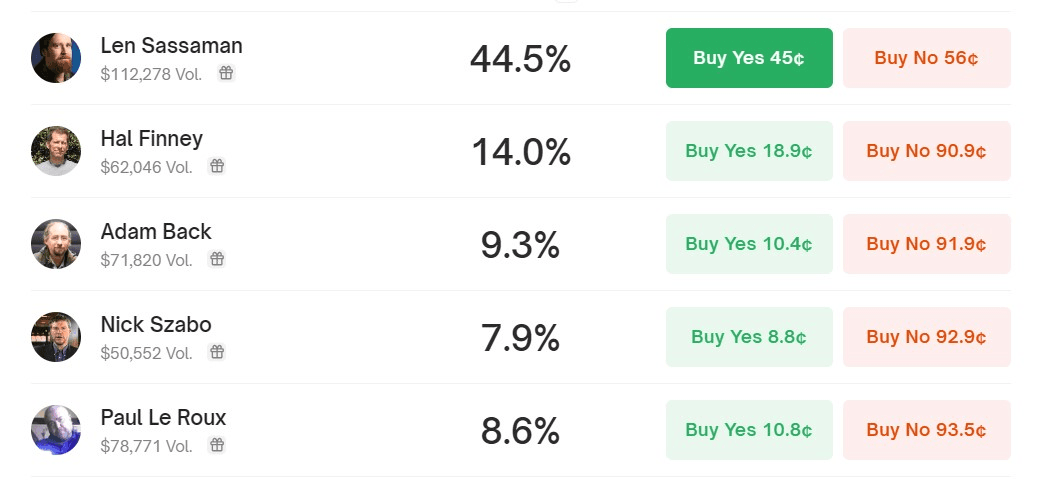
In 2024, HBO released a documentary about Satoshi Nakamoto. Before its release, bettors on Polymarket, a decentralized prediction market platform, had bet on Len Sassaman as the most likely candidate. According to Cointelegraph, Len Sassaman was a respected cryptographer and cypherpunk (a privacy activist) who worked on technologies like "remailers," which are considered precursors to Bitcoin.
He also collaborated with Hal Finney, another possible candidate. Furthermore, the timing of his death in 2011 coincides with the last known communication from Satoshi Nakamoto to the Bitcoin community. However, Meredith Patterson, his widow, publicly stated on X that Len was not Satoshi Nakamoto.
Peter Todd
The HBO documentary ultimately suggested that Satoshi Nakamoto was likely Peter Todd. He is a Canadian developer and a regular contributor to the Bitcoin network. He also founded OpenTimestamps, an open-source project.
However, Peter Todd denied the documentary's claim, labeling it a conspiracy theory. Many experts also question this hypothesis, particularly due to his young age at the time of Bitcoin's creation and the complexity of the white paper.
Nick Szabo
According to Coinacademy, Nick Szabo could also be Satoshi Nakamoto. He is an expert in computer science, law, and economics and developed the concept of smart contracts. He proposed a digital currency called Bit Gold in 1998, which shares many similarities with Bitcoin.
However, while Satoshi disappeared in 2011 when the CIA began to take an interest in Bitcoin, Szabo remained an active public figure, giving interviews and participating in conferences. Furthermore, he has always denied being Satoshi.
Hal Finney
For Cointribune, Hal Finney could potentially be Satoshi Nakamoto given his profile: an experienced developer, cypherpunk, and creator of Reusable Proof Of Work (RPOW), a system that preceded Bitcoin. He was also the recipient of the very first Bitcoin transaction. Some point out that he lived near a man named Dorian Satoshi Nakamoto, which could have inspired the pseudonym.
However, there is no concrete evidence to support this theory, and Hal Finney always publicly denied being Satoshi Nakamoto.
Adam Black
BeInCrypto mentions Adam Black as another candidate due to his pioneering work in cryptography, particularly with the Hashcash proof-of-work concept, which inspired Bitcoin. He was also in direct contact with Satoshi Nakamoto.
However, the article refutes this theory: Black himself denied being the creator of Bitcoin and even shared exchanges with him, showing that he was simply contacting him to share a citation regarding him, not that they were one and the same person. Moreover, Adam Black participated in the Craig Wright trial, providing evidence that separates the two identities.
Paul Le Roux
Paul Le Roux could also be Satoshi Nakamoto. An expert in programming, he worked on encryption solutions like E4M. He shares the Bitcoin creator's ideas on anonymity and the banking system. Furthermore, the dates of his arrest and Satoshi's disappearance coincide.
However, as an international drug trafficker and violent cartel leader, it is difficult to lend credibility to this hypothesis, which runs counter to Satoshi Nakamoto's philosophy. Moreover, there is no objective or tangible evidence for this theory.
Jack Dorsey
For Journal du Coin, several troubling coincidences suggest that Jack Dorsey, co-founder of Twitter, could be Satoshi Nakamoto.
January 11, his mother's birthday, is also the date of the first transaction; March 5, his father's birthday, is the date of the last block mined by Satoshi; and November 19, his own birthday, is also the date of Satoshi's registration on the forum. Additionally, a Bitcoin address created by Satoshi starts with "jD2m," which could stand for "Jack Dorsey 2 Mint," in reference to Jack Dorsey's former residence in San Francisco.
However, this theory is controversial, as it seems contradictory for the creator of a decentralized currency to also be the source of the censorship that Jack Dorsey imposed on Twitter. Finally, according to Journal du Coin, the very fact that Jack Dorsey has worn a "Satoshi" t-shirt calls this theory into question, as it is unlikely that the true creator of Bitcoin, who has always been anonymous, would have risked it.
Satoshi Nakamoto: An AI from the future?
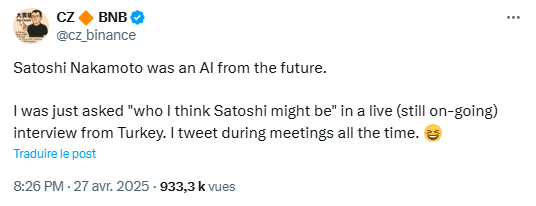
Finally, an unexpected theory: could Satoshi Nakamoto be an AI from the future? This is at least what Changpeng Zhao, or CZ, founder of Binance, claims in a post on the social network X.
Is Satoshi Nakamoto's anonymity a strength?
For Cryptoast, Satoshi Nakamoto's anonymity could be an advantage for Bitcoin. It reinforces the project's ideals of absolute decentralization by preventing the emergence of a single authority figure who could influence the network, a limitation encountered by other more centralized projects like Ethereum.
This absence of a leader avoids several problems:
- Conflicts of interest and cult of personality: without a central figure, Bitcoin is protected from the influences and the impact that a person's statements could have on the market, as has been observed with Elon Musk and Dogecoin. The work of the contributors is highlighted, thus respecting Satoshi's initial intentions.
- Potential legal issues: by remaining anonymous, Satoshi protects himself from legal proceedings that creators of alternatives to fiat currencies might face from regulators.
Conclusion
While speculation continues to fuel the mystery surrounding Satoshi Nakamoto, his anonymity has become a foundational element of Bitcoin. This absence of a single authority figure reinforces the project's ideal of decentralization and resilience. Whether it is an individual, a group, or even an AI, his departure from the public stage has allowed Bitcoin to develop autonomously, far from any centralizing influence. The question "Who is Satoshi Nakamoto?" is ultimately perhaps no longer as important as the principles that the creator of Bitcoin left behind.
Click here to learn more about Bitcoin and to find out how to buy Bitcoin on WEEX.
WARNING
WEEX and its affiliates provide digital asset exchange services, including derivatives and margin trading, only where permitted by law and for eligible users. All content is provided for general information purposes and does not constitute financial advice. Please consult an independent advisor before trading. Cryptocurrency trading is highly risky and can result in the total loss of your assets. By using WEEX services, you accept all associated risks and conditions. Never invest more than you can afford to lose. Please see our Terms of Use and our Risk Disclosure for more details.