
Introducing RedStone Airdrop & Premarket: How to Claim Your RED Tokens?
Key Takeaways:
- RedStone Airdrop Rewards: RedStone Airdrop rewards dedicated community members who participated in the RedStone Expedition.
- RED Token Premarket Access: RED will be available on Binance Pre-Market, allowing early investors and users to gain exposure before the full launch.
- Staking Incentives: Users can stake RED tokens on EigenLayer AVS to earn additional rewards while contributing to the security and efficiency of RedStone’s oracle network.
What is RedStone Oracles? RedStone (RED), a next-gen decentralized oracle, is gaining major attention in the crypto space following its pre-market listing on Binance on February 28, 2025. The RedStone airdrop allocation checker is now live, letting participants verify their eligibility for the upcoming airdrop. This article will guide you on how to claim your RED token airdrop and explore staking and ecosystem benefits.
What is RedStone (RED)?
RedStone is a next-generation decentralized finance (DeFi) oracle that provides real-time, on-demand blockchain data across multiple ecosystems. Built to serve both EVM and non-EVM blockchains, RedStone ensures efficient, scalable, and cost-effective data delivery for decentralized applications (dApps). With its innovative approach, RedStone aims to revolutionize the way blockchain networks access and utilize external data.
RedStone Tokenomics & RED Token Distribution
The RED token is the foundation of the RedStone ecosystem, designed to drive decentralization, incentivize participation, and secure long-term growth. With a hard-capped max supply of 1 billion RED tokens, RedStone ensures a sustainable economic model through strategic allocations, staking incentives, and governance mechanisms.
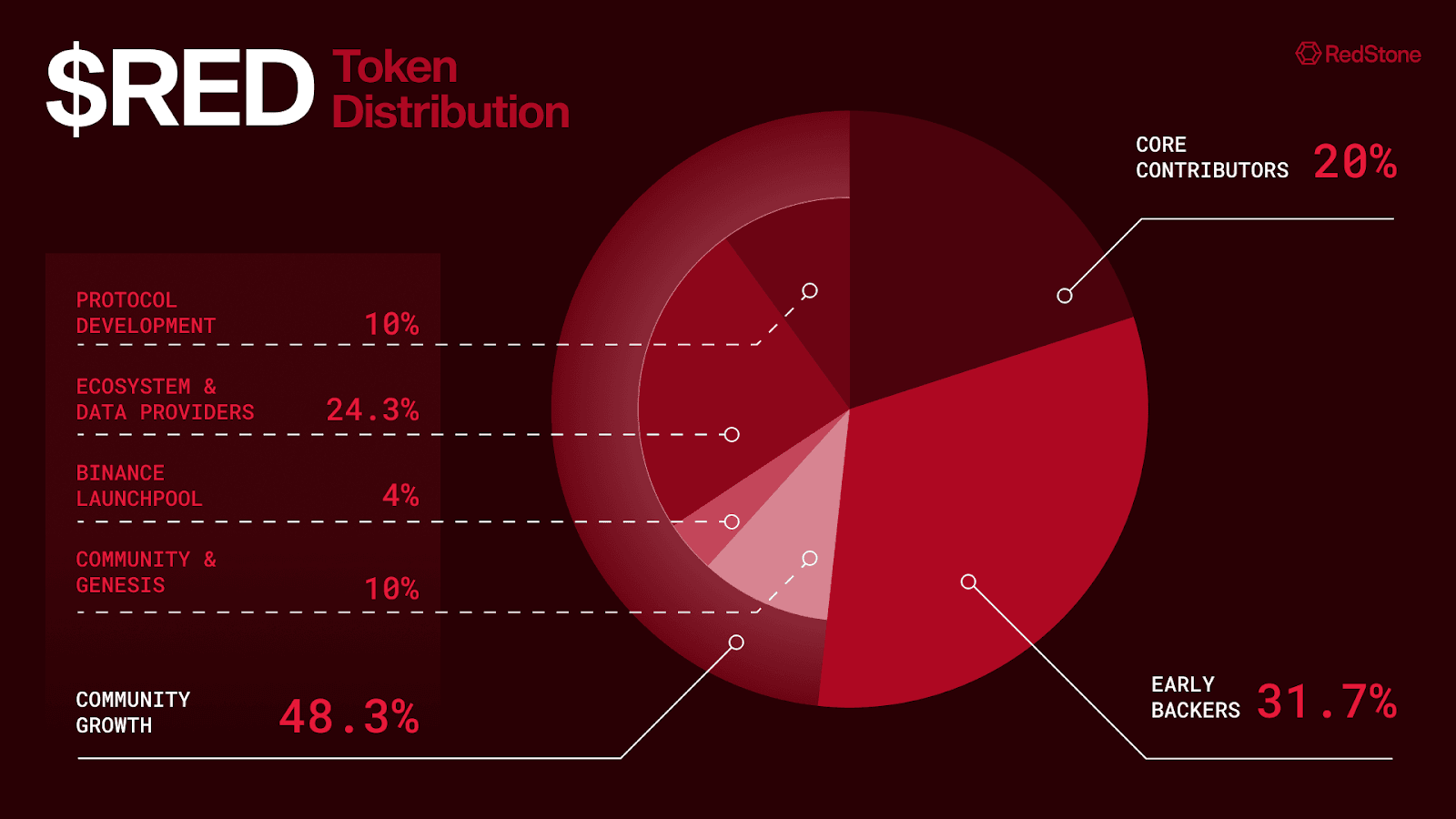
Key Tokenomics Details:
- Max Supply: 1,000,000,000 RED
- Network: Ethereum (ERC-20) | Expansion to Solana, Base, and others via Wormhole Native Token Transfer
- Float at TGE: 28% (280M RED)
- Binance Pre-Market Circulating Supply: 40M RED
- Community & Ecosystem Allocation: 48.3% (Incentives, Staking, Data Providers)
- Locked Supply: 72% (Gradual unlock over 4 years per the Token Release Schedule)
RED Token Distribution Breakdown
Category | Allocation | Lock Status |
| Community & Genesis | 10.0% | Unlocked |
| Ecosystem & Data Providers | 24.3% | Partially Locked |
| Protocol Development | 10.0% | Partially Locked |
| Binance Launchpool | 4.0% | Unlocked |
| Core Contributors | 20.0% | Locked |
| Early Backers | 31.7% | Locked |
RedStone (RED) Premarket Listing
As RedStone (RED) prepares for its full token launch, it has secured a premarket listing, giving early investors and community members access before its official debut. This early exposure allows users to track RED token price movements and make informed investment decisions. With growing adoption, RED’s value is expected to rise, reflecting its increasing demand as a next-gen oracle solution.
Adding to the momentum, RedStone (RED) has been selected as the 64th project on Binance Launchpool, where users can stake BNB, USDC, and FDUSD to farm RED tokens ahead of public trading. RedStone’s innovative approach supports both EVM and non-EVM blockchains, delivering cost-efficient, real-time data to decentralized applications (dApps). Its on-demand oracle model enhances scalability and efficiency, positioning RedStone as a key player in blockchain infrastructure.
With $15M secured for expansion, RedStone is set to revolutionize the oracle space, making blockchain data more accessible and reliable across diverse ecosystems.
What is RedStone Airdrop?
The RedStone Airdrop is an initiative designed to reward the most dedicated contributors to the ecosystem. Unlike traditional token giveaways, the RedStone Miner Airdrop prioritizes engagement, creativity, and sustained participation. The goal is to ensure real community members benefit, while filtering out sybil attackers and inauthentic engagement.
How to Claim Your RedStone Airdrop?
To participate in the RedStone Airdrop, users must have engaged in the RedStone ecosystem through the RedStone Expedition. The eligibility criteria for the RED airdrop include:
- Active Discord Participation: Engaging in discussions, completing community challenges, and contributing to RedStone’s growth.
- RedStone Gems (RSG) Accumulation: Earning RSG by completing tasks and challenges within the RedStone Expedition.
- Special Role Achievements: Roles such as “Deep Miner,” “Mentor,” and “Winter Miner” provide higher RED airdrop allocations.
- On-Chain Quests: Completing blockchain-based activities in collaboration with partners like Pendle and Venus.
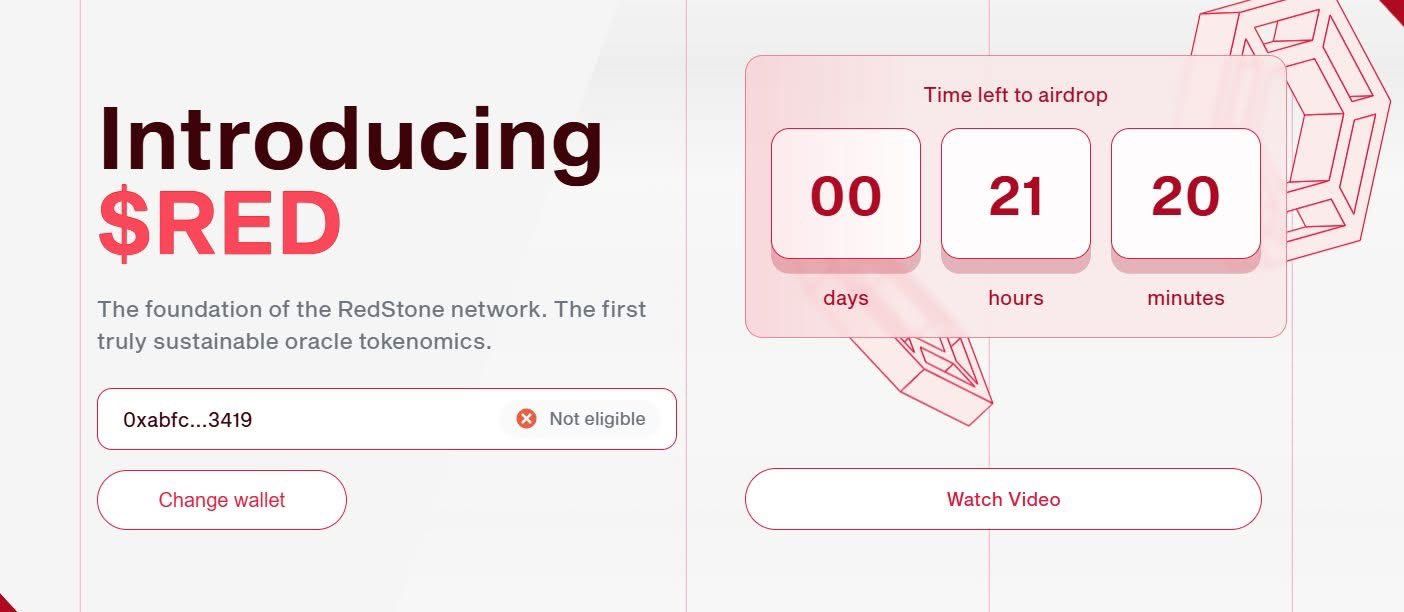
Participants can check their RED airdrop allocation on the official claim.redstone.finance website. Once the airdrop goes live, users can claim and stake their RED tokens directly from the same platform.
Staking RED Tokens
After claiming their RED tokens, users have the option to stake them on EigenLayer AVS to earn rewards. Staked RED tokens help secure RedStone price feeds, ensuring accuracy and reliability in decentralized finance applications. Users can stake directly through EigenLayer App or use EigenPie for liquid staked mRED.
Why Participate in RedStone Airdrop?
- Early Access to RED Tokens: Get RED before it becomes widely available on major exchanges.
- Higher RED Token Price Potential: With growing adoption and staking mechanisms, RED token price is expected to increase over time.
- Passive Income through Staking: Earn additional rewards by staking RED tokens on EigenLayer.
- Be Part of a Thriving DeFi Community: Join an innovative ecosystem at the forefront of decentralized oracle solutions.
Future of RedStone Community
The RedStone Distributed Data Association is committed to ongoing community incentives, ensuring that the ecosystem remains dynamic and rewarding. Future RED airdrop campaigns, governance participation, and staking incentives will continue to enhance engagement and adoption.
Final Thoughts
The RedStone Airdrop represents a unique opportunity for crypto enthusiasts to earn RED tokens while supporting a groundbreaking DeFi oracle project. With a strong tokenomics model, a dedicated community, and the potential for long-term staking rewards, RedStone is positioned for significant growth. Don’t miss your chance to claim and stake your RED tokens—check your eligibility today at claim.redstone.finance.
Latest Updates on WEEX
WEEX Exchange’s WXT Token Surges 101%
If you want to buy WXT now, you can sign up for a WEEX account
WEEX Owen: Michael Owen Joins as Global Brand Ambassador
Championing a revolutionary crypto trading experience
You may also like

WEEX Gold & Silver 0% Fees Event: Trade Metals, Crude Oil and Stock Futures With Zero Fees
Join the WEEX 0-fee futures event from April 16 to May 31, 2026. Trade eligible gold, silver, crude oil, and stock futures with 0% fees.

Can PAC Coin Reach $1 Soon? Analyzing Public Asset Control
PAC is a Solana-based meme token with a government-themed narrative, but it is highly speculative.
At its current price (~$0.0009) and 1B supply, reaching $1 would require a $1B market cap, which is very unlikely.
Short-term moves to $0.001 or $0.01 are more realistic, but the token is highly volatile due to low liquidity and hype-driven trading.
Overall, $1 is not a realistic target, and PAC is better suited for short-term speculation than long-term investment.

What Is SAOS? Strategic American Oil Supply Token Explained
SAOS is a meme token on Solana with a 75,000 USD market cap and 22,000 USD locked liquidity, positioned around oil supply themes but lacking real asset backing
It thrives on pure narrative speculation, with no utility, website, or doxxed team, making it highly volatile and attention-dependent
Traders should distinguish SAOS from legitimate real-world asset projects, as its branding is speculative rather than substantive
Positive aspects include locked liquidity reducing rug pull risks, but low trading activity signals high uncertainty
NBIS Stock: What Nebius’ AI Cloud Surge Means Now
NBIS stock jumped as Nebius reported rapid AI cloud growth. See the key Q1 2026 numbers, catalysts, valuation risks, and what to watch next.

What Is Public Asset Control (PAC) Coin? Explained for Beginners
Public Asset Control (PAC) is a Solana-based token that uses a “government asset control” narrative involving oil and gold themes, but it has no verified ties to any real institutions or governments. It is mainly an entertainment-focused, speculative meme coin.
The project’s claims about links to entities like BlackRock or Palantir are unverified, and its own disclaimer states it is not a real financial or institutional asset. Like many new Solana tokens, PAC is highly volatile, with low liquidity and limited transparency, including no fully verified audit.
Overall, PAC is a high-risk speculative token driven by hype and storytelling rather than real utility. Beginners are advised to be cautious, verify contract details, and prioritize risk control before considering any trading.

Public Asset Control: What PAC Token Really Is
Public Asset Control PAC is a Solana token with bold asset-control branding. Learn what it is, what is verified, and the key trading risks.

Why Is Chinese Oil Asset Reserve (COAR Crypto) Trending Now?
Why is Chinese Oil Asset Reserve trending now? Learn the latest COAR crypto price action, trading volume, oil narrative, Solana pair data, and what is driving attention today.

How to Buy Chinese Oil Asset Reserve (COAR) Token in 2026: Latest Step-by-Step Guide, Contract Address, and Safe Buying Tips
How to buy Chinese Oil Asset Reserve (COAR) token step by step, including the official COAR contract address, Solana wallet setup, SOL funding, and latest market data.

COAR Coin: What Chinese Oil Asset Reserve Really Is
COAR coin is a new Solana oil-narrative token. Learn what Chinese Oil Asset Reserve claims, how to verify the contract, and key trading risks.

Did the CLARITY Act Pass Today? Latest Status and the History of the Crypto Bill
SEO meta description: Did the CLARITY Act pass today? Read the latest crypto bill update, the history of the CLARITY Act, House and Senate votes, and what happens next for U.S. crypto regulation.

What Is Chinese Oil Asset Reserve (COAR) Token? $COAR and Coar Stock Relationship Explained
Chinese Oil Asset Reserve (COAR) token explained, $COAR price, Solana details, and the relationship between COAR and Coar stock. Learn the latest facts.

Trade to Earn on WEEX: Join the Futures Trading Event and Earn Real-Time WXT Rewards Throughout May 2026
Join the WEEX Trade to Earn Series Five event from May 1–31, 2026 and earn real-time WXT rewards through futures trading. Boost your rebate level, complete missions, invite friends, and maximize your trade to earn rewards with USDT-M futures trading.

Trade to Earn With Futures Trading on WEEX: How Smart Traders Are Turning Every Position Into WXT Rewards
Join the WEEX Trade to Earn Series Five campaign and earn real-time WXT rewards through futures trading from May 1–31, 2026. Upgrade mining levels, unlock higher rebate ratios, complete missions, and maximize your trade to earn rewards with USDT-M futures trading.

CBRS Stock: What to Know About Cerebras After Its IPO
CBRS stock surged after Cerebras priced its IPO at $185. Learn what the AI chipmaker does, why valuation matters, and what risks to watch.
SpaceX IPO Stock Market Impact: What Investors Should Watch
SpaceX’s IPO could reshape indexes, liquidity, space stocks, and crypto risk appetite. Here is what matters before the listing.

HMSTR Token Price: What Moves Hamster Kombat Now
Track HMSTR token price, supply, catalysts, and risks. Learn what drives Hamster Kombat price action and what traders should watch.

How to Buy Public Asset Control (PAC) Token in 2026: Latest Solana Buying Guide
How to buy Public Asset Control (PAC) token in 2026, PAC contract address, Solana wallet setup, Jupiter swap guide, latest price, liquidity, and risks.

What Is Public Asset Control (PAC) Token and How Does It Work? Latest Solana PAC Token Guide
Public Asset Control (PAC) token explained. Learn what PAC is, how it works on Solana, current price snapshot, risks, and buying basics.
WEEX Gold & Silver 0% Fees Event: Trade Metals, Crude Oil and Stock Futures With Zero Fees
Join the WEEX 0-fee futures event from April 16 to May 31, 2026. Trade eligible gold, silver, crude oil, and stock futures with 0% fees.
Can PAC Coin Reach $1 Soon? Analyzing Public Asset Control
PAC is a Solana-based meme token with a government-themed narrative, but it is highly speculative.
At its current price (~$0.0009) and 1B supply, reaching $1 would require a $1B market cap, which is very unlikely.
Short-term moves to $0.001 or $0.01 are more realistic, but the token is highly volatile due to low liquidity and hype-driven trading.
Overall, $1 is not a realistic target, and PAC is better suited for short-term speculation than long-term investment.
What Is SAOS? Strategic American Oil Supply Token Explained
SAOS is a meme token on Solana with a 75,000 USD market cap and 22,000 USD locked liquidity, positioned around oil supply themes but lacking real asset backing
It thrives on pure narrative speculation, with no utility, website, or doxxed team, making it highly volatile and attention-dependent
Traders should distinguish SAOS from legitimate real-world asset projects, as its branding is speculative rather than substantive
Positive aspects include locked liquidity reducing rug pull risks, but low trading activity signals high uncertainty
NBIS Stock: What Nebius’ AI Cloud Surge Means Now
NBIS stock jumped as Nebius reported rapid AI cloud growth. See the key Q1 2026 numbers, catalysts, valuation risks, and what to watch next.
What Is Public Asset Control (PAC) Coin? Explained for Beginners
Public Asset Control (PAC) is a Solana-based token that uses a “government asset control” narrative involving oil and gold themes, but it has no verified ties to any real institutions or governments. It is mainly an entertainment-focused, speculative meme coin.
The project’s claims about links to entities like BlackRock or Palantir are unverified, and its own disclaimer states it is not a real financial or institutional asset. Like many new Solana tokens, PAC is highly volatile, with low liquidity and limited transparency, including no fully verified audit.
Overall, PAC is a high-risk speculative token driven by hype and storytelling rather than real utility. Beginners are advised to be cautious, verify contract details, and prioritize risk control before considering any trading.
Public Asset Control: What PAC Token Really Is
Public Asset Control PAC is a Solana token with bold asset-control branding. Learn what it is, what is verified, and the key trading risks.