
Global Digital Energy Reserve (GDER) Crypto: What It Is and What to Verify
Global Digital Energy Reserve (GDER) Crypto is a Solana-based token project built around an energy-reserve narrative. Its public website presents GDER as a “digital energy reserve” connected to strategic petroleum reserves, institutional custody, and sovereign-style infrastructure. That framing has made GDER stand out among newer Solana tokens, especially for traders watching real-world asset narratives, oil themes, and high-volatility on-chain markets.
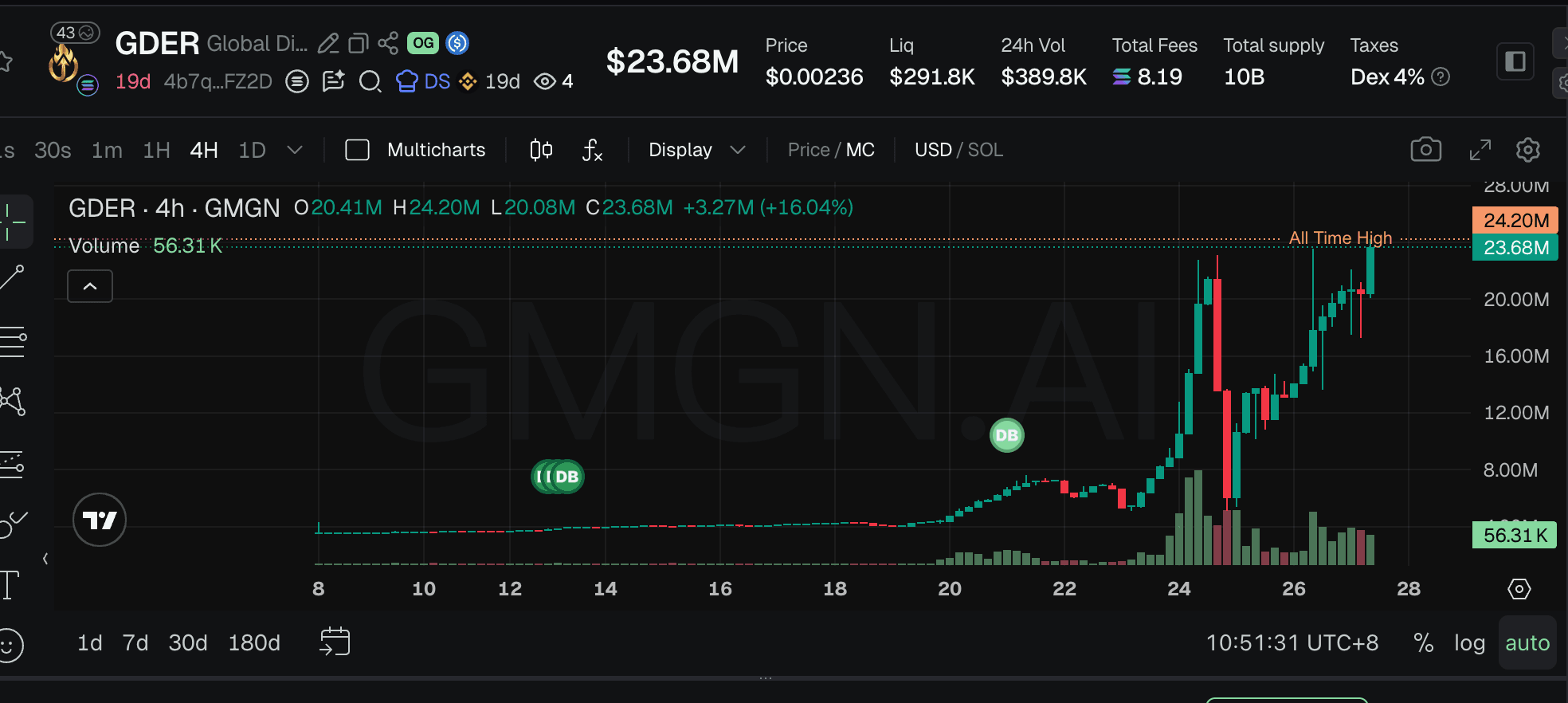
The important point is that GDER should not be treated as proven oil exposure just because the branding uses energy-reserve language. Public data around the token is fragmented, and several pages show different contract addresses, market values, or verification status. For a quick background read, WEEX has a useful Global Digital Energy Reserve (GDER) Crypto guide.
What Is Global Digital Energy Reserve (GDER) Crypto?
Global Digital Energy Reserve, or GDER, is presented as a tokenized energy-reserve project. The project website lists the contract address VDoRrZix72Er41foJAdKrwFqYNozPbktuPa4Xy1A7Au and describes four reserve categories: crude oil, heavy crude, refined products, and strategic petroleum reserves.
Those claims are large, but they should be read carefully. The same website includes a disclaimer stating that institutional references are illustrative and that tokens carry inherent risk. In practice, that means the reserve story is a project narrative unless independent audits, custody records, legal entities, and verifiable proof-of-reserve data support it.
How GDER Works on Solana
GDER appears to operate as a Solana SPL token. On Solana, the token’s real identity is the mint address, not the name or logo shown inside a wallet. This matters because more than one token can use similar names or tickers.
Solana’s own documentation explains that tokens are uniquely identified by their mint account. That is why anyone researching Global Digital Energy Reserve (GDER) Crypto should start by checking the mint address, then compare it against the source they intend to use. A ticker match alone is not enough.
Why GDER Is Getting Attention
GDER combines several market narratives that often attract short-term crypto interest: energy, strategic reserves, real-world assets, and Solana token speculation. That can make the token highly searchable and highly tradable, but it does not automatically make it fundamentally strong.
The stronger reading is that GDER is currently a narrative-driven token with uncertain proof behind its real-world asset claims. Traders may still watch it for momentum, but long-term investors need stronger evidence than branding, charts, or social media activity.
If your search intent is closer to “how to buy GDER safely,” start with WEEX’s GDER contract address and risk checklist before taking any action.
The Key Issue: Contract and Data Confusion
As of April 27, 2026, public pages show conflicting information around GDER. The project website lists one address, while some market pages show other GDER-related addresses. Some pages also mark a GDER token as unverified.
This is not a small detail. In crypto, contract confusion is one of the fastest ways people lose money. A buyer may think they are buying the token they researched, but a similar ticker can point to a different mint, different liquidity pool, or different risk profile.
Before trading, check:
The exact Solana mint address
Whether the token is verified or unverified
Holder concentration
Liquidity depth
24-hour volume
Whether mint or freeze authority remains active
Whether the project has independent reserve proof
For broader market context, users can also compare assets through WEEX Markets or browse related explainers in the WEEX Crypto Wiki.
Is GDER Backed by Real Energy Assets?
Based on public information available now, GDER’s real-world energy backing is not independently proven. The project’s own website uses reserve and custody language, but the disclaimer weakens any hard interpretation that the token is directly backed by audited barrels of oil or strategic energy infrastructure.
That does not mean every part of the project is false. It means the burden of proof is still on the project. For a token claiming an energy-reserve theme, credible proof would usually include named legal entities, independent audit reports, custody confirmations, redemption mechanics, and transparent links between token supply and reserve assets.
Without those, Global Digital Energy Reserve (GDER) Crypto is better understood as a speculative Solana token with an energy-reserve narrative, not a verified commodity-backed instrument.
FAQ
What is Global Digital Energy Reserve (GDER) Crypto?
GDER is a Solana-based crypto token presented as a digital energy-reserve project. Its public branding focuses on strategic energy holdings, but independent proof of real reserve backing remains unclear.
What is the GDER contract address?
The project website lists VDoRrZix72Er41foJAdKrwFqYNozPbktuPa4Xy1A7Au. Because public pages show inconsistent GDER-related data, users should always verify the mint address before trading.
Is GDER verified?
Some public token pages mark GDER-related listings as unverified. An unverified token is not automatically a scam, but it increases the need for contract, liquidity, and holder checks.
Is GDER an oil-backed crypto?
Public materials use energy-reserve language, but there is not enough independent evidence to treat GDER as a verified oil-backed token. The safer interpretation is that it is an energy-themed crypto asset.
Can I trade GDER on WEEX?
Check the latest WEEX market listings directly before assuming availability. If you use WEEX for research or trading, create a WEEX account and verify the exact asset page before placing orders.
Risk Warning
Global Digital Energy Reserve (GDER) Crypto is a high-risk digital asset. Key risks include wrong-contract purchases, unverified token status, thin liquidity, sharp slippage, concentrated holders, unclear reserve backing, and sudden price reversals. Do not treat energy-reserve branding as proof of collateral. Always verify the mint address, check liquidity and holder data, and never trade funds you cannot afford to lose. This article is for informational purposes only and is not financial advice.
You may also like

World Collective Oil Reserve (WCOR) Price Prediction 2026-2045: Expert Insights
WCOR (World Collective Oil Reserve) is a Solana-based cryptocurrency token that promotes an “oil reserve + real-world asset (RWA) narrative.” However, there is no public evidence that it is actually backed by physical oil assets. It is essentially a highly speculative, narrative-driven token. Its current market cap is around $14 million, with relatively low liquidity and high volatility, and its price is mainly driven by market sentiment and hype. Most analyses suggest limited short-term upside, with a possible gradual increase to around $0.02 by 2030. Overall, it is considered a high-risk crypto asset driven more by narrative speculation than fundamentals.

WEEX Gold & Silver 0% Fees Event: Trade Metals, Crude Oil and Stock Futures With Zero Fees
Join the WEEX 0-fee futures event from April 16 to May 31, 2026. Trade eligible gold, silver, crude oil, and stock futures with 0% fees.

Can PAC Coin Reach $1 Soon? Analyzing Public Asset Control
PAC is a Solana-based meme token with a government-themed narrative, but it is highly speculative.
At its current price (~$0.0009) and 1B supply, reaching $1 would require a $1B market cap, which is very unlikely.
Short-term moves to $0.001 or $0.01 are more realistic, but the token is highly volatile due to low liquidity and hype-driven trading.
Overall, $1 is not a realistic target, and PAC is better suited for short-term speculation than long-term investment.

What Is SAOS? Strategic American Oil Supply Token Explained
SAOS is a meme token on Solana with a 75,000 USD market cap and 22,000 USD locked liquidity, positioned around oil supply themes but lacking real asset backing
It thrives on pure narrative speculation, with no utility, website, or doxxed team, making it highly volatile and attention-dependent
Traders should distinguish SAOS from legitimate real-world asset projects, as its branding is speculative rather than substantive
Positive aspects include locked liquidity reducing rug pull risks, but low trading activity signals high uncertainty
NBIS Stock: What Nebius’ AI Cloud Surge Means Now
NBIS stock jumped as Nebius reported rapid AI cloud growth. See the key Q1 2026 numbers, catalysts, valuation risks, and what to watch next.

What Is Public Asset Control (PAC) Coin? Explained for Beginners
Public Asset Control (PAC) is a Solana-based token that uses a “government asset control” narrative involving oil and gold themes, but it has no verified ties to any real institutions or governments. It is mainly an entertainment-focused, speculative meme coin.
The project’s claims about links to entities like BlackRock or Palantir are unverified, and its own disclaimer states it is not a real financial or institutional asset. Like many new Solana tokens, PAC is highly volatile, with low liquidity and limited transparency, including no fully verified audit.
Overall, PAC is a high-risk speculative token driven by hype and storytelling rather than real utility. Beginners are advised to be cautious, verify contract details, and prioritize risk control before considering any trading.

Public Asset Control: What PAC Token Really Is
Public Asset Control PAC is a Solana token with bold asset-control branding. Learn what it is, what is verified, and the key trading risks.

Why Is Chinese Oil Asset Reserve (COAR Crypto) Trending Now?
Why is Chinese Oil Asset Reserve trending now? Learn the latest COAR crypto price action, trading volume, oil narrative, Solana pair data, and what is driving attention today.

How to Buy Chinese Oil Asset Reserve (COAR) Token in 2026: Latest Step-by-Step Guide, Contract Address, and Safe Buying Tips
How to buy Chinese Oil Asset Reserve (COAR) token step by step, including the official COAR contract address, Solana wallet setup, SOL funding, and latest market data.

COAR Coin: What Chinese Oil Asset Reserve Really Is
COAR coin is a new Solana oil-narrative token. Learn what Chinese Oil Asset Reserve claims, how to verify the contract, and key trading risks.

Did the CLARITY Act Pass Today? Latest Status and the History of the Crypto Bill
SEO meta description: Did the CLARITY Act pass today? Read the latest crypto bill update, the history of the CLARITY Act, House and Senate votes, and what happens next for U.S. crypto regulation.

What Is Chinese Oil Asset Reserve (COAR) Token? $COAR and Coar Stock Relationship Explained
Chinese Oil Asset Reserve (COAR) token explained, $COAR price, Solana details, and the relationship between COAR and Coar stock. Learn the latest facts.

Trade to Earn on WEEX: Join the Futures Trading Event and Earn Real-Time WXT Rewards Throughout May 2026
Join the WEEX Trade to Earn Series Five event from May 1–31, 2026 and earn real-time WXT rewards through futures trading. Boost your rebate level, complete missions, invite friends, and maximize your trade to earn rewards with USDT-M futures trading.

What Is World Cup Meme Coin? Football Meme Crypto Narrative Explained
World Cup meme coin $WCMEME is a Solana token that collapsed 96% in 24 hours. Learn how football meme narratives work and the risks involved.

Trade to Earn With Futures Trading on WEEX: How Smart Traders Are Turning Every Position Into WXT Rewards
Join the WEEX Trade to Earn Series Five campaign and earn real-time WXT rewards through futures trading from May 1–31, 2026. Upgrade mining levels, unlock higher rebate ratios, complete missions, and maximize your trade to earn rewards with USDT-M futures trading.

CBRS Stock: What to Know About Cerebras After Its IPO
CBRS stock surged after Cerebras priced its IPO at $185. Learn what the AI chipmaker does, why valuation matters, and what risks to watch.
SpaceX IPO Stock Market Impact: What Investors Should Watch
SpaceX’s IPO could reshape indexes, liquidity, space stocks, and crypto risk appetite. Here is what matters before the listing.

HMSTR Token Price: What Moves Hamster Kombat Now
Track HMSTR token price, supply, catalysts, and risks. Learn what drives Hamster Kombat price action and what traders should watch.
World Collective Oil Reserve (WCOR) Price Prediction 2026-2045: Expert Insights
WCOR (World Collective Oil Reserve) is a Solana-based cryptocurrency token that promotes an “oil reserve + real-world asset (RWA) narrative.” However, there is no public evidence that it is actually backed by physical oil assets. It is essentially a highly speculative, narrative-driven token. Its current market cap is around $14 million, with relatively low liquidity and high volatility, and its price is mainly driven by market sentiment and hype. Most analyses suggest limited short-term upside, with a possible gradual increase to around $0.02 by 2030. Overall, it is considered a high-risk crypto asset driven more by narrative speculation than fundamentals.
WEEX Gold & Silver 0% Fees Event: Trade Metals, Crude Oil and Stock Futures With Zero Fees
Join the WEEX 0-fee futures event from April 16 to May 31, 2026. Trade eligible gold, silver, crude oil, and stock futures with 0% fees.
Can PAC Coin Reach $1 Soon? Analyzing Public Asset Control
PAC is a Solana-based meme token with a government-themed narrative, but it is highly speculative.
At its current price (~$0.0009) and 1B supply, reaching $1 would require a $1B market cap, which is very unlikely.
Short-term moves to $0.001 or $0.01 are more realistic, but the token is highly volatile due to low liquidity and hype-driven trading.
Overall, $1 is not a realistic target, and PAC is better suited for short-term speculation than long-term investment.
What Is SAOS? Strategic American Oil Supply Token Explained
SAOS is a meme token on Solana with a 75,000 USD market cap and 22,000 USD locked liquidity, positioned around oil supply themes but lacking real asset backing
It thrives on pure narrative speculation, with no utility, website, or doxxed team, making it highly volatile and attention-dependent
Traders should distinguish SAOS from legitimate real-world asset projects, as its branding is speculative rather than substantive
Positive aspects include locked liquidity reducing rug pull risks, but low trading activity signals high uncertainty
NBIS Stock: What Nebius’ AI Cloud Surge Means Now
NBIS stock jumped as Nebius reported rapid AI cloud growth. See the key Q1 2026 numbers, catalysts, valuation risks, and what to watch next.
What Is Public Asset Control (PAC) Coin? Explained for Beginners
Public Asset Control (PAC) is a Solana-based token that uses a “government asset control” narrative involving oil and gold themes, but it has no verified ties to any real institutions or governments. It is mainly an entertainment-focused, speculative meme coin.
The project’s claims about links to entities like BlackRock or Palantir are unverified, and its own disclaimer states it is not a real financial or institutional asset. Like many new Solana tokens, PAC is highly volatile, with low liquidity and limited transparency, including no fully verified audit.
Overall, PAC is a high-risk speculative token driven by hype and storytelling rather than real utility. Beginners are advised to be cautious, verify contract details, and prioritize risk control before considering any trading.

