
What is the Bitcoin Halving? A Comprehensive Guide from Mechanics to Price Impact

After hitting an all-time high in October 2025, how will the next 2028 cycle unfold?
In April 2024, Bitcoin (BTC) underwent its fourth halving. Since then, the market has followed a gradual upward trend, reaching an all-time high in October 2025. While many have heard the term "halving," surprisingly few fully understand its mechanics or its impact on price.
In this article, we provide a clear and comprehensive explanation for beginners, covering the basic mechanics of the Bitcoin halving, historical data, and investment strategies for the next halving in 2028.
What is the Bitcoin Halving? Basic Mechanics
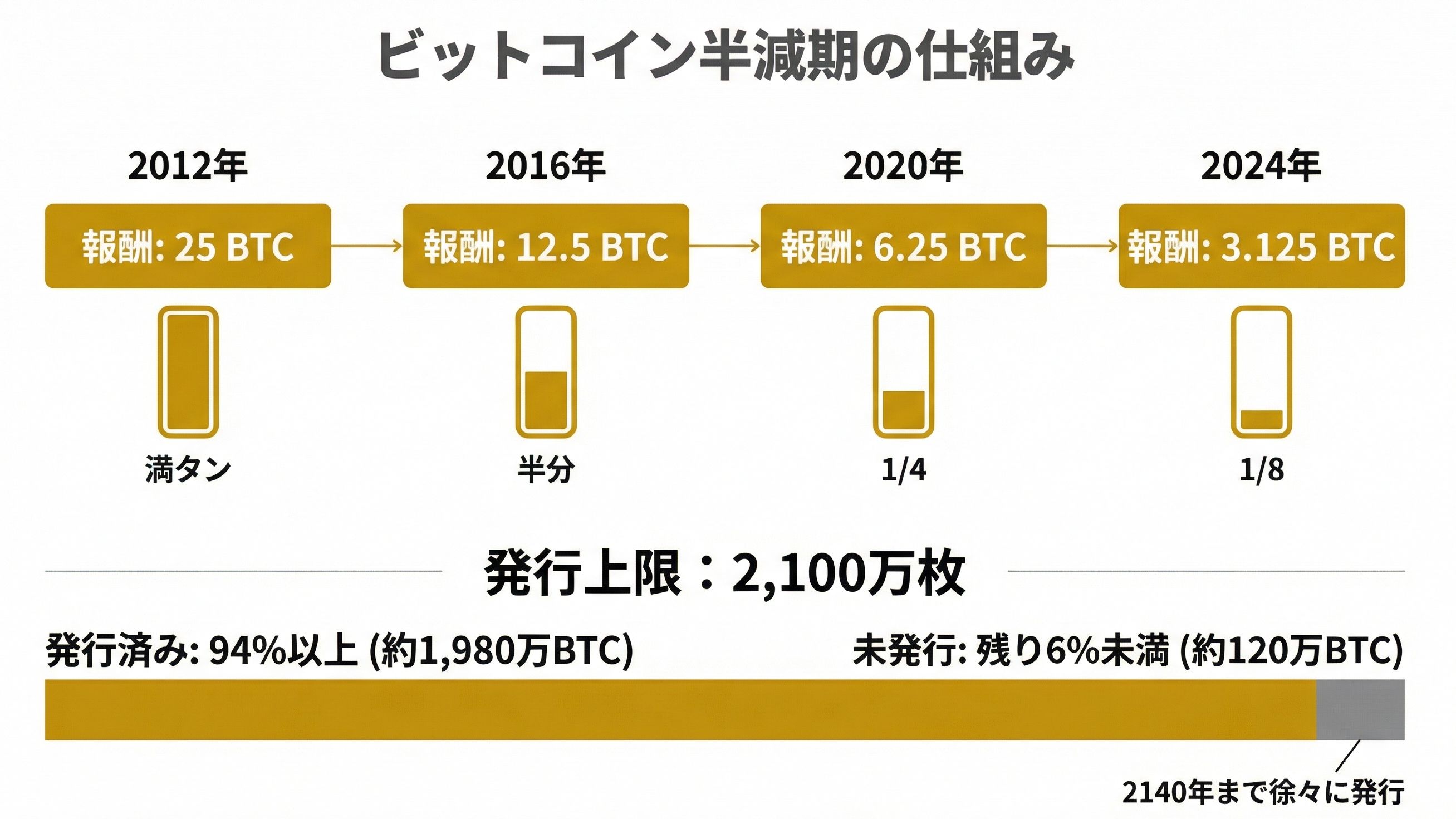
The Bitcoin halving is an event where the mining reward is cut in half. On the Bitcoin blockchain, a new block is generated approximately every 10 minutes, and the miner who generates that block is paid in Bitcoin as a reward.
Why does it happen every four years?
The halving occurs every 210,000 blocks generated. Since the generation time for one block is about 10 minutes, the calculation is 210,000 blocks ÷ 6 blocks (per hour) ÷ 24 hours ÷ 365 days ≈ 4 years, meaning the halving occurs roughly every four years.
Relationship with Bitcoin's maximum supply
Bitcoin has a hard cap of 21 million coins. As mining rewards gradually decrease due to the halving, the supply of Bitcoin increases slowly, with the limit expected to be reached around the year 2140. This scarcity is one of the reasons Bitcoin is referred to as "digital gold."
To date, over 19.8 million Bitcoins have been issued, meaning more than 94% of the total supply is already in circulation. The remaining less than 6% will be issued gradually over the next 100+ years.
Past Halvings and Price Trends
Bitcoin has experienced four halvings so far, and each has been followed by a significant price increase. Let's look at the historical halving data in the table below.
| Halving | Mining Reward | Price at Halving | Price Change 1 Year Later |
| Nov 2012 | 50 → 25 BTC | ~$12 | ~$1,000 (~+8,000%) |
| July 2016 | 25 → 12.5 BTC | ~$650 | ~$2,500 (~+280%) |
| May 2020 | 12.5 → 6.25 BTC | ~$8,500 | ~$58,000 (~+580%) |
| April 2024 | 6.25 → 3.125 BTC | ~$64,000 | ~$105,000 (~+64%)* |
*The all-time high recorded in October 2025 (approx. $105,000 / slightly under 19 million JPY) is listed as a provisional peak.
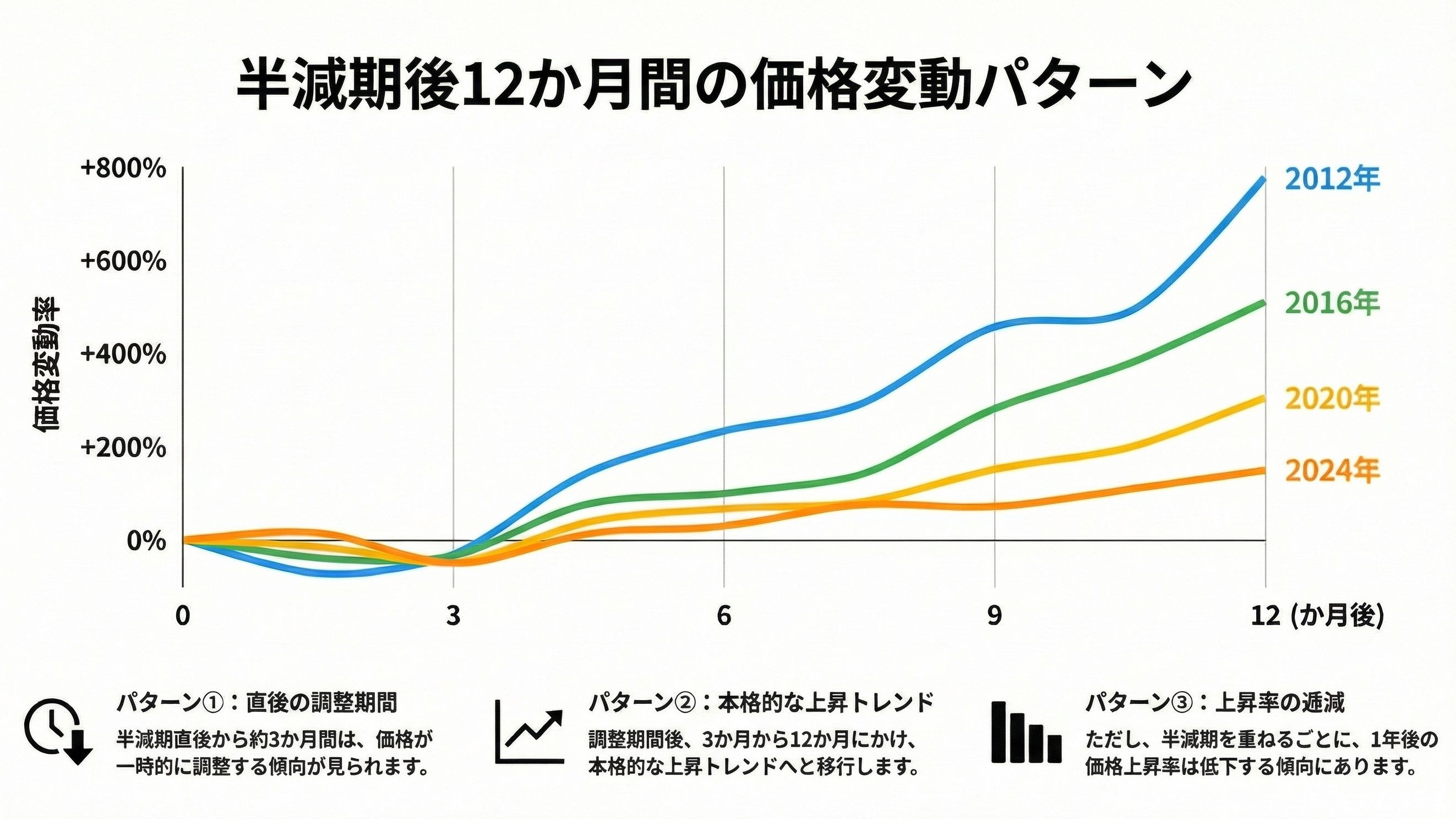
As is clear from this table, past halvings have always been followed by significant price increases within a year. However, there is a trend of the rate of increase declining with each cycle. This is likely due to the expansion of the market size and a relative decrease in volatility.
Common patterns before and after the halving
Analyzing historical data reveals the following common patterns:
- Prices begin to rise 6 to 12 months before the halving (heightened expectations)
- A temporary adjustment phase may occur immediately after the halving
- A full-scale bull market arrives 6 to 18 months after the halving
- After hitting an all-time high, the market enters another adjustment phase
Why does the halving tend to drive prices up?
The tendency for prices to rise after a halving is due to a combination of factors.
Reduced Supply:
When the halving cuts mining rewards in half, the amount of new Bitcoin supplied to the market also halves. If demand remains constant or increases while supply decreases, prices tend to rise according to basic economic principles.
Increased Scarcity:
Bitcoin's issuance is capped at 21 million, and with each halving, the remaining supply decreases. This increased scarcity boosts expectations for long-term value appreciation. Like gold, limited supply is a key factor supporting its value.
Market Expectations (Self-fulfilling Prophecy):
Because prices have risen after the past three halvings, market participants expect a similar rise in the next one. This expectation itself creates buying pressure, acting as a "self-fulfilling prophecy" that pushes prices up.
Changes in the Stock-to-Flow Ratio:
The Stock-to-Flow (S2F) ratio is an indicator showing the ratio of existing supply (stock) to new supply (flow). When the halving reduces the flow, the S2F ratio increases, further enhancing scarcity. Research shows that assets with higher S2F ratios, such as gold and Bitcoin, tend to have higher value.
However, past patterns do not always repeat. Various factors such as market environment, regulatory trends, and macroeconomic conditions affect prices, so it is impossible to predict prices based on the halving alone.
What happened after the April 2024 halving?
Bitcoin, which underwent its fourth halving in April 2024, followed a gradual upward trend over the subsequent months, reaching an all-time high in October 2025. Expectations built up from early 2024 leading into the halving, and prices maintained an upward trajectory.
The 2024 halving had a unique characteristic compared to the previous three: the approval of spot Bitcoin ETFs in the U.S. in January 2024, which led to the full-scale entry of institutional investors. The combination of reduced supply from the halving and increased demand from ETFs is believed to have led to the all-time high in 2025.
Looking ahead to the next halving in 2028
The next halving is expected to occur around 2028. The mining reward will be halved from 3.125 BTC to 1.5625 BTC.
What you should prepare now
There are things you can start preparing now for the 2028 halving.
- Start a long-term investment plan (Dollar-Cost Averaging)
- Understand the halving cycle and avoid emotional decision-making
- Hold Bitcoin as part of your portfolio
- Continuously learn about market trends and regulatory environment changes
Investment strategies with an understanding of the halving
Investment strategy based on the halving cycle
Understanding the halving pattern reveals a phased investment strategy:
Phase 1: 1–2 years before the halving
This is the perfect time to start a savings-style investment. Start purchasing a fixed amount every month using dollar-cost averaging when prices are relatively stable.
Phase 2: Immediately before the halving (from 6 months prior)
This is a period where prices are likely rising due to expectations. Be cautious about making large new purchases, and consider holding what you already have.
Phase 3: After the halving (6–18 months)
Historically, this is when a full-scale bull market arrives. Continue holding for the long term, and consider taking partial profits once your target price is reached.
Phase 4: 1 year before the next halving
This is when prices are likely to be hitting all-time highs. It is a good time to consider taking profits, though gradual profit-taking rather than selling everything at once may be better.
Important principles in investment strategy
- Invest only with surplus funds (aim for about 5–10% of your total assets)
- Use dollar-cost averaging to eliminate emotional decisions
- Thoroughly manage risk with TP/SL functions
- Refer to past patterns, but do not rely on them blindly
Why dollar-cost averaging is effective
Dollar-cost averaging (regular fixed-amount purchasing) is a very effective strategy for leveraging the halving cycle. As prices fluctuate significantly around the halving, purchasing a fixed amount every month helps diversify the risk of buying at the top.
In particular, by starting your savings 1–2 years before the halving and continuing after it, you can lower your average cost basis while benefiting from the long-term upward trend.
The importance of risk management
Even if you understand the halving pattern, the market can always move unexpectedly. Just because prices rose after the last three halvings does not mean the same pattern will repeat. Various risks exist, including changes in the regulatory environment, macroeconomic deterioration, and technical issues. Therefore, it is essential to thoroughly manage risk by investing only with surplus funds, diversifying your portfolio, and utilizing TP/SL functions.
Conclusion
The Bitcoin halving is an important event that occurs approximately every four years. The reduction in mining rewards decreases supply, and in all three previous halvings, significant price increases were seen within a year.
Even after the April 2024 halving, an all-time high was reached in October 2025, continuing the halving cycle pattern. However, the rate of increase has declined with each cycle, and there is no guarantee that the same pattern will repeat in the next 2028 halving.
By understanding the halving cycle and practicing long-term dollar-cost averaging, you can benefit from Bitcoin's growth while mitigating risk. However, always remember to invest only with surplus funds and maintain thorough risk management.
If you want to start planning your Bitcoin investment with an understanding of the halving cycle, WEEX is a great choice. We support spot and futures trading, allowing you to trade while controlling risk with TP/SL functions. Register or log in now to start your cryptocurrency trading journey.
Related Articles
Will Bitcoin Price Recover? A Thorough Explanation of 2025 Trends and 2026 Outlook
Bitcoin Price Prediction for December 2025 | What's Next?
Bitcoin Gains Momentum as Selling Pressure Eases
Disclaimer
WEEX and its affiliates provide digital asset exchange services, including derivatives and margin trading, only to eligible users in legally permitted regions. This content is for general information purposes only and is not investment advice. Always consult with a professional before trading. Cryptocurrency trading carries high risk, and you may lose all invested funds. By using WEEX services, you are deemed to have agreed to all associated risks and terms of service. Please invest within your means and exercise your own judgment. For details, please check our Terms of Service and Risk Disclosure.