
Why Should I Short SOL?


Original Author: The Giver
Original Translation: Ismay, BlockBeats
Editor's Note: This article provides an in-depth analysis of Solana's recent performance, discussing potential challenges from supply events, competitive pressures, complacency, among other perspectives, and predicts the future market trend. The author, through data and market phenomena, reveals Solana's potential concerns in terms of fund flows, ecosystem competition, and investor behavior, while also highlighting the changing trend of marginal buying and selling pressure in the market.
The following is the original content:
Here are some brief thoughts on Solana, mainly discussing why I believe Solana may underperform compared to other assets in December (I believe this trend has already started but will continue).
I opened a short position around ~$235-240 and believe this is the last excellent asymmetric opportunity of the year. However, it should be noted that I also hold short positions on other assets (such as Bitcoin, as the price gap between Saylor's buy-in price and the ETF is widening; also, I think if Ethereum falls, its downward trend may last even longer).
In summary, most of Solana's performance this year has not truly been tested, and its main driving force is running out (or in the process of running out).
Why will SOL underperform?
In my view, the real factors that have driven Solana to become the best-performing asset in the YTD among scalable assets this year include the following:
1. A more active and diversified ecosystem than its competitors, with fast transaction speeds;
2. The most powerful "casino" environment that has attracted many meme participants willing to use SOL as a unit of account;
3. Mid-year inflows — I believe many fund managers and large liquidity participants have been squeezed out due to the lack of ETH ETF heat, experiencing some form of "existence crisis" in future asset allocation.
Today, I believe the above three main driving forces have weakened and are highly vulnerable to shocks, with a significant amount of excess froth still needing to be trimmed. Here are my specific reasons:
As a speed- and diversity-focused leading L1, Solana faces a strong threat from HYPE and ETH/Base
The rise of these threats has been unexpected and remains inadequately addressed.
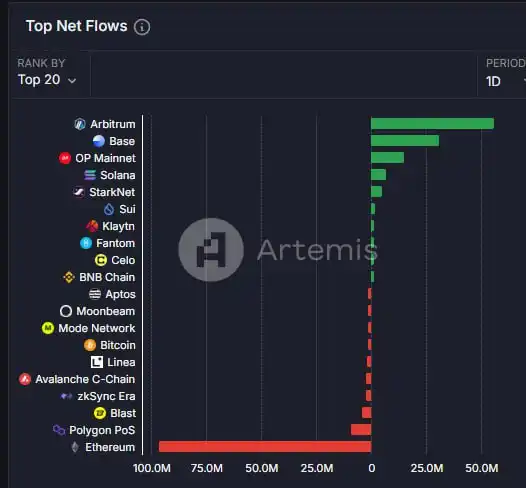
The chart below shows Artemis traffic data, where you can choose to view it over a 1-week or 1-month period. This is the most significant instance this year of Solana's capital flow shifting to EVM, a shift that is reflected not only in traffic. We can also observe this in popular domain use cases, such as the meme coin sector in the AI domain—previously considered top-tier projects like GOAT, FARTCOIN, ZEREBRO, and AI16Z have all halved in valuation during this period, while the VIRTUAL and proxy ecosystems have flourished.
Furthermore, I believe Solana has not faced a true competitor in the L1 space for quite some time. While the HYPE is still in its early stages, its pursuit of democratizing ownership and the team's demonstrated strength are attractions that cannot be ignored in the short term.
Solana has yet to experience a true supply shock event by 2024
In contrast, other major assets have already undergone severe tests, such as Bitcoin's MTGOX incident and regulatory issues in Germany, as well as Ethereum's ETF launch. Solana has almost been unaffected in this regard, with only a brief fluctuation during the Jump sell-off earlier this summer, quickly brushed aside as ETH's larger retracement diverted attention.
The period of the last few months has been Solana's time to shine as a high beta asset to Bitcoin, capturing much of the capital flow from Ethereum (a trend that has gradually dissipated) while attracting attention far beyond lackluster, unappealing small-cap altcoins.
In the realm of liquid funds, for the 2024 fiscal year, GPs should have only two options for realizing cash distributions:
1. Distribute based on a percentage of realized gains;
2. Distribute based on a percentage of unrealized gains but subject to clawback adjustment based on the prior year's high watermark.
In either case, given Solana's outstanding performance last year, I believe fund managers would lean toward selling SOL, reasons for which may include:
a) As the best-performing asset of the year, it has seen a significant price increase;
b) It is believed that parts of the portfolio that have previously underperformed still have untapped upside potential and are more worthy of holding, while also observing other altcoins that have shown trend strength recently on the H1/H4/1 timeframes to capture gains.
Furthermore, this trend is also being driven by the hype around the Galaxy Auction (SOL cost basis at $80-100). Fund managers participating in the auction can profit in the following ways:
For example, selling one-third of the locked supply purchased near historical highs and then "reclaiming" these tokens in the first unlock event in March of next year to realize the price difference in nominal value.
The exit liquidity of the SOL ETF weakened due to the rise of established tokens and the potential impact of the XRP ETF
XRP's performance is being driven by two main factors:
a) It is considered the asset most likely to launch an ETF product after ETH, closely linked with Bitwise;
b) Rumors of the U.S. cryptocurrency capital gains tax dropping to 0%.
Considering XRP's track record (as one of the earliest crypto assets) and SEC Chair Gary Gensler's resignation, even if the probability of an XRP ETF launch remains on par with or slightly lower than SOL, it is undeniable that it is diverting market share that originally belonged entirely to SOL.
Complacency
Although this sentiment is difficult to quantify precisely, intuitively, I believe Solana's arrogance has reached a bottleneck, contrasting the situation from a few years ago — back then, ETH caught up with SOL head-on due to its superior position, and that position acted as an impenetrable moat.
Here are some typical examples:
1. "Network Expansion vs. L2"; DRIFT compared to HL, demonstrating an "incorruptible" attitude;
2. Many claim "no one would ever want to bridge from Solana to Base," despite clear counterexamples;
3. Some users who were staunch supporters of ETH surrendered completely a few weeks before ETH's 35% surge, with some suddenly strongly predicting that the target price for ETHSOL would plummet to very low levels (e.g., 0.027 ETHSOL).
Summary
In the next 30 days, I believe the attractiveness of Solana to marginal buyers is at its weakest point this year (ETF liquidity significantly lags behind ETH; the attention on altcoins is more diversified than before), while the selling pressure from marginal sellers is at its strongest (profit-taking; users who have made significant gains through memes or holding SOL choosing to sell to cash out and hedge).
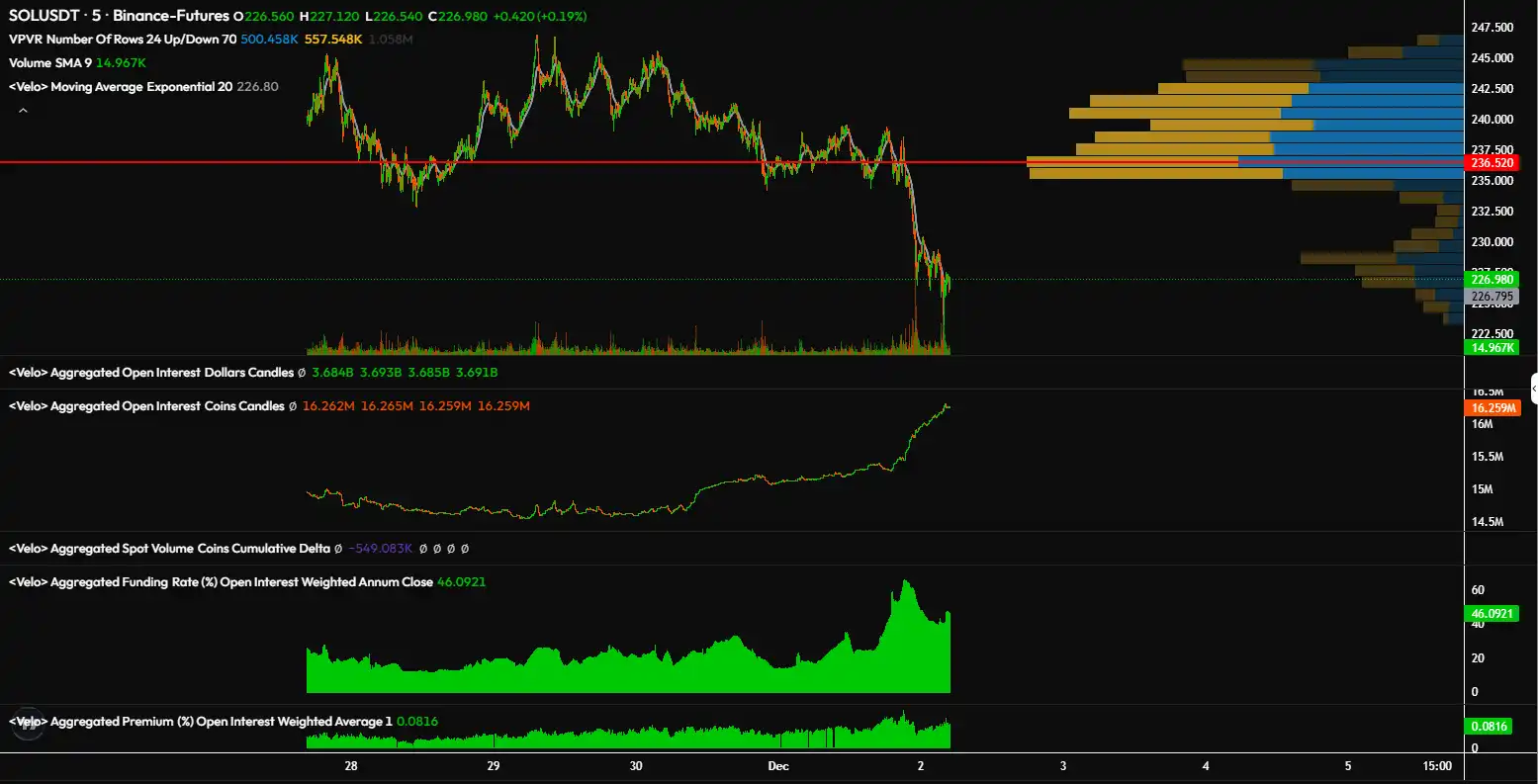
Furthermore, as the bulls attempt to drive the price up, the funding cost remains high, with this upward movement being entirely leveraged-driven and reflected in recent (yet short-lived) ATH breaches.
You may also like

Bloomberg: As Bitcoin Weakens, Stablecoins and RWA Continue to Drive Expansion in Crypto Businesses
In June, Bloomberg reported that despite Bitcoin falling below $60,000 last week, wiping out about $235 billion in market value within seven days, and dropping close to 50% from last year’s peak, some core businesses in the crypto industry are still expanding, mainly in stablecoins, real-world asset tokenization (RWA), payments, and infrastructure. The report also noted that overall altcoin activity has contracted significantly: altcoin market capitalization has fallen from a peak of about $431 billion in November 2021 to around $170 billion, and among the tens of millions of tokens issued in recent years, fewer than 1,700 still maintain meaningful trading activity.

Galaxy Deep Research Report: How Hyperliquid's HIP-4 Upgrade Changes the Landscape of Prediction Markets?

Binance Research: RWA Market Expected to Expand Nearly 6x from Early 2025, with Public Equities and Onchain Payments Heating Up Together
In June, Binance Research said in its monthly market report that the real-world asset (RWA) market is expected to grow by about 589% from the beginning of 2025. Bond- and money market fund-related RWA expanded by about $6.5 billion, up 83% year over year, while publicly traded equity RWAs grew by about 422%. The report also noted that monthly crypto debit card transaction volume exceeded $747 million in May, up 48.6% year to date.

Japan to Assess a Framework for Yen Stablecoins and Crypto ETFs as Asia’s Compliant Payments Narrative Heats Up
Recently, according to the original report, Japan is considering the launch of yen stablecoins and cryptocurrency ETFs. Public information remains limited at this stage, and there is still no complete policy text, regulatory draft, or clear implementation timeline, so this is better characterized as a “policy discussion” rather than formal implementation. The original wording also noted that advancing stablecoin regulation in Asia is driving XRP usage and supporting growth in the XRPL ecosystem. However, based on currently available public information, there is not enough evidence to directly establish a clear causal relationship between this round of discussion in Japan and XRP or XRPL.

ZachXBT: Humanity private key leak and abnormal surge in H token should be viewed separately
On June 9, according to related disclosures, on-chain investigator ZachXBT posted an update on Humanity’s roughly $31 million security incident, saying that after further analyzing fund flows, he currently tends to believe the project team was not involved in an “inside job” or a self-staged attack. According to him, the official explanation about the private key leak was broadly accurate, but before the token unlock, the price of H had been artificially pushed higher, and the hacker later took advantage of that market environment; therefore, the private key leak and the earlier abnormal price pumping should be regarded as two separate and independent events. This reframing has shifted the market’s understanding of the nature of the incident. Earlier discussion around Humanity had focused on whether the team directly participated in the attack or used the security incident to cover up internal operations. ZachXBT’s latest remarks shift the focus from “whether it was self-theft” to “whether there were pre-unlock market structure issues.” He also questioned whether the team may have.

Morning Report | OpenAI has submitted an S-1 registration statement draft to the U.S. SEC; Morpho completes $175 million financing

Morning Report | BitMine increased its holdings by 126,971 ETH last week; trader Eugene announced his exit from the crypto market

Wang Chuan: How can one not feel anxious after the neighbor Old Wang made thirty times profit by investing in storage stocks? (Seven) - A quarter-century cycle

Cryptocurrency CEXs are flocking to sell US stocks, and traditional brokerages are facing an "uninvited guest."
$75 billion in foreign capital has fled, and South Korean retail investors have absorbed it all using leverage

Japan’s Three Megabanks Plan Joint Stablecoin Issuance in Fiscal 2026
MUFG, SMBC, and Mizuho reportedly plan to jointly issue fiat-pegged stablecoins in fiscal 2026, signaling Japan’s growing push into bank-led digital payment infrastructure.

Humanity Discloses H Token Dual-Chain Attack Details, With Losses on Ethereum and BSC Exceeding $36 Million
Humanity said the H token attack across Ethereum and BSC caused more than $36 million in losses after leaked ProxyAdmin keys enabled malicious contract upgrades and token minting.
White House Discusses CLARITY Act With Law Enforcement Ahead of Senate Vote
The White House discussed the CLARITY Act with law enforcement ahead of a Senate vote, focusing on illicit finance risks and developer protections.

Bitcoin Trading Guide 2026: Strategies for Experienced Traders

What Is XAUT and PAXG? Why Tokenized Gold Is Booming in 2026

Will the SpaceX IPO Hurt Bitcoin? Here's What Traders Are Watching

Foreign selling in the South Korean stock market accelerates, with cumulative net sales reportedly reaching $75 billion this year
On June 9, The Kobeissi Letter, citing Goldman Sachs data, reported that global investors are selling South Korean stocks at an unusually rapid pace. In the latest trading session, foreign investors sold about $801 million worth of Kospi constituent stocks again; total foreign outflows last week reached about $10 billion, and the market has been in net foreign selling on nearly every trading day over the past month. According to the data cited in the report, foreign investors have sold about $75 billion worth of South Korean stocks so far this year. Meanwhile, South Korean retail and institutional investors together recorded roughly $69 billion in net buying over the same period, suggesting that the market’s main buying support has come from domestic capital rather than returning overseas funds. The information currently disclosed still mainly comes from The Kobeissi Letter’s retelling and Goldman Sachs data summaries, while public details on the statistical period and the specific definition of “selling” remain relatively limited.

Fortune Warns of Strategy’s Financing Structure Risks as Bitcoin Premium Narrows
Fortune warned that Strategy’s Bitcoin treasury model faces growing financing risks as MSTR’s net asset premium narrows and preferred stock dividend pressure increases.
Bloomberg: As Bitcoin Weakens, Stablecoins and RWA Continue to Drive Expansion in Crypto Businesses
In June, Bloomberg reported that despite Bitcoin falling below $60,000 last week, wiping out about $235 billion in market value within seven days, and dropping close to 50% from last year’s peak, some core businesses in the crypto industry are still expanding, mainly in stablecoins, real-world asset tokenization (RWA), payments, and infrastructure. The report also noted that overall altcoin activity has contracted significantly: altcoin market capitalization has fallen from a peak of about $431 billion in November 2021 to around $170 billion, and among the tens of millions of tokens issued in recent years, fewer than 1,700 still maintain meaningful trading activity.
Galaxy Deep Research Report: How Hyperliquid's HIP-4 Upgrade Changes the Landscape of Prediction Markets?
Binance Research: RWA Market Expected to Expand Nearly 6x from Early 2025, with Public Equities and Onchain Payments Heating Up Together
In June, Binance Research said in its monthly market report that the real-world asset (RWA) market is expected to grow by about 589% from the beginning of 2025. Bond- and money market fund-related RWA expanded by about $6.5 billion, up 83% year over year, while publicly traded equity RWAs grew by about 422%. The report also noted that monthly crypto debit card transaction volume exceeded $747 million in May, up 48.6% year to date.
Japan to Assess a Framework for Yen Stablecoins and Crypto ETFs as Asia’s Compliant Payments Narrative Heats Up
Recently, according to the original report, Japan is considering the launch of yen stablecoins and cryptocurrency ETFs. Public information remains limited at this stage, and there is still no complete policy text, regulatory draft, or clear implementation timeline, so this is better characterized as a “policy discussion” rather than formal implementation. The original wording also noted that advancing stablecoin regulation in Asia is driving XRP usage and supporting growth in the XRPL ecosystem. However, based on currently available public information, there is not enough evidence to directly establish a clear causal relationship between this round of discussion in Japan and XRP or XRPL.
ZachXBT: Humanity private key leak and abnormal surge in H token should be viewed separately
On June 9, according to related disclosures, on-chain investigator ZachXBT posted an update on Humanity’s roughly $31 million security incident, saying that after further analyzing fund flows, he currently tends to believe the project team was not involved in an “inside job” or a self-staged attack. According to him, the official explanation about the private key leak was broadly accurate, but before the token unlock, the price of H had been artificially pushed higher, and the hacker later took advantage of that market environment; therefore, the private key leak and the earlier abnormal price pumping should be regarded as two separate and independent events. This reframing has shifted the market’s understanding of the nature of the incident. Earlier discussion around Humanity had focused on whether the team directly participated in the attack or used the security incident to cover up internal operations. ZachXBT’s latest remarks shift the focus from “whether it was self-theft” to “whether there were pre-unlock market structure issues.” He also questioned whether the team may have.
Morning Report | OpenAI has submitted an S-1 registration statement draft to the U.S. SEC; Morpho completes $175 million financing


