
- Buy Crypto
- Markets
 Futures
- Spot
- Copy Trade
- Earn
- More
MCP In-Depth Research Report: Protocol New Infrastructure in the AI+Crypto Mega Trend

Original Title: "Huobi Growth Academy: MCP In-Depth Report: Protocol New Infrastructure in the AI+Crypto Megatrend"
Original Source: Huobi Growth Academy
Abstract:
As artificial intelligence (AI) and blockchain (Crypto) technologies gradually merge, the global digital economy is undergoing a profound transformation. The combination of AI+Crypto has not only brought new development opportunities to traditional industries but also provided innovative business models for the crypto market and the digital asset field. In this trend, the MCP (Model Context Protocol) protocol, as a key protocol for deep integration of AI and blockchain, is providing a new solution for the decentralized assetization of AI models with its decentralized, transparent, and traceable characteristics.
Chapter One AI+Crypto: The Accelerating Convergence of a Dual Wave
Since 2024, we have been hearing the phrase "AI+Crypto" more and more frequently. From the emergence of ChatGPT to the successive launch of multimodal super-scale models by emerging model institutions such as OpenAI, Anthropic, and Mistral, and to various DeFi protocols, governance systems, and even NFT social platforms in the on-chain world attempting to integrate AI Agents, the convergence of this "dual technological wave" is no longer a distant imagination but has become a new paradigm evolution happening in reality.
The fundamental driving force of this trend comes from the complementary nature of the two major technological systems on the demand side and the supply side. The development of AI has enabled the migration of "task execution" and "information processing" from humans to machines, but it still faces fundamental limitations such as "lack of contextual understanding," "lack of incentive structures," and "untrustworthy outputs." The data system, incentive design mechanisms, and programmatic governance frameworks provided by Crypto can precisely address these shortcomings of AI. Conversely, the Crypto industry urgently needs more intelligent tools to handle highly repetitive tasks such as user behavior, risk management, and transaction execution, which are precisely the strong suits of AI.
In other words, Crypto provides a structured world for AI, while AI injects proactive decision-making capabilities into Crypto. This underlying technological integration forms a new deep-seated landscape of "mutual infrastructure." A notable example is the emergence of "AI Market Makers" in DeFi protocols. These systems use AI models to model market fluctuations in real-time and, combining on-chain data, order book depth, cross-chain sentiment indicators, and other variables, achieve dynamic liquidity scheduling, replacing traditional static parameter models. In governance scenarios, AI-assisted "Governance Agents" are beginning to parse proposal content, user intent, predict voting tendencies, and provide users with personalized decision-making recommendations. In this scenario, AI is not just a tool but is gradually evolving into an "on-chain cognitive executor."
Furthermore, from a data perspective, on-chain behavioral data inherently possesses verifiable, structured, and censorship-resistant attributes, making it an ideal training material for AI models. Some emerging projects (such as Ocean Protocol, Bittensor) have already attempted to incorporate on-chain behavior into the model fine-tuning process, and in the future, we may even see the emergence of a "On-Chain AI Model Standard," enabling models to have native Web3 semantic understanding capabilities during training.
Simultaneously, the on-chain incentive mechanisms also provide AI systems with a more robust and sustainable economic incentive compared to Web2 platforms. For example, through the Agent incentive protocol defined by the MCP protocol, model executors no longer rely on API call billing but can instead receive token rewards through on-chain "task execution proof + user intent fulfillment + traceable economic value." In other words, AI agents can now, for the first time, "participate in the economic system" rather than just being nested as a tool within it.
From a more macro perspective, this trend is not just about technological integration but also a paradigm shift. AI+Crypto could eventually evolve into a "On-Chain Social Structure with Agents at its core": humans are no longer the sole governors, models on-chain can not only execute contracts but also understand context, coordinate games, engage in active governance, and establish their microeconomies through token mechanisms. This is not science fiction but a reasonable extrapolation based on the current technological trajectory.
It is precisely for this reason that the AI+Crypto narrative has rapidly gained significant attention from the capital markets in the past half year. From a16z, Paradigm to Multicoin, from Eigenlayer's "Validator Market" to Bittensor's "Model Mining," and to the recent launches of projects like Flock, Base MCP, we see a consensus gradually forming: AI models in Web3 will play not only the role of a "tool" but that of a "subject" – they will have an identity, context, incentives, and even governance rights.
It can be foreseen that in the Web3 world post-2025, AI agents will be inevitable system participants. This form of participation is not the traditional access of "off-chain model + on-chain API" but is gradually evolving into a new form where "models are nodes" and "intent is the contract." Behind this transformation lies a new set of protocols such as MCP (Model Context Protocol) constructing a semantic and execution paradigm.
The fusion of AI and Crypto represents one of the few "bottom-layer to bottom-layer" integration opportunities in the past decade. This is not a singular hot spot outbreak but a long-cycle, structural evolution. It will determine how AI operates, coordinates, and is incentivized on-chain, and ultimately, it will define the future form of on-chain social structures.
Chapter 2 Background and Core Mechanism of MCP Protocol
The integration of AI and encryption technology is transitioning from the conceptual exploration stage to the key phase of practical validation. Especially since 2024, large models represented by GPT-4, Claude, and Gemini have begun to possess stable context management, complex task decomposition, and self-learning capabilities. AI is no longer just providing "off-chain intelligence," but gradually gaining the ability for on-chain continuous interaction and autonomous decision-making. Meanwhile, the encryption world itself is undergoing structural evolution. The maturity of technologies such as Modular Blockchain, Account Abstraction, Rollup-as-a-Service has greatly increased the flexibility of on-chain execution logic, clearing the environmental barriers for AI to become a native participant in the blockchain.
In this context, the MCP (Model Context Protocol) is proposed with the goal of building a universal protocol layer for AI models to run, execute, provide feedback, and receive rewards on-chain. This is not only to address the technical challenge of "AI cannot efficiently use on-chain," but also to respond to the systemic demand of the Web3 world transitioning to an "Intent-centric Paradigm." Traditional smart contract invocation logic requires users to have a high understanding of the chain's state, function interfaces, and transaction structure, creating a significant gap with natural user expression. The intervention of AI models can bridge this structural gap. However, for an AI model to be effective, it must have "identity," "memory," "permissions," and "economic incentives" on-chain. The MCP protocol is born to address this series of bottlenecks.
Specifically, the MCP is not a single independent model or platform but a full-chain semantic layer protocol that runs through AI model invocation, context construction, intent understanding, on-chain execution, and incentive feedback. Its design core revolves around four aspects: firstly, the establishment of the model identity mechanism. In the MCP framework, each model instance or agent has an independent on-chain address and can receive assets, initiate transactions, and call contracts through a permission verification mechanism, thus becoming a "first-class account" in the blockchain world. Secondly, context collection and semantic interpretation system. This module abstracts on-chain state, off-chain data, historical interaction records, and combines natural language input to provide the model with a clear task structure and environmental background, enabling it to have a "semantic context" for executing complex instructions.
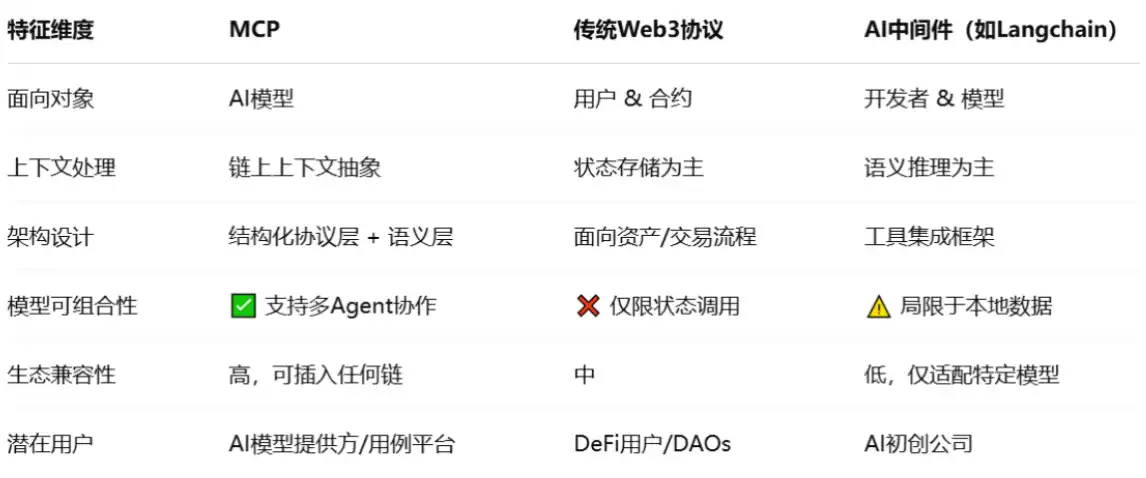
Several projects have already begun to build prototype systems around the MCP concept. For example, Base MCP is attempting to deploy AI models as publicly callable on-chain agents, serving scenarios such as transaction strategy generation and asset management decisions. Flock is constructing a multi-agent collaboration system based on the MCP protocol, allowing multiple models to dynamically collaborate on the same user task. Projects like LyraOS and BORK are further attempting to extend MCP into the foundation layer of a "model operating system," where any developer can build model plugins with specific capabilities on top of it and make them available for others to call, thereby forming a shared on-chain AI service marketplace.
From the perspective of a crypto investor, the introduction of MCP brings not only a new technological path but also an opportunity for industrial restructuring. It has opened up a new "native AI economic layer" where models are not just tools but economic participants with accounts, credit, earnings, and an evolutionary path. This means that in the future of DeFi, liquidity providers may be models, DAO governance voting participants may be models, NFT ecosystem content curators may be models, and even on-chain data itself may be analyzed, combined, and repriced by models, thereby creating entirely new "AI behavior data assets." Investment thinking will therefore shift from "investing in an AI product" to "investing in an incentive hub, service aggregation layer, or cross-model coordination protocol within an AI economic layer." As the foundational semantic and execution interface protocol, MCP's potential network effects and standardization premium are well worth medium to long-term attention.
As more models enter the Web3 world, the closed loop of identity, context, execution, and incentives will determine whether this trend can truly take off. MCP is not a singular breakthrough but rather an "infrastructure-level protocol" that provides a consensus interface for the entire AI+Crypto wave. It seeks to address not only the technical question of "how to get AI on-chain" but also the economic question of "how to incentivize AI to continuously create value on-chain."
Chapter 3 Typical Landing Scenarios of AI Agents: How MCP Refactors On-Chain Task Patterns
When an AI model truly has on-chain identity, semantic context awareness, can interpret intent, and execute on-chain tasks, it is no longer just a "tool" but becomes a substantive on-chain Agent, serving as the active entity of logic execution. And this is precisely the greatest significance of the MCP protocol—its purpose is not to make any single AI model stronger but to provide a structured path for AI models to enter the blockchain world, interact with contracts, collaborate with humans, and interact with assets. This path includes not only underlying capabilities such as identity, permissions, and memory but also intermediate operations such as task decomposition, semantic planning, and fulfillment proof, ultimately leading to the possibility of AI Agents actually participating in building the Web3 economic system.
Starting from the most realistic applications, on-chain asset management is the first area where AI Agents are most likely to penetrate. In past DeFi scenarios, users needed to manually configure wallets, analyze liquidity pool parameters, compare APYs, and set strategies, a process that was highly unfriendly to ordinary users. However, with an AI Agent based on MCP, after gaining intentions such as "optimizing yield" or "controlling risk exposure," it can automatically crawl on-chain data, assess risk premiums of different protocols, expected volatility, dynamically generate trade strategy combinations, and then verify the security of the execution path through simulation or on-chain live testing. This model not only enhances the personalization and response speed of strategy generation but, more importantly, enables non-professional users to, for the first time, delegate assets in natural language, making asset management no longer a highly technical barrier.
Another rapidly maturing scenario is on-chain identity and social interaction. Previous on-chain identity systems were mostly based on transaction history, asset ownership, or specific proof mechanisms (such as POAP), with very limited expressiveness and malleability. However, with AI models getting involved, users can have a "semantic agent" that is continuously synchronized with their preferences, interests, and behavioral dynamics. This agent can enable users to participate in social DAOs, publish content, plan NFT events, and even help users maintain their on-chain reputation and influence. For example, some social chains have already started deploying Agents that support the MCP protocol to automatically assist new users in completing the onboarding process, building a social graph, participating in comments and votes, thereby transforming the "cold start problem" from a product design issue to an intelligent agent participation issue. Furthermore, in a future where identity diversity and personality forking are widely accepted, a user may have multiple AI agents, each used in different social contexts, with MCP becoming the "identity governance layer" managing the behavior guidelines and execution permissions of these agents.
The third key focus of the AI Agent is governance and DAO management. In current DAOs, activity levels and governance participation rates have always been bottlenecks, and the voting mechanism has strong technical barriers and behavioral noise. With the introduction of MCP, Agents with semantic parsing and intent understanding capabilities can help users regularly review DAO dynamics, extract key information, provide semantic summaries of proposals, and recommend voting options or automatically execute voting based on understanding user preferences. This on-chain governance mechanism based on the "preference agent" greatly alleviates information overload and incentive misalignment issues. Additionally, the MCP framework allows models to share governance experiences and strategy evolution paths among models. For example, if an Agent observes negative externalities caused by a certain type of governance proposal in multiple DAOs, it can provide feedback to the model itself, forming a mechanism for transferring governance knowledge across communities and building increasingly "intelligent" governance structures.
In addition to the mainstream applications mentioned above, MCP also provides a unified interface for AI in on-chain data curation, game world interaction, ZK automatic proof generation, cross-chain task relay, and other scenarios. In the Play-to-Earn Gaming (GameFi) field, the AI Agent can act as the behind-the-scenes brain for non-player characters (NPCs), enabling real-time dialogue, story generation, task scheduling, and behavioral evolution. In the NFT content ecosystem, models can serve as "semantic curators," dynamically recommending NFT collections based on user interests and even generating personalized content. In the ZK field, models can quickly translate intent into ZK-friendly constraint systems through structured compilation, simplifying the zero-knowledge proof generation process and enhancing the universality of development barriers.
The commonality among these applications clearly shows that the MCP protocol is not changing the performance of a single application, but rather the paradigm of task execution itself. Traditional Web3 task execution is built on the premise of "knowing how to do it" — users must have a clear understanding of contract logic, transaction structure, network fees, and other underlying knowledge. MCP, on the other hand, transforms this paradigm into "you only need to express what you want to do," leaving the rest to the model to complete. The middleware layer for user-to-chain interaction has shifted from a code interface to a semantic interface, from function calls to intent orchestration. This fundamental transformation elevates AI from a "tool" to an "agent of behavior" and transforms blockchain from a "protocol network" to an "interactive context."
Chapter 4 In-Depth Analysis of the Market Outlook and Industry Applications of the MCP Protocol
As an avant-garde innovation integrating AI and blockchain technology, the MCP protocol has not only brought a new economic model to the crypto market but also provided fresh development opportunities for multiple industries. With the continuous advancement of AI technology and the expanding blockchain application scenarios, the market outlook of the MCP protocol will gradually reveal its enormous potential. This chapter will delve into the application prospects of the MCP protocol in various industries and conduct an in-depth exploration from market dynamics, technological innovation, industrial chain integration, and other aspects.
4.1 Market Potential of AI+Crypto Integration
The integration of AI and blockchain has become a significant force driving the global economic digital transformation. Particularly, under the impetus of the MCP protocol, AI models can not only execute tasks but also engage in value exchange on the blockchain, becoming an independent economic entity. With the continuous development of AI technology, an increasing number of AI models are starting to undertake practical market tasks, participating in various fields such as commodity production, service delivery, financial decision-making, and more. Simultaneously, the decentralization, transparency, and tamper-resistant features of blockchain provide an ideal trust mechanism for AI models, enabling them to be rapidly implemented and applied in multiple industries.
It is expected that the integration of AI with the crypto market will experience explosive growth in the coming years. As one of the pioneers of this trend, the MCP protocol will gradually occupy a significant position, especially in the fields of finance, healthcare, manufacturing, smart contracts, and digital asset management. The emergence of AI-native assets has not only created abundant opportunities for developers and investors but also brought unprecedented disruptive impact to traditional industries.
4.2 Diversification of Market Applications and Cross-Industry Collaboration
The MCP protocol has brought possible cross-industry integration and collaboration to multiple sectors. Especially in industries such as finance, healthcare, and the Internet of Things, the application of the MCP protocol will greatly drive innovation and development in various fields. In the financial industry, the MCP protocol can deepen the DeFi ecosystem by providing tradable "revenue rights" assets for AI models. Users can invest not only in the AI model itself but also trade model revenue rights on decentralized finance platforms through smart contracts. This model provides investors with a more diverse investment selection and may encourage more traditional financial institutions to expand into the blockchain and AI domains.
In the healthcare field, the MCP protocol can support AI applications in precision medicine, drug development, disease prediction, and more. AI models analyze large amounts of medical data to generate disease prediction models or drug development directions, and collaborate with healthcare institutions through smart contracts. This collaboration not only enhances the efficiency of healthcare services but also provides a transparent and fair solution for data privacy protection and outcomes distribution. The incentive mechanism of the MCP protocol ensures that the interests of AI models and healthcare service providers are equally distributed, thereby encouraging the emergence of more innovative technologies.
The Internet of Things (IoT) will also benefit from the MCP protocol, especially in applications within smart homes and smart city development. AI models can provide intelligent decision support for IoT devices by analyzing real-time sensor data. For example, AI can optimize energy consumption based on environmental data, improve collaboration efficiency between devices, and reduce the overall system costs. The MCP protocol provides reliable incentives and reward mechanisms for these AI models, ensuring the participation of all parties and driving further development of the IoT.
4.3 Technological Innovation and Industry Chain Integration
The market prospects of the MCP protocol lie not only in its technological breakthroughs but also in its ability to promote the integration and collaboration of the entire industry chain. In the integration of blockchain and AI, the MCP protocol will facilitate the deep integration of the industry chain, break traditional industry barriers, and promote cross-industry resource integration. For instance, in the sharing of AI training data and algorithm optimization, the MCP protocol can provide a decentralized platform, enabling parties to share computing resources and training data without relying on traditional centralized institutions. Through decentralized transactions, the MCP protocol helps break the data silos in traditional industries, promoting data flow and sharing.
Furthermore, the MCP protocol will further drive the open-sourcing and transparency of technology. Through blockchain-based smart contracts, developers and users can autonomously customize and optimize AI models. The decentralized nature of the MCP protocol allows innovators and developers to collaborate in an open ecosystem, sharing technological achievements, which supports the overall industry's technological progress and innovation. Meanwhile, the combination of blockchain and AI expands the application scenarios of technology continuously, from finance to manufacturing, from healthcare to education, the MCP protocol has a broad application space.
4.4 Investment Perspective: Future Capital Markets and Commercialization Potential
As the MCP protocol becomes more widespread and mature, investor interest in this field will continue to rise. The MCP protocol provides investors with various participation methods through decentralized reward mechanisms and asset-backed model profits. Investors can directly purchase the revenue rights of AI models and gain returns through the model's market performance. Additionally, the tokenomics design in the MCP protocol also offers a new investment type for the capital market. In the future digital asset market, AI model assets based on the MCP protocol may become an important investment target, attracting various capital entries, including venture capital, hedge funds, and individual investors.
Participation in the capital markets will not only drive the adoption of the MCP Protocol but also accelerate its commercialization process. Enterprises and developers can obtain funding support for further development and optimization of AI models through financing, sale, or licensing of the revenue rights to AI models. In this process, the flow of capital will become a significant force driving technological innovation, market application, and industry expansion. Investor confidence in the MCP Protocol will directly impact its position and business value in the global market.
Chapter 5 Conclusion and Future Outlook
The MCP Protocol represents a significant direction for the integration of AI with the crypto market, especially in decentralized finance (DeFi), data privacy protection, smart contract automation, and AI assetization. It has demonstrated enormous potential for development. As AI technology advances, more industries will gradually embrace AI empowerment, and the MCP Protocol provides a decentralized, transparent, and traceable operating platform for these AI models. Within this framework, not only can the efficiency and value of AI models be enhanced, but they can also gain broad market acceptance.
Over the past few years, blockchain technology and artificial intelligence (AI) have gradually transitioned from their respective independent fields to integration. With the continuous development of technology, the combination of AI and blockchain has not only provided new solutions for various industries but also driven the emergence of entirely new business models. The MCP Protocol has emerged in this context, leveraging the decentralized and incentive mechanisms, utilizing the complementary advantages of AI and blockchain, and bringing unprecedented innovation to the crypto market. As AI and blockchain technologies continue to mature, the MCP Protocol will not only reshape the ecosystem of the digital asset economy but also provide new impetus for global economic transformation.
From an investment perspective, the application of the MCP Protocol will attract a significant inflow of capital, especially from venture capital and hedge funds seeking innovative investment opportunities. As more AI models can be assetized, traded, and value-added through the MCP Protocol, the resulting market demand will further drive the protocol's adoption. Additionally, the decentralized nature of the MCP Protocol means it can avoid single points of failure in centralized systems, enhancing its long-term stability in the global market.
In the future, as the ecosystem of the MCP Protocol becomes increasingly robust, AI and crypto assets based on the protocol may become mainstream investment tools in the digital currency and financial markets. These AI assets can not only serve as value-added tools in the crypto market but may also develop into significant financial commodities on a global scale, driving the formation of a new global economic landscape.
This article is a contributed submission and does not represent the views of BlockBeats.
You may also like

Crypto Price Prediction Today 18 February – XRP, Bitcoin, Ethereum
Key Takeaways XRP’s potential as a replacement for SWIFT is bolstered by regulatory approvals, potentially driving its price…

XRP Price Prediction: XRP is Outpacing Solana and Targeting Binance Coin Next – Should You Invest Now?
Key Takeaways XRP Ledger has moved into the sixth place by tokenized real-world asset value, surpassing Solana and…

New AI Predicts the Price of XRP, Dogecoin, and Solana By 2026
Key Takeaways ChatGPT anticipates significant price increases for XRP, Dogecoin, and Solana by the end of 2026. XRP…

Arthur Hayes Shares Two Scenarios for Bitcoin Price, Calling for a Major Crypto Rally
Key Takeaways Arthur Hayes predicts a significant crypto rally fueled by a $572 billion liquidity injection from the…

Bitcoin Price Prediction: Abu Dhabi Gov Funds Buy $1 Billion in BTC – What Do They Know?
Key Takeaways Abu Dhabi has revealed a $1 billion stake in Bitcoin through major ETF investments, signaling strong…

Bitcoin’s Divergence From Nasdaq Signals Dollar Liquidity Risk, Says Arthur Hayes
Key Takeaways Arthur Hayes highlights a concerning divergence between Bitcoin and the Nasdaq, pointing to a potential dollar…

Lagarde’s Possible Early Exit Could Alter Digital Euro Plans and Stablecoin Oversight
Key Takeaways Christine Lagarde’s potential departure as ECB president may disrupt the digital euro timeline and stablecoin policies.…
HYLQ Strategy Invests in Hyperliquid Quantum Solutions Pioneer qLABS, Acquires 18,333,334 qONE Tokens
Key Takeaways HYLQ Strategy Corp has made a strategic investment in qLABS, purchasing over 18 million qONE tokens…

WLFI Crypto Surges Toward $0.12 as Whale Purchase Precedes Trump-Linked Forum
Key Takeaways Whale accumulation has spurred a rally in WLFI crypto prices, reaching towards $0.12 ahead of a…
Cathie Wood Reverses Path with $6.9 Million Purchase in Coinbase Stock – Is ARK Strategizing a Rebound?
Key Takeaways ARK Invest acquires 41,453 shares of Coinbase, showing renewed interest post recent divestment. This acquisition by…
Crypto Lobby Establishes Working Group to Advocate for Prediction Market Regulatory Clarity
Key Takeaways The Digital Chamber announced the Prediction Markets Working Group to promote federal oversight of prediction markets.…

Peter Thiel Discreetly Withdraws from Ethereum Treasury Venture ETHZilla – A Cautionary Note for the DAT Model?
Key Takeaways Peter Thiel and Founders Fund have completely exited their position in ETHZilla. Thiel’s withdrawal raises questions…

Coin Center Advocates Protecting Crypto Developer Liability
Key Takeaways Coin Center is actively lobbying the U.S. Senate to safeguard crypto developer liability protections. The ongoing…

$150B in US Tax Refunds Could Catalyze Fresh Crypto Inflows, Historical Trends Indicate
Key Takeaways The IRS anticipates distributing approximately $150 billion in tax refunds to U.S. consumers by the end…

Oracle Error Leads DeFi Lender Moonwell to $1.8 Million in Bad Debt
Key Takeaways A critical oracle pricing glitch caused Moonwell to incur nearly $1.8 million in bad debt. The…
Crypto Price Prediction Today 18 February – XRP, Solana, Dogecoin
Key Takeaways XRP targets a $5 move, driven by its role as an alternative to SWIFT for cross-border…

China’s DeepSeek AI Predicts the Price of XRP, PEPE, and Shiba Inu By the End of 2026
Key Takeaways DeepSeek AI suggests significant potential price increases for XRP, PEPE, and Shiba Inu by 2026. XRP…

XRP Battles Key Support Amid Grayscale Sentiment Surge
Key Takeaways XRP has experienced a 29% price drop recently, creating a tense atmosphere among traders eyeing key…
Crypto Price Prediction Today 18 February – XRP, Bitcoin, Ethereum
Key Takeaways XRP’s potential as a replacement for SWIFT is bolstered by regulatory approvals, potentially driving its price…
XRP Price Prediction: XRP is Outpacing Solana and Targeting Binance Coin Next – Should You Invest Now?
Key Takeaways XRP Ledger has moved into the sixth place by tokenized real-world asset value, surpassing Solana and…
New AI Predicts the Price of XRP, Dogecoin, and Solana By 2026
Key Takeaways ChatGPT anticipates significant price increases for XRP, Dogecoin, and Solana by the end of 2026. XRP…
Arthur Hayes Shares Two Scenarios for Bitcoin Price, Calling for a Major Crypto Rally
Key Takeaways Arthur Hayes predicts a significant crypto rally fueled by a $572 billion liquidity injection from the…
Bitcoin Price Prediction: Abu Dhabi Gov Funds Buy $1 Billion in BTC – What Do They Know?
Key Takeaways Abu Dhabi has revealed a $1 billion stake in Bitcoin through major ETF investments, signaling strong…
Bitcoin’s Divergence From Nasdaq Signals Dollar Liquidity Risk, Says Arthur Hayes
Key Takeaways Arthur Hayes highlights a concerning divergence between Bitcoin and the Nasdaq, pointing to a potential dollar…


 App
App