
Ethereum Foundation Researcher Claims: Solana's Golden Age is Over, Will be Surpassed by ETH L2


Original Title: "Ethereum Foundation Researcher: Solana's Golden Age is Over! Two Major Advantages Will Be Overtaken by ETH L2"
Original Author: Ting, BlockTempo of Doo Wan Inc.
During this bull market cycle, the public blockchain Solana, with its fast transaction speed and low gas fees, has dominated the majority of the meme season frenzy traffic, and on November 22, the SOL token price broke through $260, hitting a new all-time high.
In contrast, the leading blockchain Ethereum has not seen significant breakthroughs in recent ecosystem development, coupled with high gas fee issues, causing on-chain users to stay away, thereby keeping the Ethereum price continuously sluggish.
However, Ethereum Foundation researcher Justin Drake recently stated that Solana's good days may be coming to an end.
Ethereum Foundation Researcher: Solana's Golden Age Coming to an End
The crypto media outlet The Defiant tweeted today (29th) that in the latest episode of the podcast, Ethereum Foundation researcher Justin Drake discussed how Ethereum Layer 2 is poised to surpass Solana in terms of latency and throughput, bluntly stating that Solana's golden age is about to end:
Bitcoin, Ethereum, and Solana: Different Focuses of Competition
Justin Drake:
To sum up this competition, you could say: on one hand, Bitcoin's competitive advantage lies in its stability, Lindy effect (historical persistence), and monetary properties; whereas Beam Chain's focus is to maximize Ethereum Layer 1's efficiency, making its competition with Bitcoin more direct. On the other hand, Solana's core is its performance.
In my model, Solana's competitor is actually Ethereum's Layer 2, not Layer 1 itself. For Solana, the good news is that it has excelled in two key performance indicators in the past year or two: latency and throughput.
Solana's Advantages Fading: Latency and Throughput
Justin Drake:
In terms of Latency, Solana has a very short slot time. However, for Ethereum, the arrival of a pre-confirmation mechanism will significantly improve latency, even surpassing Solana. Currently, Solana's average latency is 200 milliseconds. But the pre-confirmation mechanism will reduce latency to around 10 milliseconds, meaning a 20x improvement in slot latency.
In terms of Throughput, this year we have witnessed the thriving development of Layer 2. A website, rollup.wtf, shows the growth of throughput from a computational perspective (measured in gas per second). Ethereum aims to have the entire ecosystem process as many transactions as possible, and Layer 2 has demonstrated its ability to horizontally scale. Currently, the overall throughput of Layer 2 is about 100 times higher than Ethereum Layer 1, and it is very likely to grow to 1,000 times or even 10,000 times next year. This is a sustainable and scalable architecture.
Meanwhile, Solana's strategy is to concentrate all activity on a single server. Each validation node requires a large server to handle all activities, but the performance of these servers has basically reached its limit, so a significant increase in throughput is not possible. I believe Solana will not be able to increase its gas limit by 10x next year, while Ethereum is likely to expand the overall gas limit by 10x through Layer 2.
In summary, we may be about to see the end of Solana's golden age, as its two once-proud performance metrics will no longer provide a competitive advantage.
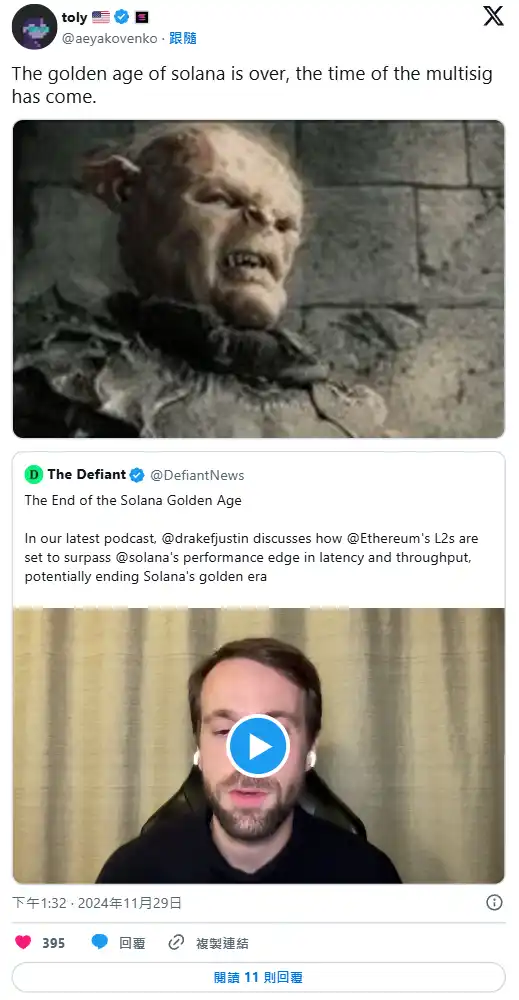
Interestingly, Solana co-founder Anatoly Yakovenko also referenced a tweet from The Defiant and an accompanying image:
"Solana's golden age is over, the era of multi-sigs has come."
This tweet seems to have a sarcastic tone, suggesting that the Ethereum Foundation lacks practical accomplishments and only uses the statement "Ethereum is about to surpass Solana" to motivate users and developers within its ecosystem. (Note: The Ethereum ecosystem places great emphasis on technologies such as multi-signature, account abstraction, etc.)
The Ethereum Foundation Invests Millions of Dollars in zkVMs
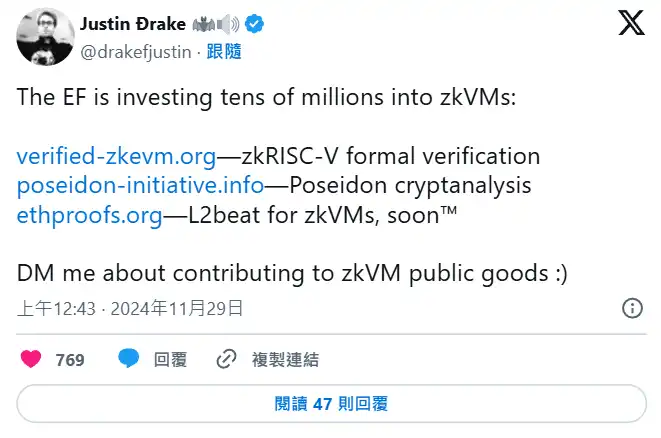
On the other hand, Ethereum Foundation researcher Justin Drake also tweeted today (29) that the Ethereum Foundation is investing tens of millions of dollars in the zkVMs project, including zkRISC-V formal verification, Poseidon cryptanalysis, and L2beat for zkVMs.
You may also like

CFTC Reportedly Plans New Prediction Market Rules Focused on Manipulation Risk and Public Interest Review
The CFTC is reportedly preparing new prediction market rules focused on manipulation risk, public interest review, and retail trader protections.

Meet the new WEEX trial fund—your gateway to greater profits

WEEX Labs Lands at Dutch Blockchain Week: A Disruptive Crypto × AI Conversation Sets Sail in Amsterdam

SK Hynix Reportedly Plans U.S. ADR Listing as Early as August, With SEC Approval Possible in Late June
SK Hynix may pursue a U.S. ADR listing as early as August, with SEC approval reportedly possible in late June amid strong AI chip supply chain demand.

SpaceX vs Tesla vs xAI: Which Elon Musk Trade Has the Biggest Upside in 2026?
OpenAI Reveals It Has Confidentially Submitted an S-1 to the SEC, Keeping the Door Open for a Future IPO
On June 9, according to an OpenAI announcement, the company recently confidentially submitted a draft S-1 registration statement to the U.S. Securities and Exchange Commission (SEC), beginning the preliminary compliance process for a potential initial public offering. OpenAI said it chose to disclose this proactively because it expected the news might leak; however, the company has not yet set a specific listing timeline, and related arrangements may still take some time.

Latest research from 13 top universities including Cornell University: The current state, challenges, and misconceptions of the fusion of Crypto and AI
Deconstructing Anthropic: The Best AI Company, Possibly Also a Type of Organizational Invention
Apollo and Blackstone Reportedly Back $35 Billion Anthropic Chip Financing as Deal Details Remain Unclear
On June 9, according to currently available news alerts, Apollo and Blackstone Group participated in a $35 billion financing for an Anthropic “chip project.” Based on the original wording of the report, the funding has already been raised, but public information remains limited. The financing structure, use of proceeds, project entity, and whether Apollo and Blackstone participated through equity, debt, or project financing have not yet been disclosed.

Humanity Protocol Security Incident Escalates: More Than $31 Million Stolen From Related Addresses as Attacker Continues Selling H for ETH
On June 9, according to monitoring by Onchain Lens, more than $31 million has been stolen from addresses linked to Humanity Protocol, and the attack is still ongoing, with the hacker continuously swapping H tokens for ETH. Project founder Terence Kwok later confirmed the security incident on X, saying the issue involved a private key leak.

Bloomberg: As Bitcoin Weakens, Stablecoins and RWA Continue to Drive Expansion in Crypto Businesses
In June, Bloomberg reported that despite Bitcoin falling below $60,000 last week, wiping out about $235 billion in market value within seven days, and dropping close to 50% from last year’s peak, some core businesses in the crypto industry are still expanding, mainly in stablecoins, real-world asset tokenization (RWA), payments, and infrastructure. The report also noted that overall altcoin activity has contracted significantly: altcoin market capitalization has fallen from a peak of about $431 billion in November 2021 to around $170 billion, and among the tens of millions of tokens issued in recent years, fewer than 1,700 still maintain meaningful trading activity.

Galaxy Deep Research Report: How Hyperliquid's HIP-4 Upgrade Changes the Landscape of Prediction Markets?
Binance Research: RWA Market Expected to Expand Nearly 6x from Early 2025, with Public Equities and Onchain Payments Heating Up Together
In June, Binance Research said in its monthly market report that the real-world asset (RWA) market is expected to grow by about 589% from the beginning of 2025. Bond- and money market fund-related RWA expanded by about $6.5 billion, up 83% year over year, while publicly traded equity RWAs grew by about 422%. The report also noted that monthly crypto debit card transaction volume exceeded $747 million in May, up 48.6% year to date.

Japan to Assess a Framework for Yen Stablecoins and Crypto ETFs as Asia’s Compliant Payments Narrative Heats Up
Recently, according to the original report, Japan is considering the launch of yen stablecoins and cryptocurrency ETFs. Public information remains limited at this stage, and there is still no complete policy text, regulatory draft, or clear implementation timeline, so this is better characterized as a “policy discussion” rather than formal implementation. The original wording also noted that advancing stablecoin regulation in Asia is driving XRP usage and supporting growth in the XRPL ecosystem. However, based on currently available public information, there is not enough evidence to directly establish a clear causal relationship between this round of discussion in Japan and XRP or XRPL.

ZachXBT: Humanity private key leak and abnormal surge in H token should be viewed separately
On June 9, according to related disclosures, on-chain investigator ZachXBT posted an update on Humanity’s roughly $31 million security incident, saying that after further analyzing fund flows, he currently tends to believe the project team was not involved in an “inside job” or a self-staged attack. According to him, the official explanation about the private key leak was broadly accurate, but before the token unlock, the price of H had been artificially pushed higher, and the hacker later took advantage of that market environment; therefore, the private key leak and the earlier abnormal price pumping should be regarded as two separate and independent events. This reframing has shifted the market’s understanding of the nature of the incident. Earlier discussion around Humanity had focused on whether the team directly participated in the attack or used the security incident to cover up internal operations. ZachXBT’s latest remarks shift the focus from “whether it was self-theft” to “whether there were pre-unlock market structure issues.” He also questioned whether the team may have.

Morning Report | OpenAI has submitted an S-1 registration statement draft to the U.S. SEC; Morpho completes $175 million financing

Morning Report | BitMine increased its holdings by 126,971 ETH last week; trader Eugene announced his exit from the crypto market

Wang Chuan: How can one not feel anxious after the neighbor Old Wang made thirty times profit by investing in storage stocks? (Seven) - A quarter-century cycle
CFTC Reportedly Plans New Prediction Market Rules Focused on Manipulation Risk and Public Interest Review
The CFTC is reportedly preparing new prediction market rules focused on manipulation risk, public interest review, and retail trader protections.
Meet the new WEEX trial fund—your gateway to greater profits
WEEX Labs Lands at Dutch Blockchain Week: A Disruptive Crypto × AI Conversation Sets Sail in Amsterdam
SK Hynix Reportedly Plans U.S. ADR Listing as Early as August, With SEC Approval Possible in Late June
SK Hynix may pursue a U.S. ADR listing as early as August, with SEC approval reportedly possible in late June amid strong AI chip supply chain demand.
SpaceX vs Tesla vs xAI: Which Elon Musk Trade Has the Biggest Upside in 2026?
OpenAI Reveals It Has Confidentially Submitted an S-1 to the SEC, Keeping the Door Open for a Future IPO
On June 9, according to an OpenAI announcement, the company recently confidentially submitted a draft S-1 registration statement to the U.S. Securities and Exchange Commission (SEC), beginning the preliminary compliance process for a potential initial public offering. OpenAI said it chose to disclose this proactively because it expected the news might leak; however, the company has not yet set a specific listing timeline, and related arrangements may still take some time.


