
Crypto and AI: the hidden digital gray market of Xianyu

 Prefer us on Google


Source: TechFlow (Shenchao)
Searching for “USDT” on Xianyu returns a blank page. Change the keyword to “selling USD coins,” and a hidden digital black market instantly unfolds.
Sellers use homophones, coded language, and images to evade platform moderation. “If you know, you know” is the local password. Some hide contact details in the corners of images; others post screenshots of exchange logos to signal they are “insiders.”
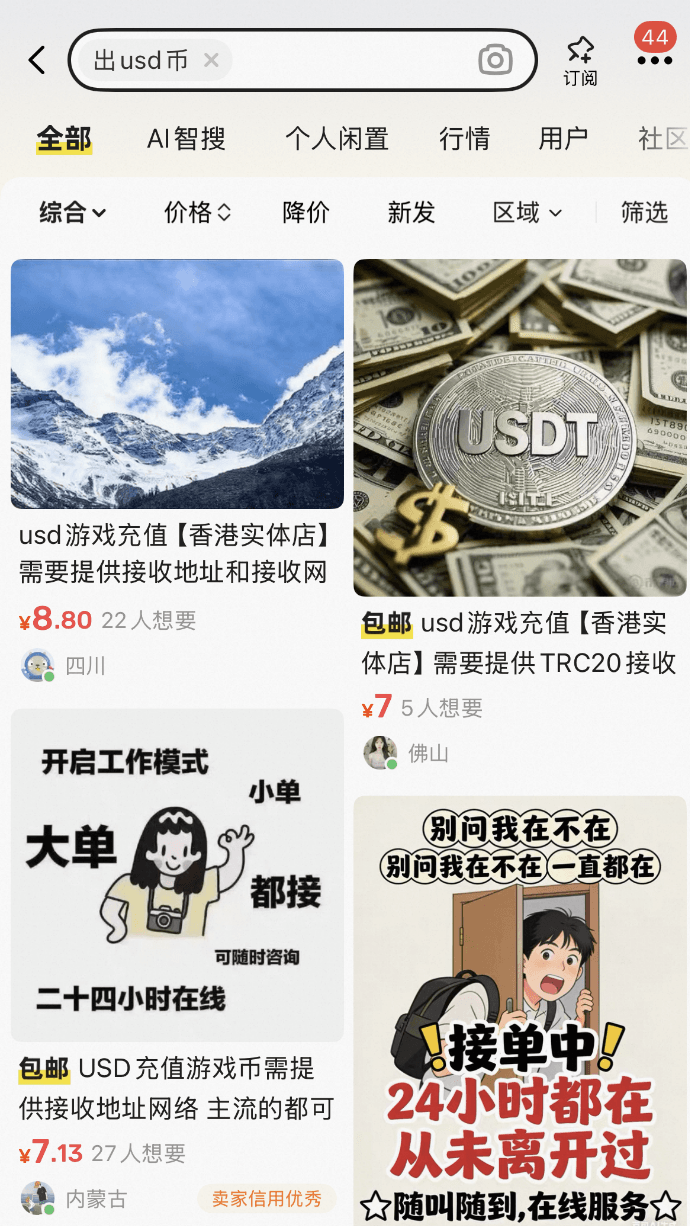
Crypto assets—highly sensitive and tightly restricted in public discourse—have not disappeared. They have been disguised and folded into a more down-market platform.
“Buying and selling USDT,” “step-by-step exchange app setup,” “overseas IDs for exchange KYC,” “Binance Alpha tutorials”—here, you can purchase what looks like a one-stop shop for crypto trading guidance.
The digital black market extends far beyond crypto: discounted flights, hotel bookings, hard-to-get restaurant reservations, front-row concert tickets, and even “GI AI verification.”
A common line circulating on social media captures it succinctly:
“You can buy almost anything on Xianyu.”
This is hardly an exaggeration.
The Hidden Crypto Trade
In October 2025, the official X account of the Republic of Palau Digital ID posted a rare announcement—in Chinese.
It warned that forged Palau ID documents were being openly displayed on social platforms and used to bypass KYC checks, constituting serious identity fraud. The RNS.ID authority announced secondary verification for all Palau IDs using Chinese pinyin; unverified users would be flagged as fraudulent and synced to a global fraud database.
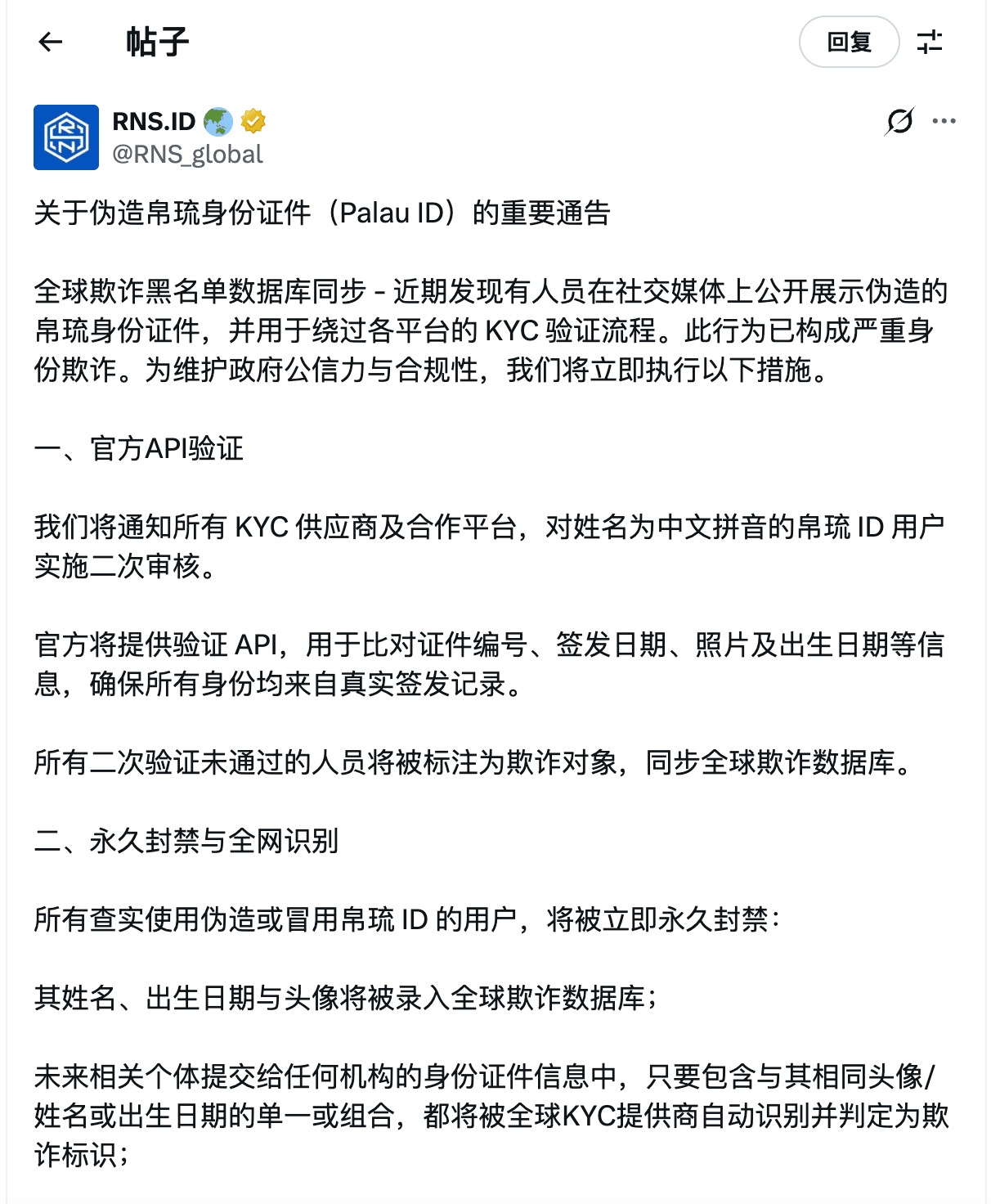
Why would a Pacific island nation issue a notice in Chinese? The answer lies in Xianyu’s search results.
Search terms like “overseas identity” or “Palau ID” reveal an underground network selling fake documents, priced from tens to hundreds of yuan, promising “100% pass rate on major exchanges.”
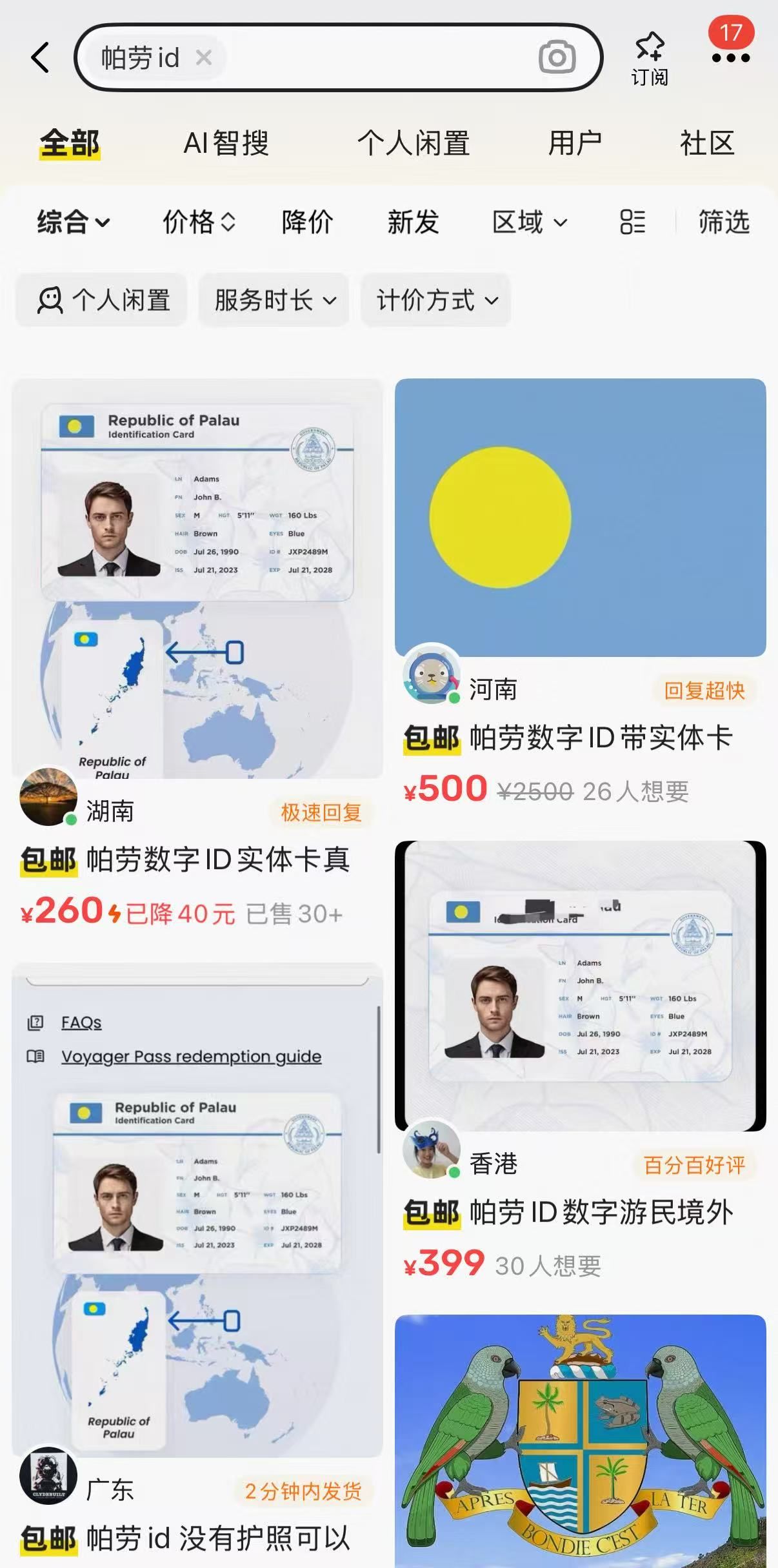
Beyond Palau, IDs from Dominica, Nigeria, and the Philippines are also popular. Forgery quality has improved, with sellers offering customization using buyers’ real photos to pass facial recognition.
But beyond fake IDs for KYC, much of Xianyu’s crypto gray market revolves around zero-cost virtual services.
One account, “Shenzhen Xiaoxia,” once sold a 30-minute Binance/OKX download and setup tutorial for RMB 10 (now removed).
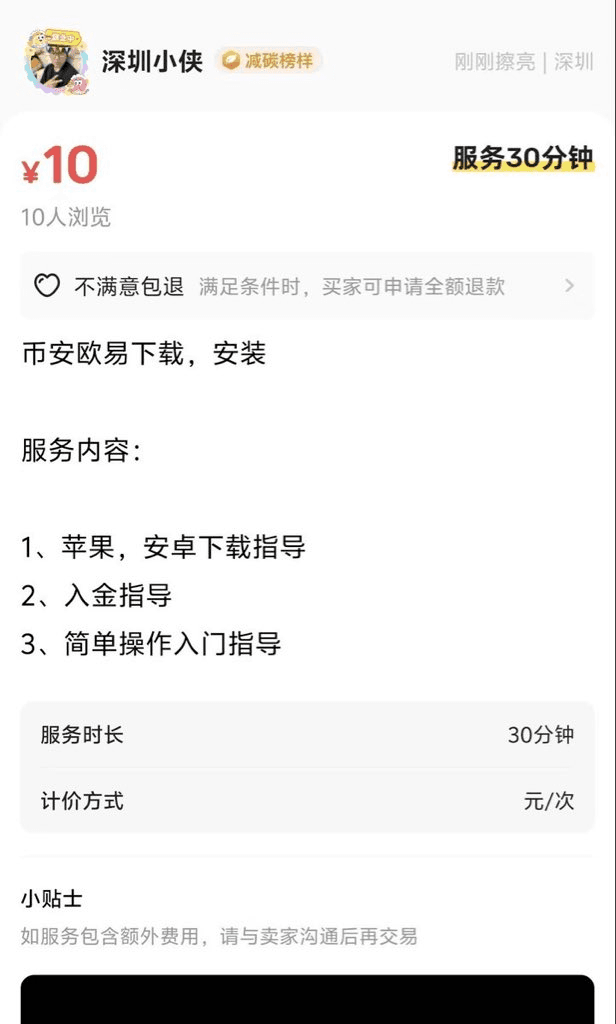
Xiaoxia is no anonymous seller. In crypto circles, the name is well known—a top-tier KOL. Not long ago, industry gossip circulated that he had gone RMB 60 million into debt to buy a luxury waterfront apartment in Shenzhen.

Why would a crypto millionaire personally sell RMB 10 “customer support” sessions on Xianyu?
Because the RMB 10 fee is just bait. The real money comes from referral commissions. Every user who registers via his link can generate ongoing trading-fee revenue—hundreds or even thousands of yuan per month per active user.
The RMB 10 product is a cheap fishing rod. On the other end is a scalable, renewable traffic pool.
If Xiaoxia’s model is an open play, many others profit from information asymmetry more directly.
An RMB 88 “Binance Alpha beginner course” promises one-on-one coaching and “hands-on guidance.” “Alpha” typically refers to task-based programs by exchanges that offer potential airdrop rewards.

These methods are widely documented on X and YouTube—often for free. But for many domestic users, the combined barriers of language, network access, and information channels are real. As one buyer commented, “The seller was enthusiastic—much easier than figuring it out myself.”
The AI “Arms Depot”
If crypto trading is just a small darkroom in Xianyu’s folded space, AI commerce is a vast, mass-participation digital arms depot.
When ChatGPT and Claude took the world by storm, an invisible wall went up as well—complex registration, network constraints, and credit-card payments blocked most curious Chinese users. They could see the fireworks, but not the entrance.
Xianyu unexpectedly became the side path around the wall.
The “arms dealers” here offer full-stack services, from beginner to advanced.
The most basic product is an account—pre-registered GPT or Claude accounts sold for tens to hundreds of yuan, often with monthly top-up services.
Want to know which overseas AI tools are hottest? Check Xianyu.
In 2025, when Manus—later acquired by Meta for USD 2 billion—first launched, internal access codes were scarce. On Xianyu, prices jumped overnight from hundreds to thousands, even tens of thousands of yuan; at peak frenzy, listings reached RMB 100,000, helping Manus break into mainstream awareness.
Today, the hottest items are Gemini and ChatGPT.
A USD 20 monthly subscription can deter many users. But Google offers students a free year, and OpenAI provides similar benefits to U.S. veterans. On Xianyu, sharp sellers turned this goodwill into a scaled business.
Search “soldier” (大兵), and a strange cyber scene appears: cartoon soldiers or tough-guy avatars, listings titled in shared slang—“Soldier approved,” “One-year Plus account”—priced from a few to dozens of yuan.

One user remarked:
“Xianyu is the largest AI training base in the Chinese-language world. Without it, most Chinese users wouldn’t have access to top-tier global AI models.”
Contradictory, yet painfully accurate.
A platform meant for second-hand goods has inadvertently become the gateway and diffuser of world-class AI in China.
Buying Everything
Crypto and AI are only the tip of the iceberg.
Some joke that “humans have developed less than 1% of Xianyu”—that it’s China’s version of the dark web.
Its “darkness” is less about crime than absurdity. Side hustles and underground services flourish, often becoming viral comedy.
Unpaid wages? One buyer hired “legal aid” on Xianyu—only to see 80 elderly women show up, crying and protesting. Wages paid within three days.
Need to refund a flight? Someone received a “death certificate.”
Xianyu is more than transactions; it may be the most authentic ethnographic field of the Chinese internet.
Wild ingenuity thrives here. It ignores corporate elegance and worships one principle only: problem-solving. When official channels fail or cost too much, grassroots creativity erupts—raw, and often darkly humorous.
The digital black market reflects a real slice of contemporary China: no glossy branding, just human impulses—speculation, shortcuts, laziness, desperation, and survival between the cracks of rules.
But when “solutions” drift deeper into gray zones, the traded object eventually becomes the person.
If hiring elderly women is renting others’ performance, the most dangerous trade is renting your own identity.
“New users wanted for exchanges,” “buying KYC-verified accounts,” “long-term recruitment for QR registrations”—these listings openly package a person’s digital KYC identity for sale. Sellers frame it as “being a landlord in the digital age,” making users believe they’re monetizing idle assets.

In reality, those accounts can become tools for fraud or money laundering.
From buying tutorials, to buying accounts; from outsourcing trouble, to becoming part of it—this bizarre chain closes into a frightening loop.
We start by paying for convenience, and end by trading ourselves for money.
This chaotic digital soil is both grassroots infrastructure—helping ordinary people bypass barriers—and a dark forest full of traps. It proves, in extreme form, that suppressed demand never disappears; it only resurfaces where rules cannot reach, in cruder and riskier ways.
Here, convenience and cost share the same price tag. You think you’re taking a shortcut—only to realize the shortcut may end at a cliff.
-- Price
This content is provided for general informational purposes only and doesn't constitute financial, investment, legal, or tax advice. Any events, rewards, online promotions, or related information mentioned herein should not be considered a recommendation, solicitation, or invitation to purchase, sell, trade, or otherwise deal in any crypto assets. Crypto assets are highly volatile and may result in loss. The availability of WEEX services, products, and related events may vary by region. You are responsible for ensuring that your participation is in accordance with applicable local laws and regulations.
You may also like

The euro stablecoin's retail VASP transaction volume increased 12 times to $777 million over 15 months

Y Combinator launches the YC Crypto Deals program, with participation from the Solana Foundation and others

The Federal Reserve is seeking feedback on the "streamlined master account" framework, proposing to allow cryptocurrency companies to access its payment system

Futures Trading Hours Explained: How Smart Traders Cut Futures Fees and Earn More Cryptocurrency in 2026

BNKR’s Recent Surge Marks New Heights in Cryptocurrency Market
Key Takeaways BNKR Token Peak: BNKR reached an all-time high of $0.0011 on July 31, 2025. Significant Market…

Beast Industries Acquires Step – Expanding Fintech Horizons
Key Takeaways Beast Industries, led by YouTube celeb MrBeast, has acquired the teen-focused fintech banking app Step, aiming…

SlowMist’s Latest Alert: A Deep Dive into LiteLLM’s Data Breach
Key Takeaways SlowMist identifies a major breach in the LiteLLM library, with approximately 300GB of sensitive data compromised.…

Steakhouse Financial Experiences Phishing Attack: A Comprehensive Overview
Key Takeaways Steakhouse Financial’s domain experienced a phishing attack, prompting user safety advisories. Depositors’ funds and smart contracts…

FTX/Alameda Wallet Transfers Over $8 Million in ZRO Tokens to Wintermute
Key Takeaways An FTX/Alameda-associated wallet moved 4.126 million ZRO tokens to market maker Wintermute, with an approximate value…

Analysis of Recent Ethereum Short Position Activity on HyperLiquid
Key Takeaways Recently, a newly created wallet deposited $4.89 million into HyperLiquid, opening a short ETH position with…

Upbit and Bithumb Designate DRIFT as a Trading Alert Item
Key Takeaways Upbit and Bithumb have labeled DRIFT as a “trading alert” asset following guidance from the Digital…
“Brother Maji” Faces Potential Liquidation with ETH Long Position
Key Takeaways “Brother Maji” currently holds a substantial 25x leveraged long position of 6,000 ETH. The position was…
Binance’s Strategic Delisting of Trading Pairs Enhances Market Health
Key Takeaways Binance has decided to remove 23 spot trading pairs, focusing on those with low liquidity and…
Renew the Spirit, Reveal the Worth: Insights on U.S. Economic Trends
Key Takeaways U.S. Treasury Secretary Scott Bessent confirms the Federal Reserve plans to eventually lower interest rates. Current…

Hackers in Brazil Use Fake Google Play Store to Steal Cryptocurrency
Key Takeaways Hackers in Brazil are exploiting fake Google Play Store pages to spread Android malware. Infected devices…

Binance to Delist Key Spot Trading Pairs: What You Need to Know
Key Takeaways Binance is set to remove several spot trading pairs on March 27, 2026, at 11:00 AM…

Dragonfly Receives $55.8 Million Worth of LIT Tokens, Locked Until December 2026
Key Takeaways Dragonfly has acquired 55.8 million LIT tokens from Lighter, according to Arkham. The tokens are valued…
Circle and Tether Freeze Iranian Exchange Wallex Wallet with $2.49M Assets on Hold
Key Takeaways Circle and Tether have frozen a significant amount of assets from an Iranian exchange called Wallex,…
Binance to Delist 10 Spot Pairs Including ARB/EUR
Key Takeaways Binance has announced the delisting of 10 spot trading pairs. The affected pairs include ARB/EUR, BANANA/FDUSD,…

SpaceX Stock Prediction: Hitting $1,200 at 2026 IPO?
Key Takeaways Elon Musk confirms SpaceX is advancing its IPO plans, with expected filing as early as weeks…

OpenClaw 3.28 Update: Potential Security Risks with Axios
Key Takeaways Recent findings suggest OpenClaw version 3.28 may contain a compromised version of the Axios library. Dependency…
Massive Whale Movement: Unstaking $84.96 Million in HYPE Tokens
Key Takeaways A crypto whale, known as TechnoRevenant, has unstaked approximately $84.96 million in HYPE tokens. The tokens…

Security Risks of Fake Ledger Nano S+ Devices Emerging Through Chinese E-Commerce
Key Takeaways Counterfeit Ledger Nano S+ devices are being sold on Chinese e-commerce platforms, posing significant risks to…

How Crypto Futures Markets Are Fueling ‘Scam Coin’ Insider Schemes
Key Takeaways: RAVE’s market cap skyrocketed to $6.7 billion before plummeting by 95% due to insider control and…

SEC’s “Innovation Exemption” Sets New Rails for Tokenized Securities
Key Takeaways: SEC Chair Paul Atkins introduces an “innovation exemption” to regulate tokenized securities. A five-category token framework…

Ripple Sets 2028 Deadline for Quantum-Ready XRPL
Key Takeaways: Ripple commits to a 2028 deadline for XRPL’s quantum-readiness, focusing on quantum-resistant cryptographic systems. Google’s research…
Breaking: Crypto Investor Tim Cook Steps Down as Apple CEO
Key Takeaways: Tim Cook will transition from CEO to Executive Chairman on September 1, 2026. John Ternus, a…
UK Fintech Stratiphy Reopens Tax-Free Crypto ETNs Through IF ISAs
Key Takeaways: Stratiphy now offers UK investors tax-free crypto ETNs via Innovative Finance (IF) ISAs. Recent policies restrict…

Stratiphy Reopens Tax-Free Crypto ETNs for UK Investors
Key Takeaways: Stratiphy reintroduces tax-free access to crypto ETNs in the UK, reversing limitations imposed by HMRC’s ISA…
Uzbekistan Launches Tax-Free Crypto Mining Zone in Karakalpakstan
Key Takeaways: Uzbekistan has initiated the “Besqala Mining Valley” in Karakalpakstan, offering a supervised zone for crypto mining…
The euro stablecoin's retail VASP transaction volume increased 12 times to $777 million over 15 months
Y Combinator launches the YC Crypto Deals program, with participation from the Solana Foundation and others
The Federal Reserve is seeking feedback on the "streamlined master account" framework, proposing to allow cryptocurrency companies to access its payment system
Futures Trading Hours Explained: How Smart Traders Cut Futures Fees and Earn More Cryptocurrency in 2026
BNKR’s Recent Surge Marks New Heights in Cryptocurrency Market
Key Takeaways BNKR Token Peak: BNKR reached an all-time high of $0.0011 on July 31, 2025. Significant Market…
Beast Industries Acquires Step – Expanding Fintech Horizons
Key Takeaways Beast Industries, led by YouTube celeb MrBeast, has acquired the teen-focused fintech banking app Step, aiming…