
BTC "V-Reversal" Bull Market Trend Continues? | Trader Observation



Amid last week's continued questioning of the Fed's pause in rate cuts, consecutive bearish non-farm payroll data emerged, showing the strong resilience of the U.S. economy. The U.S. dollar index hit consecutive new highs, and the employment issue seems to have eased, reducing the demand for rate cuts by the Fed. From major financial institutions like Citibank and Goldman Sachs to individual traders, bets on a 2025 Fed rate cut are being reduced.
The price of BTC also experienced a huge "wipeout" state, fluctuating up and down by ten thousand points. Many in the market joked that "the price stays the same, but the position is gone." Market sentiment also showed significant fluctuations, rapidly shifting from greed to panic and back to greed. Yesterday's positive PPI data and unresolved inflation issues further increased expectations of a Fed rate cut.
Less than a week since Trump took office, tonight at 21:30 GMT+8, U.S. CPI data will be released. Will a 2025 rate cut be put on the agenda? Has the Trump narrative already been priced in, or is there still significant potential? Let's see what traders think.
Macro Analysis School
Today, the market is focusing on BTC's trading volume, referring to the C-wave third wave mentioned in the market. The third wave is often accompanied by a sharp decline and panic selling in the market, leading to a surge in short-term trading volume. Therefore, by looking at the increase in BTC trading volume, we can determine if the third wave has completed!
As the market overall declines, BTC dominance draws liquidity from ETH altcoins, accelerating the market's risk-off decline.
The BTC trading volume increased by 25%, compared to the overall market's trading volume increase of 150%, indicating that the volume increase is not significant enough, suggesting that the third wave phase has not yet been completed. Altcoin trading volume increased by 277%. Today, BTC fell below a key level, causing ETH and many mainstream altcoins to break key support levels. The altcoin market likely experienced a large-scale liquidation leading to a surge in trading volume.
On the funding side, the market's net inflow increased by $400 million, currently at $212.5 billion.
USDT: Official data shows $137.49 billion, with an increase of $0.03 billion compared to last Saturday. Despite a significant market downturn, net outflows paused in the Asian-European markets, which is a small positive sign. At the same time, USDT liquidity doubled, likely due to a widespread liquidation causing a surge in trading volume.
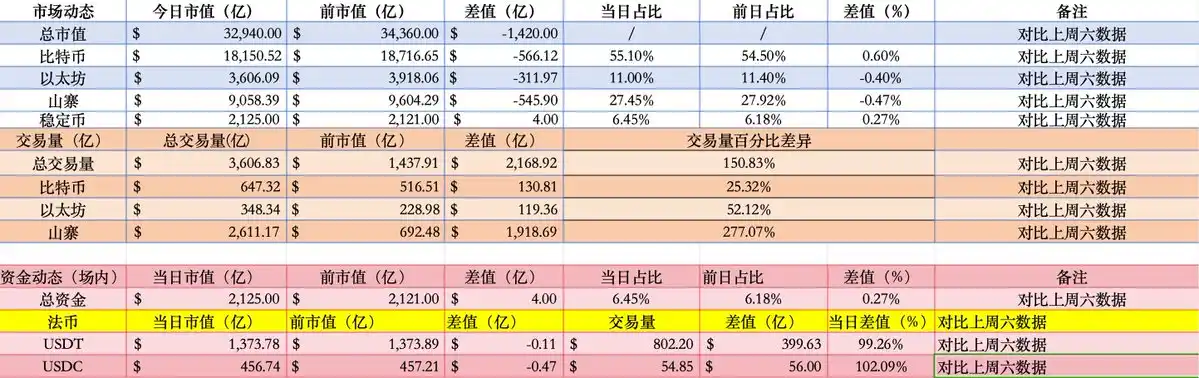
Overall, in terms of fund flows, funds that ended trading in a downtrend did not see a widespread exodus. Instead, they chose to stay in the market or return to trading, indicating that we are not currently in a panic sell-off phase.
During Monday's U.S. session, funds did not exhibit FOMO and saw net outflows for four consecutive days, even as the price rose from 89,000 to 97,000. This is also why I do not consider 89,200 as a significant bottom. The drop to 89,000 consumed a considerable amount of retail funds from non-U.S. regions, with URPD data showing that many short-term bottom buyers took profits.
According to SoSoValue data, Bitcoin spot ETFs saw a total net outflow of $210 million yesterday (January 14, U.S. Eastern Time), marking the fourth consecutive day of outflows. The Bitcoin spot ETF with the highest net inflow yesterday was the WisdomTree ETF BTCW, with a daily net inflow of $10.2372 million, bringing its total historical net inflow to $239 million, followed by the VanEck ETF HODL, which saw a daily net inflow of $5.4596 million. The total net asset value of Bitcoin spot ETFs currently stands at $108.981 billion, with an ETF net asset ratio (market value as a percentage of total Bitcoin market value) of 5.7% and a cumulative net inflow of $35.722 billion.
Since there was no second wave of risk aversion on Tuesday, it either means investors have already priced in enough expectations for the CPI or positive sentiment has offset the potential negative impact of the CPI. In fact, for the CPI data, I don't think this round of data is particularly significant.
Because the likelihood of the Fed not cutting rates in January is almost 100%, the December inflation data is unlikely to change the Fed's decision. Even in March, there is a high probability that the Fed will not cut rates. According to the dot plot, there may be two rate cuts in 2025, possibly both in the second half of the year, with little chance of a rate cut in the first half of the year.
So, a single CPI data point is not even as important as the nonfarm data. After all, the current inflation has already been somewhat anticipated by the Fed. Of course, lower inflation data is more beneficial to the market. However, even if December's inflation drops to 2%, the Fed may not immediately cut rates.
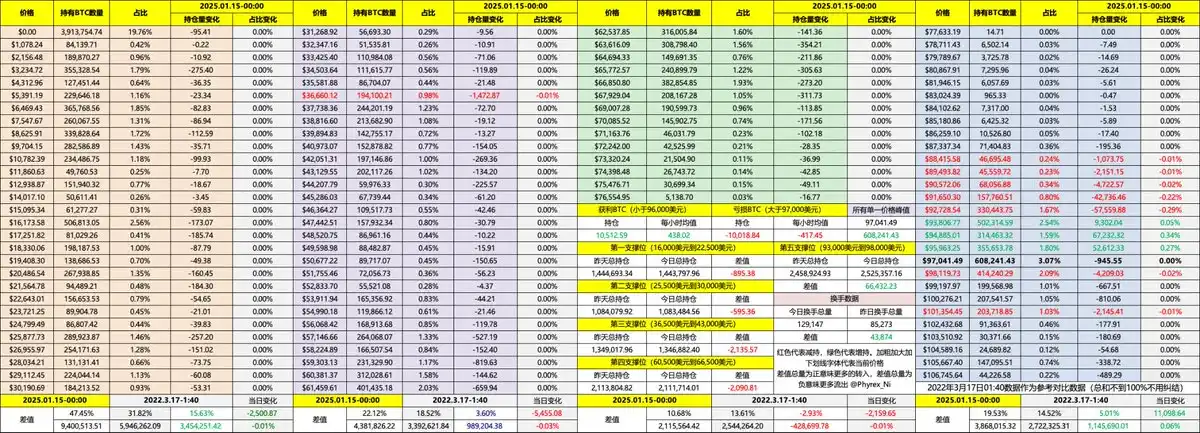
Returning to BTC data, while turnover has increased, with the rebound in BTC price, panic has not occurred. Currently, those exiting are mostly short-term profit investors. Early investors, including those at a loss, do not show significant signs of selling off. This indicates that at least for now, investor sentiment remains relatively stable.
Technical Analysis Enthusiast
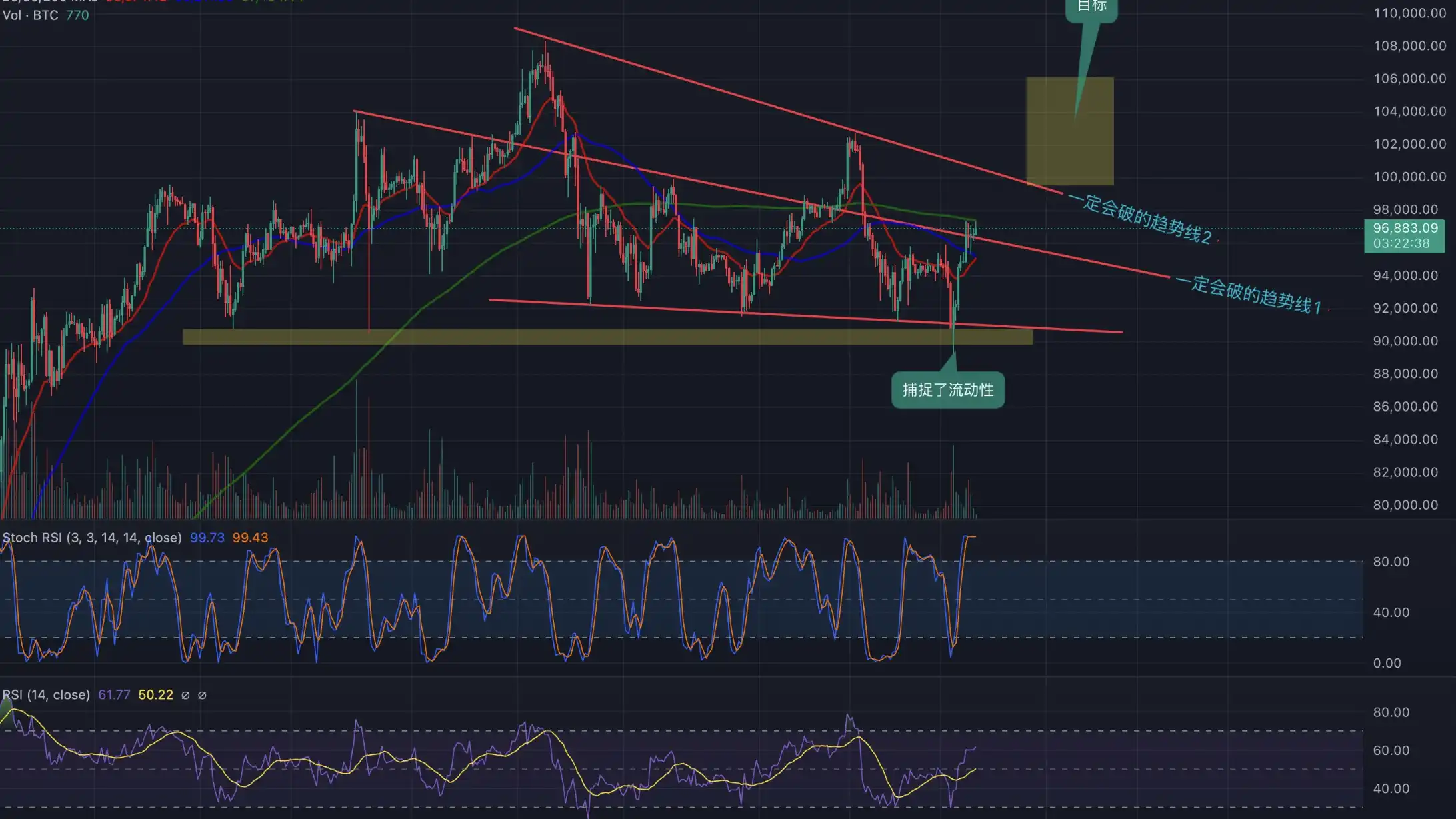
BTC has broken through the first trendline, and we expect a breakthrough of the second. In the short term, we are waiting for the moving average to catch up with the price before resting and continuing to rise.
Adding more BTC long positions here.
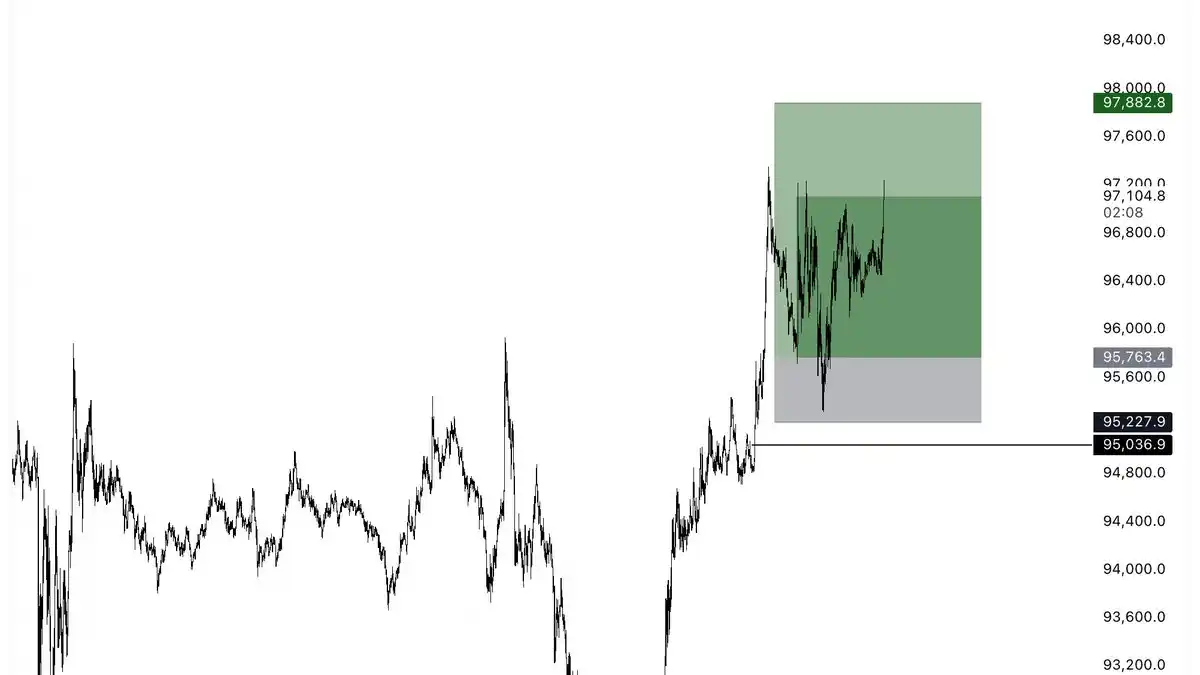
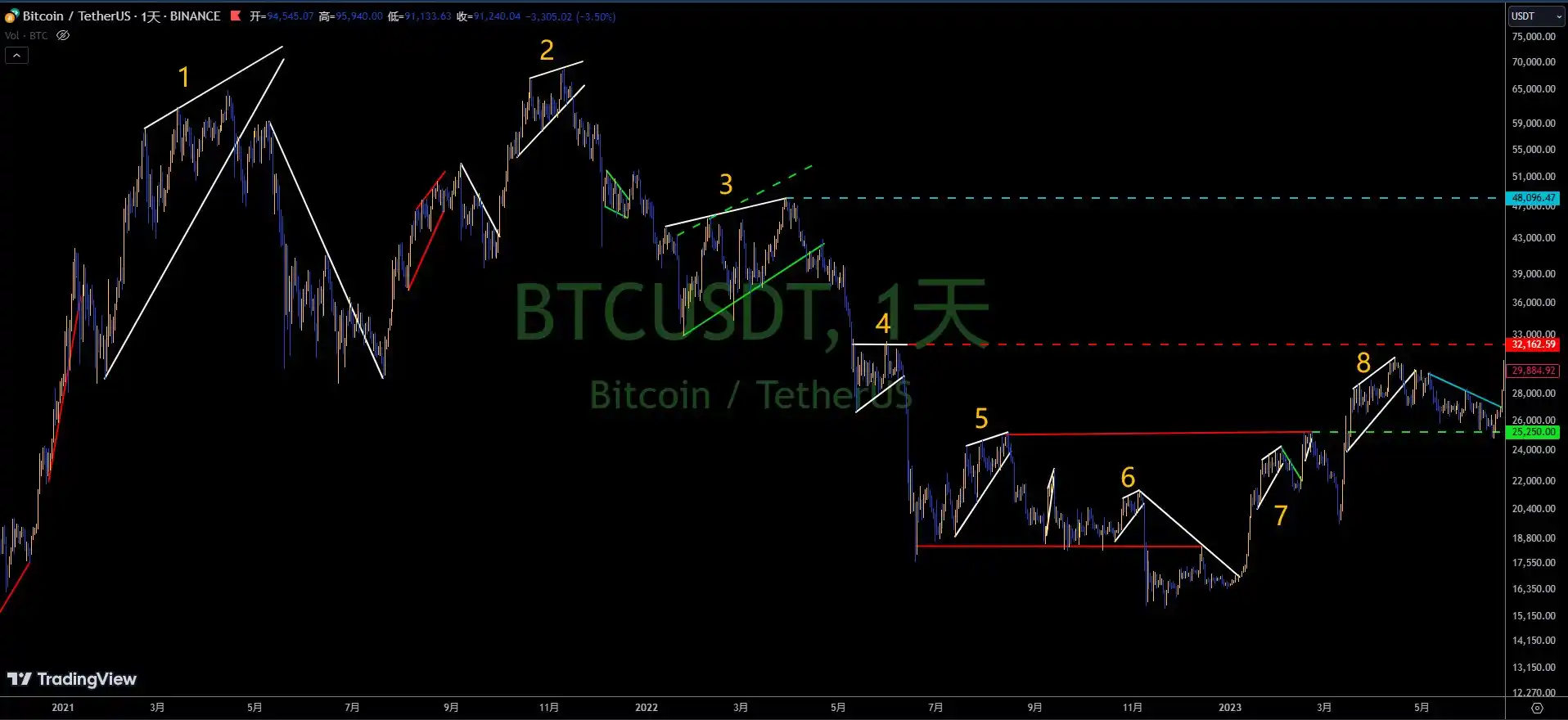
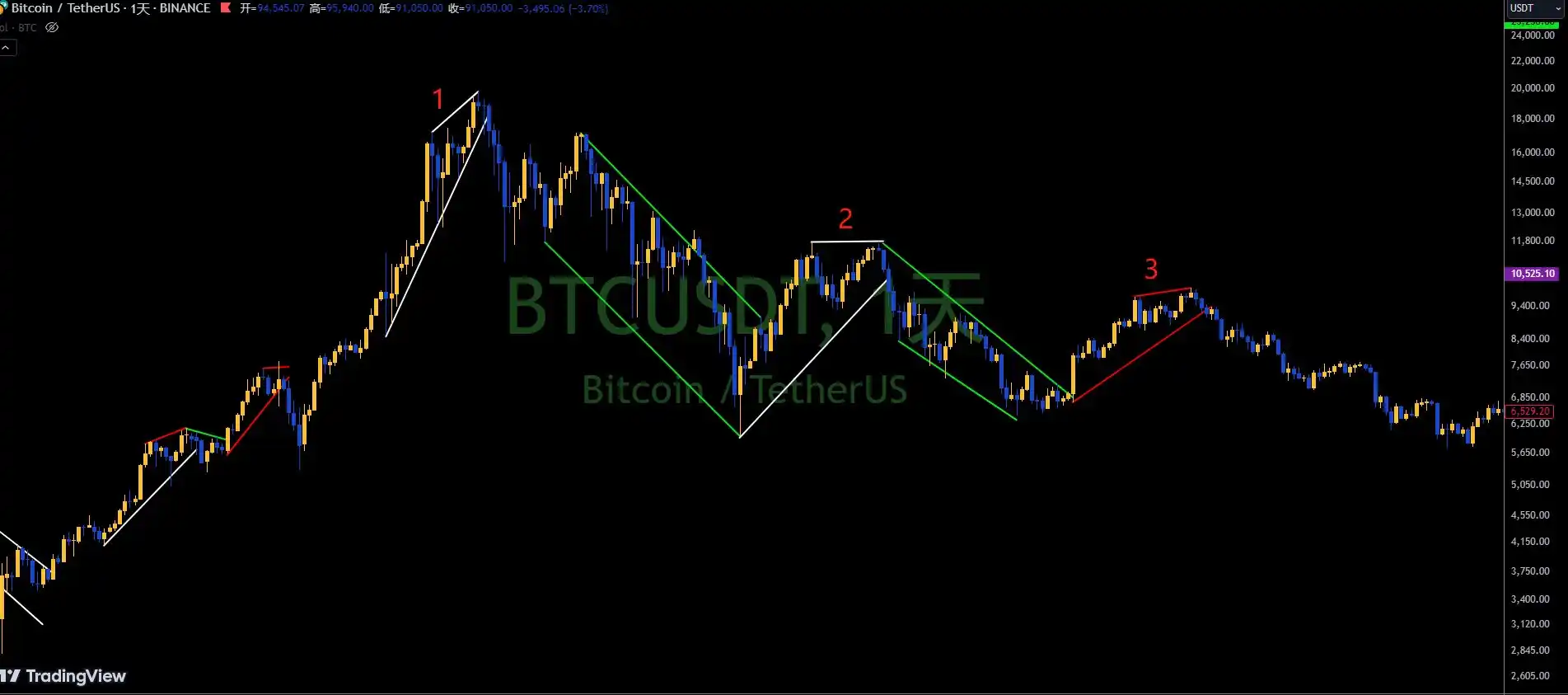
Reviewing history, history is the best teacher. This kind of structure has a high probability of occurrence, and there are often major retracements afterward, at least retracing 50% to 0.618% of the previous large wave. The most brutal year was 5.19 when it retraced back to the starting point of the rise. That was an extreme situation requiring various factors to support it. We are only talking about normal situations, and the previously mentioned 85,000 was calculated based on this.
Data Analysis Enthusiast
The probability of ETH price exceeding 4K by the end of the month is only 10.62%.

As the price continues to rise, the premium is moving back towards 0, indicating that spot demand is still entering the market. Only when the premium fully recovers to a positive value and reaches a high level, the entire BTC market can be considered in a safe mode.
Therefore, the current price increase and synchronous recovery of the premium actually represent spot demand entering the market while futures longs gradually take profit and futures shorts gradually add to their positions;
When the premium returns to around 0, it indicates that futures longs have almost completed their profit-taking. If shorts do not further increase their positions, the premium will not rise, but if shorts continue to add to their positions, then the premium will turn positive;
In short, when the premium returns to zero, minor trend reversals or continuations are likely to occur;
In a long trend, each time the premium returns to zero, it is either a consolidation or a sign of a bearish trend reversal, and similarly, in a short trend, each time the premium approaches 0, it is either a rebound to consolidate or a sign of a bullish trend reversal;
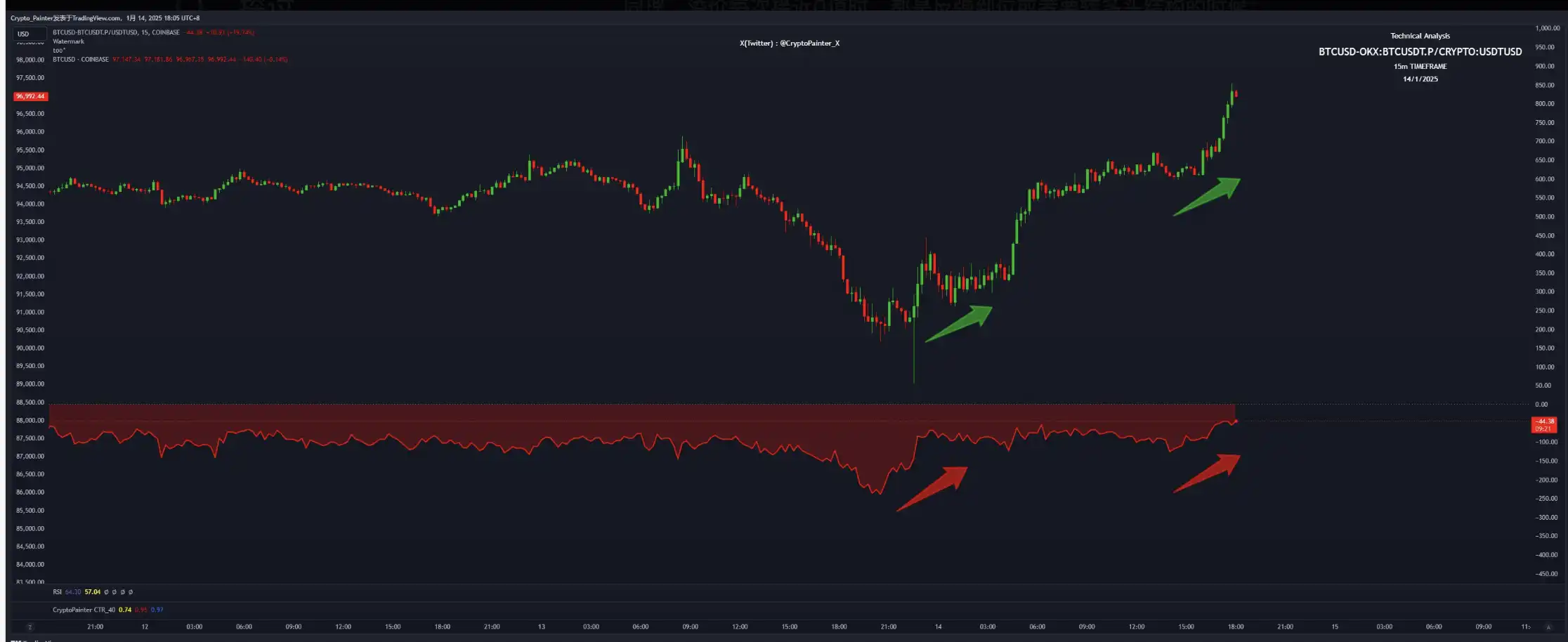
Moreover, based on the key break of $90,000, it can be seen that market demand has weakened, which is why there is the behavior of key support being breached. The current price range has the conditions to become a "distribution range." Like the ranging market in 2024, signs of distribution do not necessarily mean the market will bearish. Strengthened demand could still drive prices higher;
On-chain Whale Activity
The "whale" who profited $33.67 million from buying low and selling high in $ETH withdrew 10,000 ETH from Binance on January 13, worth $30.76 million, at an average cost of $3075.57 per ETH; currently, they hold a total of 55,166.12 ETH, valued at a staggering $169 million.
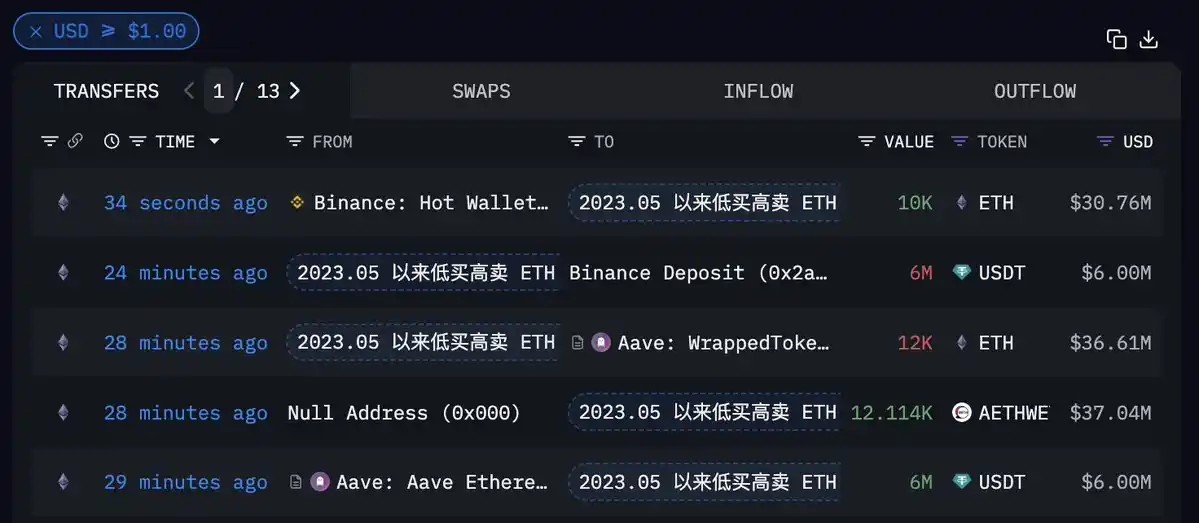
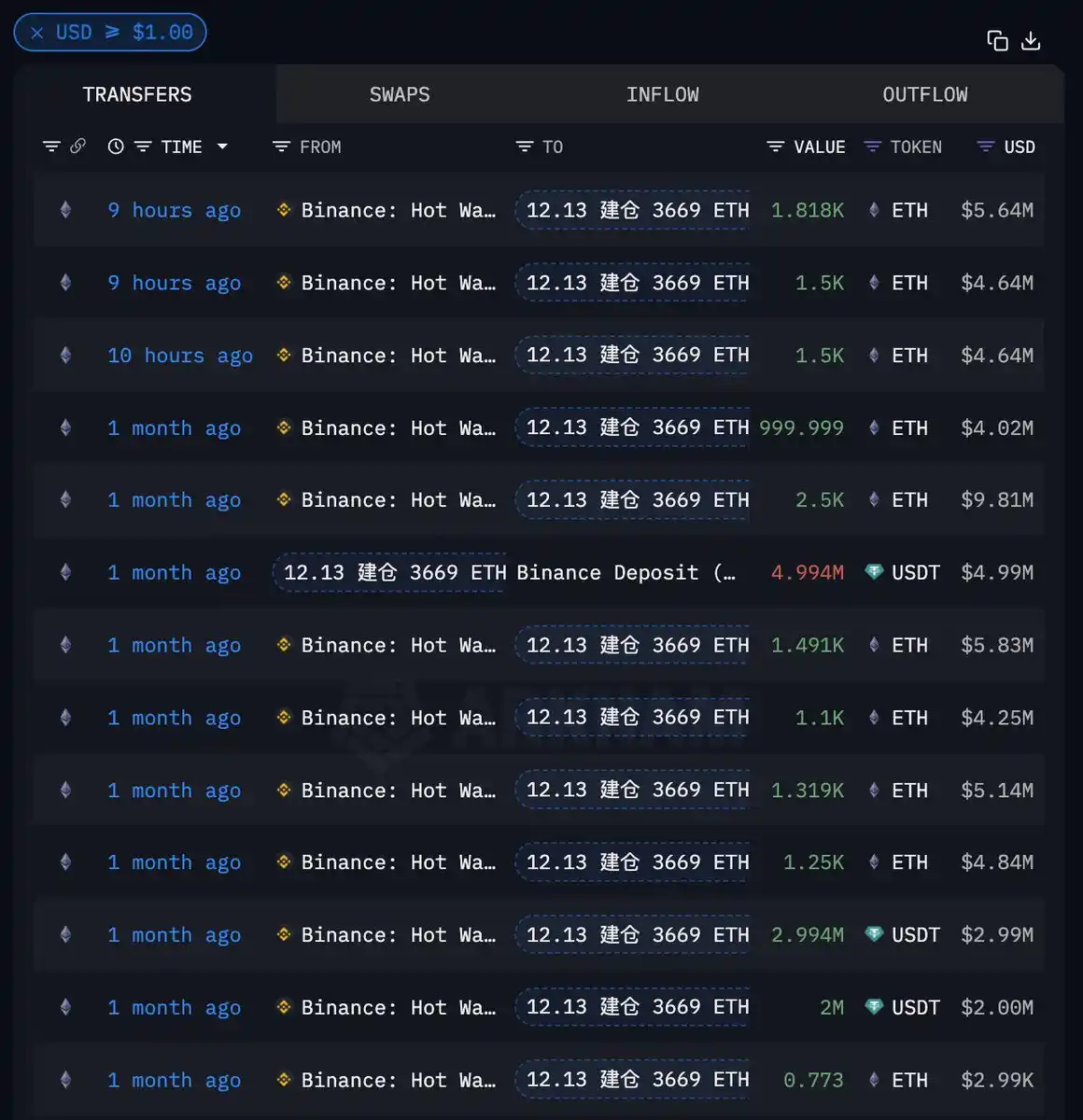
After a month, the "12.13 Positioning 3669 ETH to a New Address" once again added 4817 ETH to its position during Monday's market plunge, worth $14.92 million; since December 5, 2024, this address has accumulated a total of 13,479 ETH, valued at $42.78 million, with a cost basis of $3622, currently sitting on an unrealized loss of $5.9 million
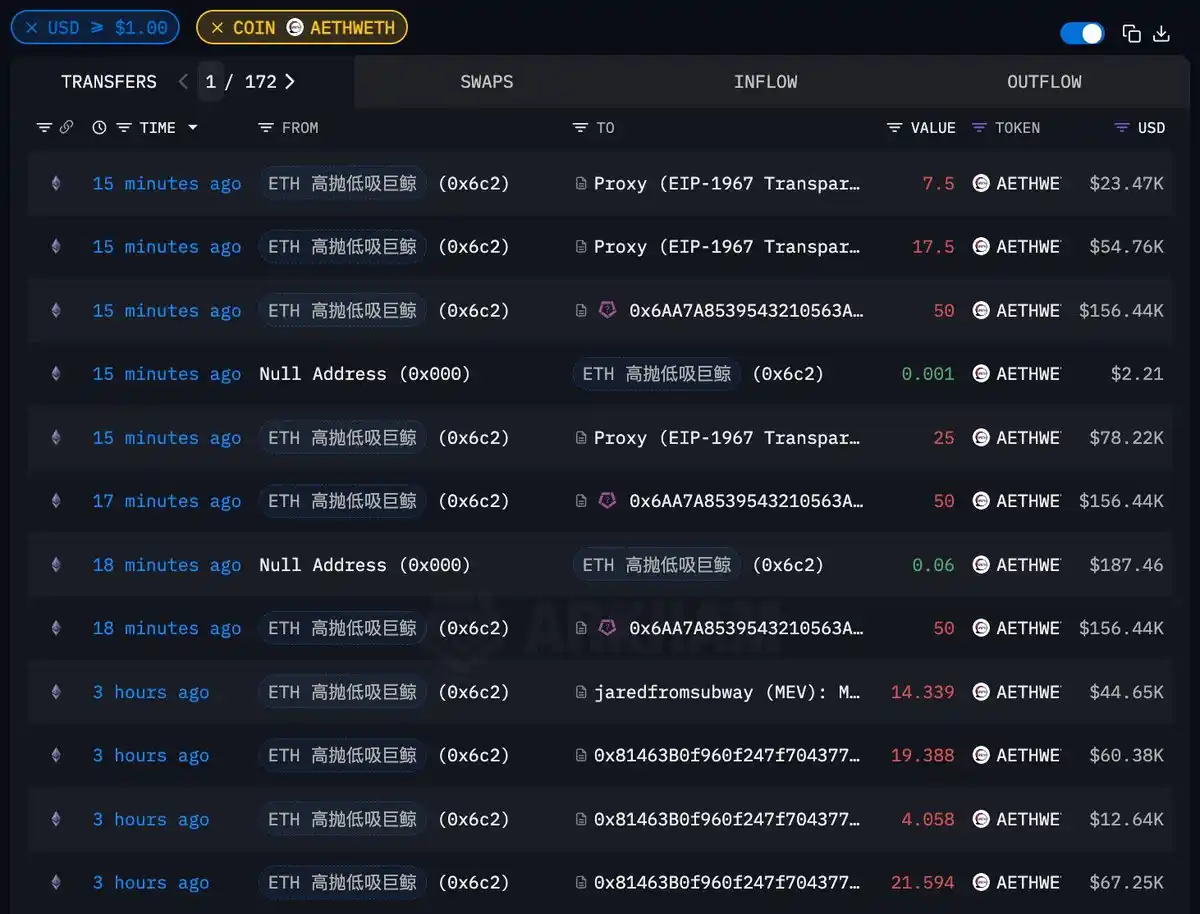
An ETH swing trader with a win rate of 83.3% reduced their position by an average of $3106.53, selling 5872.63 ETH (which was part of the additional position taken during last night's market crash), incurring a small loss of $530,000; the two addresses currently hold 11,252.98 ETH (approximately $35.39 million) with a cost basis of $3196.85
You may also like

Mastercard Launches Agent Pay for AI, Plans to Record AI Agent Payment Authorizations on Polygon
Mastercard launched Agent Pay for AI, a new payment protocol designed to help AI agents make small payments such as pay-per-use access to data and APIs. The system plans to record human-granted AI agent permissions on Polygon, focusing on verifiable authorization, identity, and payment controls.

Curve Deploys Llamalend v2 on Optimism With 250,000 OP Incentives
Curve launched Llamalend v2 on Optimism with 250,000 OP incentives from the Optimism Foundation. The upgrade expands Llamalend beyond its earlier crvUSD-focused model, adding broader collateral support, LlamaRisk market reviews, and the ability to use Curve LP tokens as collateral.

Raydium Old Liquidity Pool Reportedly Exploited, With $1.34 Million Moved to Ethereum and Tornado Cash
An old Raydium liquidity pool was reportedly exploited for around $1.34 million in USDC, RAY, and wSOL, with the stolen funds bridged to Ethereum and deposited into Tornado Cash. The incident highlights the tail risks of legacy DeFi pools, old contracts, and cross-chain fund laundering paths.

Kalshi Executive Challenges “SBF Backed AI Unicorns” Narrative, Says Leopold Aschenbrenner Was Key Figure
Kalshi executive John Wang questioned the “SBF backed AI unicorns” narrative, saying Leopold Aschenbrenner was the key figure behind major AI investment decisions.

Pantera Capital Partner: How Tokenization is Restructuring the Private Equity and Early Investment Ecosystem?

New York Proposes Stricter Stablecoin Issuer Rules Aligned With Federal GENIUS Act
NYDFS proposed stricter stablecoin issuer rules aligned with the GENIUS Act, covering reserves, custody, redemption timelines, audits, and capital buffers.
Every exchange is a "Universal Exchange."

The counterattack of traditional finance: Alliance chains are quietly reviving

CryptoQuant Says Bitcoin Profitable Supply Is Near 45% Pressure Zone as On-Chain Data Points to Market Repricing
CryptoQuant said Bitcoin’s profitable supply is nearing the 45% pressure zone, signaling rising market stress, unrealized losses, and a possible on-chain repricing phase.

Bitcoin Falls Below 200-Week Moving Average as On-Chain Data Shows Over Half of Supply in Loss
Bitcoin dropped below its 200-week moving average as on-chain data showed over 50% of circulating supply is now in loss, signaling rising market stress.

CFTC Reportedly Plans New Prediction Market Rules Focused on Manipulation Risk and Public Interest Review
The CFTC is reportedly preparing new prediction market rules focused on manipulation risk, public interest review, and retail trader protections.

Meet the new WEEX trial fund—your gateway to greater profits

WEEX Labs Lands at Dutch Blockchain Week: A Disruptive Crypto × AI Conversation Sets Sail in Amsterdam
SK Hynix Reportedly Plans U.S. ADR Listing as Early as August, With SEC Approval Possible in Late June
SK Hynix may pursue a U.S. ADR listing as early as August, with SEC approval reportedly possible in late June amid strong AI chip supply chain demand.

SpaceX vs Tesla vs xAI: Which Elon Musk Trade Has the Biggest Upside in 2026?
OpenAI Reveals It Has Confidentially Submitted an S-1 to the SEC, Keeping the Door Open for a Future IPO
On June 9, according to an OpenAI announcement, the company recently confidentially submitted a draft S-1 registration statement to the U.S. Securities and Exchange Commission (SEC), beginning the preliminary compliance process for a potential initial public offering. OpenAI said it chose to disclose this proactively because it expected the news might leak; however, the company has not yet set a specific listing timeline, and related arrangements may still take some time.
Latest research from 13 top universities including Cornell University: The current state, challenges, and misconceptions of the fusion of Crypto and AI
Deconstructing Anthropic: The Best AI Company, Possibly Also a Type of Organizational Invention
Mastercard Launches Agent Pay for AI, Plans to Record AI Agent Payment Authorizations on Polygon
Mastercard launched Agent Pay for AI, a new payment protocol designed to help AI agents make small payments such as pay-per-use access to data and APIs. The system plans to record human-granted AI agent permissions on Polygon, focusing on verifiable authorization, identity, and payment controls.
Curve Deploys Llamalend v2 on Optimism With 250,000 OP Incentives
Curve launched Llamalend v2 on Optimism with 250,000 OP incentives from the Optimism Foundation. The upgrade expands Llamalend beyond its earlier crvUSD-focused model, adding broader collateral support, LlamaRisk market reviews, and the ability to use Curve LP tokens as collateral.
Raydium Old Liquidity Pool Reportedly Exploited, With $1.34 Million Moved to Ethereum and Tornado Cash
An old Raydium liquidity pool was reportedly exploited for around $1.34 million in USDC, RAY, and wSOL, with the stolen funds bridged to Ethereum and deposited into Tornado Cash. The incident highlights the tail risks of legacy DeFi pools, old contracts, and cross-chain fund laundering paths.
Kalshi Executive Challenges “SBF Backed AI Unicorns” Narrative, Says Leopold Aschenbrenner Was Key Figure
Kalshi executive John Wang questioned the “SBF backed AI unicorns” narrative, saying Leopold Aschenbrenner was the key figure behind major AI investment decisions.
Pantera Capital Partner: How Tokenization is Restructuring the Private Equity and Early Investment Ecosystem?
New York Proposes Stricter Stablecoin Issuer Rules Aligned With Federal GENIUS Act
NYDFS proposed stricter stablecoin issuer rules aligned with the GENIUS Act, covering reserves, custody, redemption timelines, audits, and capital buffers.


