
a16z Leads $25M Investment, 0xMiden to Run a Privacy Chain on Your Phone





The recent market has been trading sideways, with few hot spots and retail investor sentiment not particularly enthusiastic. However, it is often during these "directionless" times that smart money has quietly started to move. This is especially true in those old narratives that have been repeatedly discussed, and even once considered "untradeable."
On April 29th of this year, privacy blockchain 0xMiden announced a $25 million seed round investment, led by a16zcrypto, hackVC, and 1kxnetwork, with participation from Finality Capital Partners, Symbolic Capital, and individual investors including Avery Ching (Aptos Labs CEO) and Rune Christensen (MakerDAO founder).
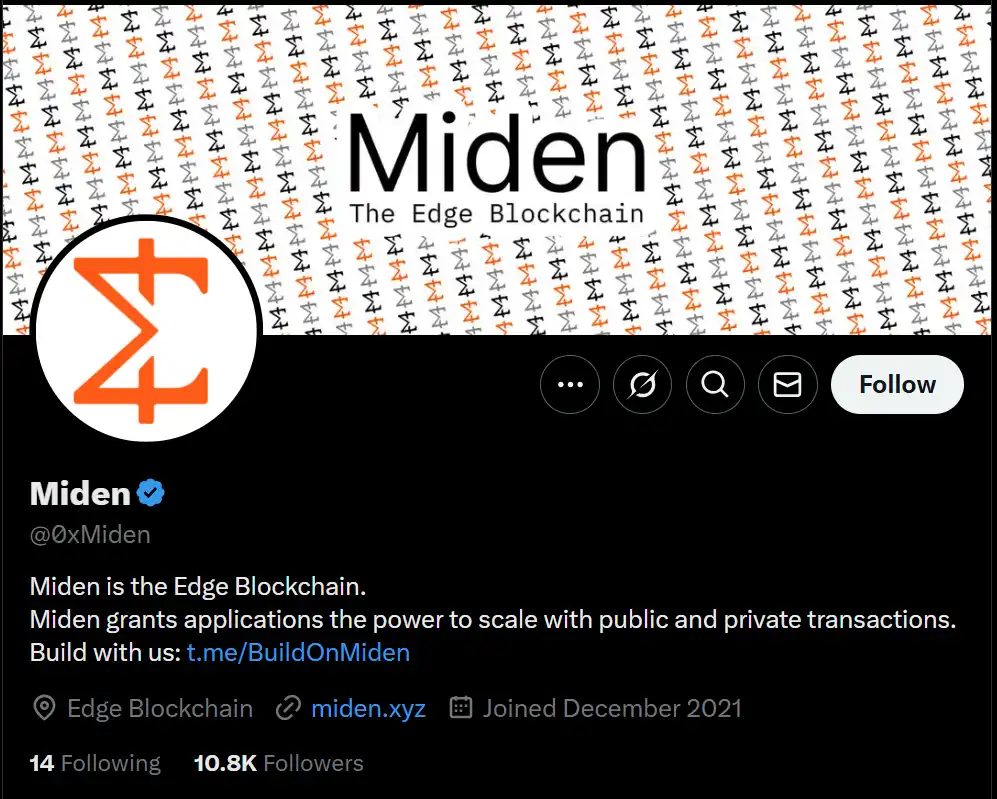
0xMiden is focused on the concept of "edge blockchain," aiming to allow applications to choose between a publicly transparent path and a one-click switch to privacy mode when processing transactions, all without sacrificing scalability. The project is incubated with support from the encrypted fundraising data platform CryptoRank.
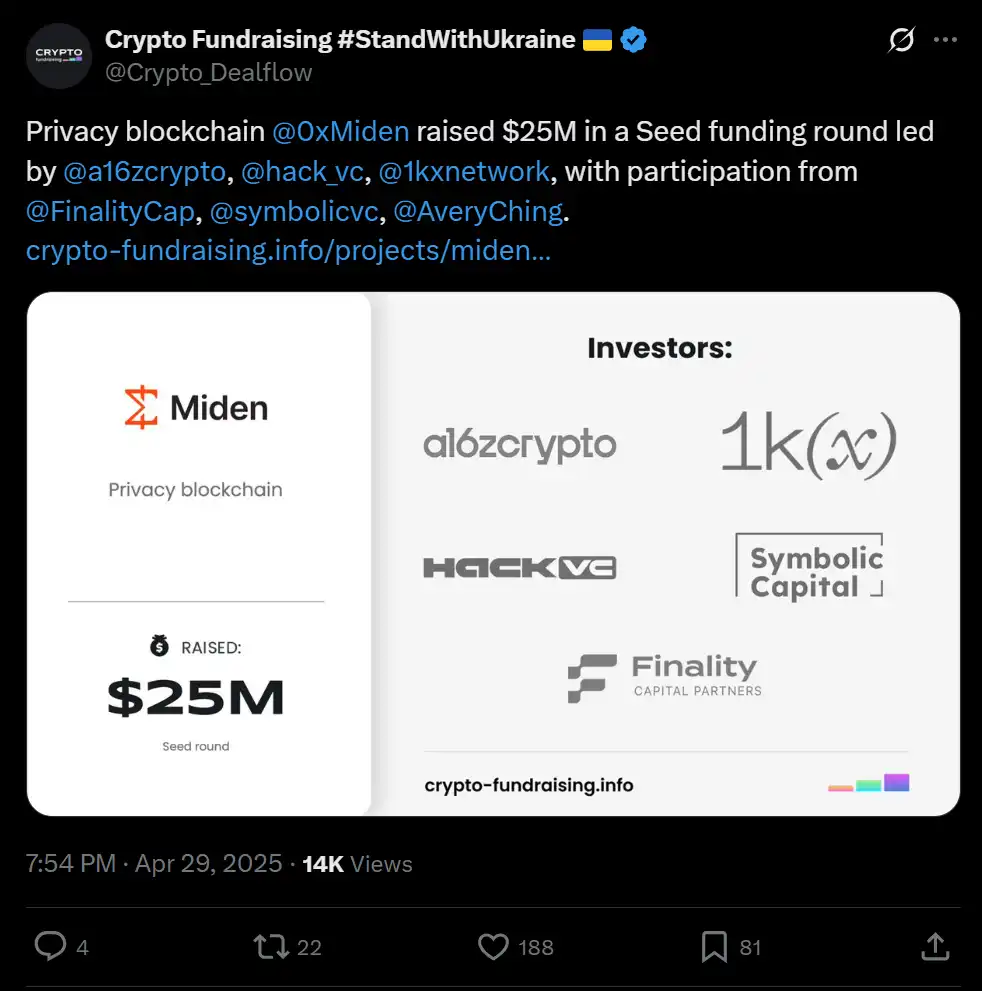
Seeing it being surrounded by big players in the ZK and privacy narratives, I became curious: What key point has this project hit that has attracted a rush of capital? What sets 0xMiden apart from projects like Aztec and Zcash, which have long been involved in privacy?
To understand this question, we must first grasp one thing: the current state of blockchain technology is actually very "non-private." However, if you blindly pursue privacy, you will sacrifice both scalability and compliance.
So, while the privacy chain direction has been talked about for years, there has never been a solution that is "usable, scalable, and not subject to blanket regulation."
Now, 0xMiden is attempting to take a new perspective on this challenge.
A Privacy Chain That Can Run Without Being Connected to the Internet
0xMiden calls itself an "edge blockchain," which may sound somewhat like edge computing, but essentially means: smart contracts are no longer all executed on the chain; instead, users perform the computations on their own devices locally, package them into a ZK proof, and then broadcast them for on-chain validation.
In other words, each device functions like a "mini blockchain node," performing its own computations, providing its own proofs, and only reporting the results to the chain for verification. In this mode, the role of the chain is no longer that of a "workhorse" but more like a "referee"; you claim you've done the calculations right, then you must provide verifiable proof.
This mode has several core changes: all executions are done locally, the chain's burden is minimal, and scalability is naturally strong. The generated ZK proof is lightweight, unlike the heavy batch proof of zkRollup, making it suitable for end-user devices to handle on their own. It is privacy-preserving by default, but developers can choose which computations to make public and which to keep private, allowing for flexible switching to adapt to different scenarios.
Ultimately, what it aims to create is not a large, all-encompassing Layer1 but rather a new way of interaction between the chain and devices, enabling smart contracts to run on-the-go like a mobile wallet.
This is quite distinct from the currently popular privacy chains in the market. For example, Aztec focuses on "ZK-rollup + encrypted EVM," still rolling up all user transactions for processing together, with a fairly centralized sequencer, essentially following a Layer2 approach. Fhenix uses TEE + homomorphic encryption, leaning more towards hardware trust + encrypted storage, with ZK playing a less prominent role.
On the other hand, 0xMiden has taken a "ZK-first + local computation" approach from the underlying logic, emphasizing flexibility, lightness, and end-user friendliness.
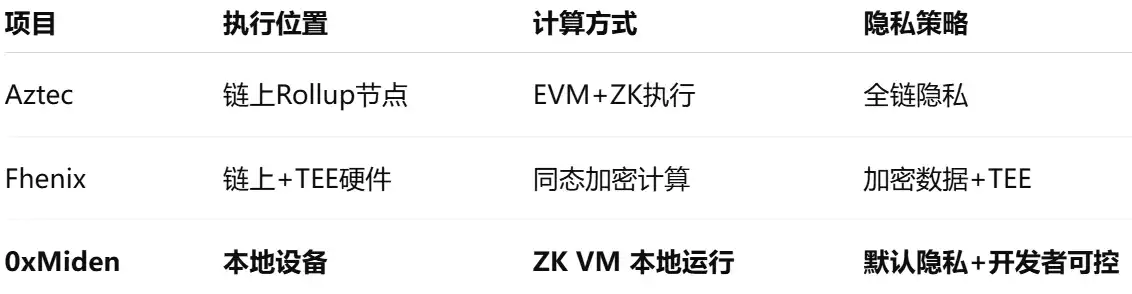
In simple terms, 0xMiden's execution is decentralized, to the extent that it can even be performed offline, proofs generated offline, and results subsequently uploaded collectively. Your phone, browser, AI chip—anything—could potentially become a small node running smart contracts, with ZK ensuring correct computations and the chain focusing solely on result verification.
Why Are Big Shots Willing to Splash the Cash?
As early as 2021, a16z invested in 0xMiden founder Bobbin Threadbare's earlier project, which was still part of Polygon Miden at that time. This recent $25 million seed round funding on April 29, 2025, with a16z participating again, highlights their long-term confidence in the Bobbin team.
On the team front, 0xMiden was founded by Bobbin Threadbare, Dominik Schmid, and Azeem Khan, all of whom have previously served on Meta's blockchain team, bringing deep expertise in zero-knowledge proofs and blockchain development.
0xMiden was originally a project developed under Polygon Labs and split into an independent entity on March 31, 2025, with this funding seen as a "team restructuring + independent financing." After the split, 0xMiden focuses on an Ethereum zk-Rollup privacy solution, with CryptoRank as the incubator providing funding and resource support, but the technical development is mainly carried out independently by the team.
0xMiden is the third project to split from Polygon after Avail and Privado ID. Sandeep Nailwal, co-founder of Polygon Labs, said in a statement, "It plans to airdrop around 10% of its native token to POL holders and stakers, directly rewarding the ecosystem that has helped its development."
From an investment perspective, 0xMiden's appeal lies in its ZK native computation model, representing the future trend of ZK. Unlike traditional Rollups, it is not a substitute for the chain but a developed privacy plug-in, offering flexible privacy options.
Project Status
Meanwhile, Miden has already launched practical development tools, allowing developers to start writing real smart contracts, moving away from projects that remain only at the conceptual stage. More importantly, its design supports "default privacy, optionally public," with some room for compliance.
The mainnet has not yet launched, but the VM and SDK are already open-source on Github. The roadmap they have provided is as follows:
· Miden VM open-source (completed)
· Developer Toolkit SDK release (completed)
· Testnet launch (expected in Q3 2024)
· Mainnet launch (earliest possible in early 2025)
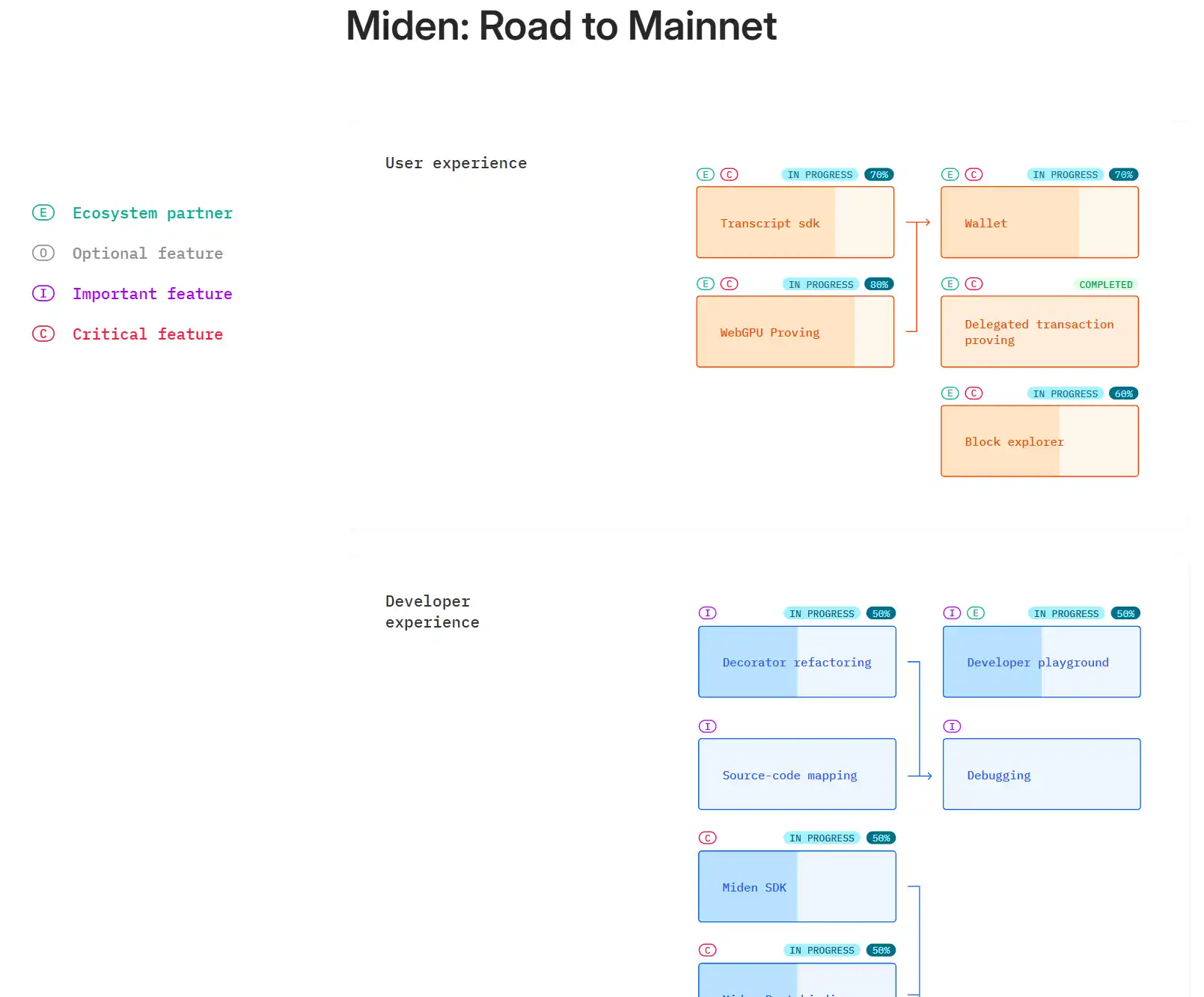
Some developers are now using the Miden VM to write demo contracts, such as local voting, device log verification, in-game asset operations, and other scenarios. However, to truly "break through," it may still require a "killer-level" application scenario like a "local version of Friend.tech" or an "AI model execution marketplace."
Privacy Blockchain: Why Is It Getting Hot Again?
This narrative is not new, but it has indeed seen a bit of a resurgence recently, driven by three core reasons.
First, regulatory pressure is on the rise. Globally, regulatory scrutiny on cryptographic identity and asset movement is becoming increasingly stringent. Whether it's on-chain KYC, wallet blacklists, or exchange compliance, the space for "absolute anonymity" is being continuously squeezed. Instead, there is a growing demand for privacy oriented towards institutions, compliance-friendly solutions, and controllable privacy, especially in enterprise-level scenarios, where selective privacy has become a necessity.
Second, ZK technology has finally become "usable." In the past few years, ZK has been stuck in the "tech demo" stage, being expensive, slow, and difficult to develop. However, with the maturity of technologies like STARK, SNARK, the cost of proof generation and verification continues to decrease, turning ZK from a "theoretical future" into a "real-world runnable reality."
Third, the rise of AI blockchain applications has seen more and more AI computations, data on-chain, edge inferences, and other scenarios being implemented, expanding the need for privacy from not just transaction privacy but also to "data privacy" and "model privacy."
These applications' privacy requirements are no longer about "full-chain black boxes" but about "on-device computation + selective encryption," which is known as localized privacy.
Meanwhile, traditional privacy projects like Monero and Zcash, which support only simple transactions, are increasingly under regulatory scrutiny. The path of promoting "absolute anonymity" has become more and more challenging.
So, a new opportunity has emerged, moving away from absolute secrecy towards "on-device computation + selective privacy."
Will this round of the privacy narrative start from the "on-device"?
The direction of privacy blockchains will not see an immediate explosion, as a truly runnable solution has always been missing.
Projects like Aztec and Fhenix are still focused on "on-chain privacy," while 0xMiden aims to take this narrative to the "off-chain" device-side, with autonomous operation and selective on-chain interactions.
This perspective is actually the next natural evolution of ZK, aligning with future trends such as "AI + blockchain," "data sovereignty," and more. If this story can be effectively communicated and the product can truly be implemented, then 0xMiden may become the next noteworthy "privacy computing infrastructure."
Of course, the prerequisite is that it can survive until the day it goes live on the mainnet.
You may also like

Bitcoin Market Analysis 2026: Can BTC Reach $150K by Year-End?

STRC unanchored by 11%, can the perpetual motion machine of Strategy still operate?

Bitcoin ETF Outflows Hit a Record $4.4 Billion: What Are Traders Doing With Their Cash?

WEEX App Just Got Smarter – New Tabs for Faster Trades & Easy Asset Management

Blockchain Capital Partner: The Core Secret of Arbitrage

WEEX All-New Search Features: Find, Trade & Earn Faster Than Ever

Will MicroStrategy fall into a death spiral? What will the macro trend be in the second half of the year?

Morning Report | Illinois signs the strictest digital asset tax law in the U.S.; RWA tokenization market size surpasses $43 billion, institutions accelerate the migration of on-chain assets

Full version of the debut Q&A! Federal Reserve Chairman Waller: Sticking to the 2% inflation target, establishing five special working groups, individual did not submit the dot plot

From Disruptor to Shadow Market: The Crypto Market is Becoming a Colony of Traditional Finance
Dalio's important long article: How to position in the current market environment?

OKX Star analyzes Binance's competitive advantages: when regulation levels the playing field, competition has just begun

New gameplay for participating in initial offerings on cryptocurrency exchanges
Why Is Bitcoin Down Today? What the Hawkish FOMC Means for SpaceX, Gold and Nasdaq

DeepSeek Financing Story

Morning Report | DeepSeek completes over $7 billion in financing, with a valuation exceeding $50 billion; Musk's personal wealth has surpassed the total market value of Bitcoin
Cursor, why did you get on Musk's spaceship?
In the name of charity, for the benefit of the family: How the Trump family turned charity into profit?
Bitcoin Market Analysis 2026: Can BTC Reach $150K by Year-End?
STRC unanchored by 11%, can the perpetual motion machine of Strategy still operate?
Bitcoin ETF Outflows Hit a Record $4.4 Billion: What Are Traders Doing With Their Cash?
WEEX App Just Got Smarter – New Tabs for Faster Trades & Easy Asset Management
Blockchain Capital Partner: The Core Secret of Arbitrage
WEEX All-New Search Features: Find, Trade & Earn Faster Than Ever


